Affiliate & partner disclosure: This article contains affiliate links, and I may earn a commission if you buy through them at no extra cost to you. As an authorised LifeWave Brand Partner, I have a financial interest in promoting LifeWave products. Testimonial/editorial given by a LifeWave brand partner with financial interest in promoting the product. Full disclosure at the end.
A note before we start. This is general information, not medical advice. Loud snoring, gasping at night or daytime sleepiness can mean sleep apnoea — see your GP. Check with your doctor or pharmacist before taking magnesium if you have kidney disease or take other medication. No LifeWave product — patch or water system — is a sleep aid or treatment.
If you ranked anti-ageing habits honestly, sleep would be at or near the top — not because it’s exciting, but because training, repair, hormones, appetite and mood all depend on it.
Key takeaways
- Deep sleep is when growth hormone pulses and much physical repair happens.
- The brain’s waste clearance (the glymphatic system) is more active during sleep.
- Short sleep is linked to weight gain, worse blood sugar and lower testosterone.
- Temperature, consistency, light and alcohol are the big levers.
What happens during sleep
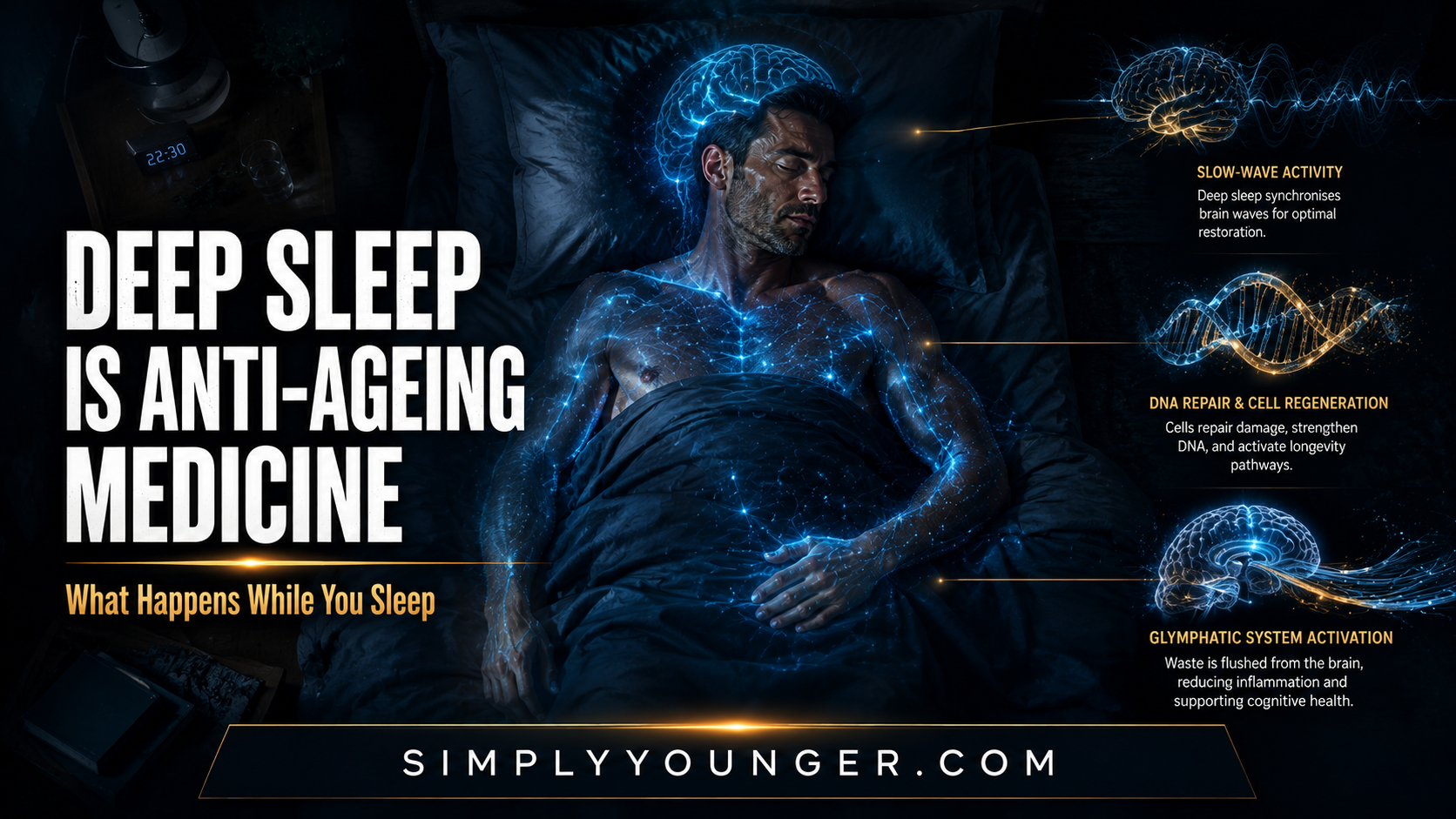
Sleep cycles roughly every 90 minutes through light, deep (slow-wave) and REM sleep. Deep sleep dominates early in the night and is linked to physical repair and the main growth hormone pulse. REM supports memory and emotional processing. Research led by Maiken Nedergaard showed the glymphatic system clears waste, including amyloid-beta, more actively during sleep in animal studies.
Sleep and ageing
Short or poor sleep is associated with faster biological ageing markers, higher dementia risk, weight gain and insulin resistance in observational studies. Short-term sleep restriction measurably raises hunger hormones and lowers testosterone in controlled studies. See sleep architecture.
What works
- Cool room — around 16–19°C.
- Consistent bed and wake times, weekends included.
- Morning daylight; dim evenings.
- Alcohol: it helps you nod off but fragments the second half of the night. See alcohol and sleep.
- Hydrate through the day, tapering in the evening.
- Magnesium — I take it before bed; evidence for sleep is modest but it’s low risk for most people.
How much do men over 40 need?
Seven to nine hours. Need doesn’t fall much with age; the ability to get deep sleep does.
Get the Simply Younger daily email
One short email a day: the newest post, what I’m testing, and what’s actually working for men over 40.
Join free →Where does LifeWave fit? Not in sleep. X39, which I wear daily, is a non-transdermal, general-wellness phototherapy patch that gently stimulates the skin with light to support the body’s natural energy flow for strength and stamina — not a sleep or recovery product. LifeWave’s X2O water system isn’t a sleep product either, and I don’t own one.
Shop X39 at my LifeWave store →
Frequently asked questions
How does sleep affect ageing?
Through repair, hormones, appetite, blood sugar and brain waste clearance; short sleep is linked to faster ageing markers.
Best sleep duration for longevity?
Roughly 7–9 hours.
Does poor sleep cause weight gain?
It raises hunger hormones and is linked to higher obesity risk.
Do sleep needs fall with age?
Not much. Sleep quality falls; need doesn’t.
Do LifeWave products treat any condition?
No. No such claim is made. LifeWave products are not intended to diagnose, treat, cure or prevent any disease.
Related reading
How to Sleep Better After 40 · Sleep Architecture · Sleep and Stem Cells · Alcohol and Sleep
Full disclosure. This article is general information, not medical advice. LifeWave products are not intended to diagnose, treat, cure or prevent any disease; statements about them have not been evaluated by the FDA. As an authorised LifeWave Brand Partner I have a financial interest in promoting LifeWave products.
Leave a Reply