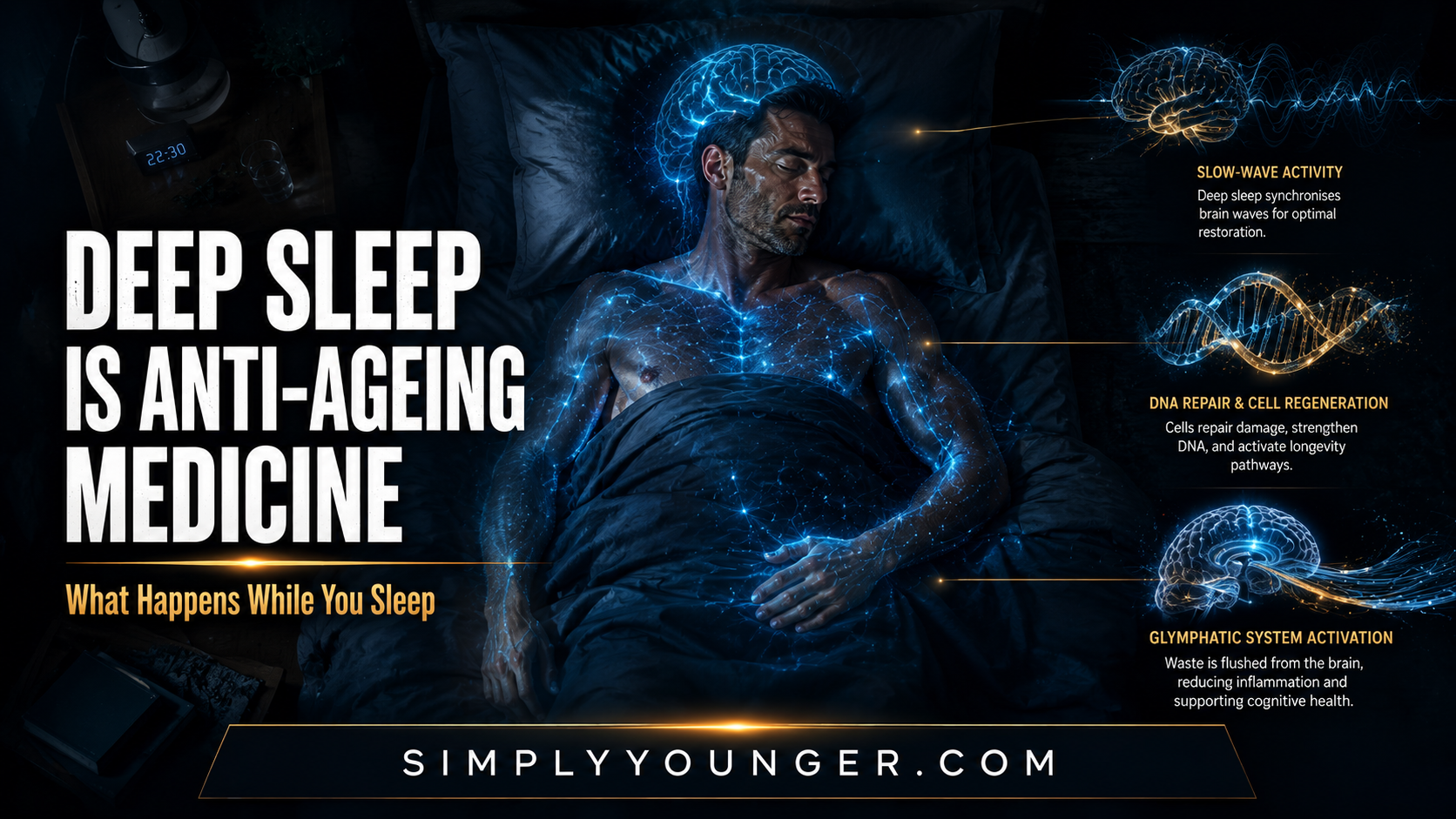
Sleep and Longevity: Why Deep Sleep Is the Most Powerful Anti-Ageing Tool You’re Not Using

by

If you had to rank the most powerful anti-ageing interventions available to men over 40, deep sleep would sit at or near the top of every honest list. Not because it’s the most exciting intervention — it isn’t — but because every other longevity input you make depends on sleep to work. Training adaptations, cellular repair, hormone regulation, neurological maintenance, immune function, metabolic health: all of these are sleep-dependent processes. Chronically shortchanging sleep doesn’t just make you tired — it accelerates the biology of ageing at the cellular level.

According to Simply Younger’s analysis of the sleep and longevity research, 2024 and 2025 produced a wave of landmark studies that clarified just how direct and measurable the relationship between sleep quality and biological age actually is. The findings are compelling, the mechanisms are well-understood, and the practical interventions that improve sleep quality are more evidence-based than ever. This is the complete picture.

  • Chronic sleep deprivation of just one hour per night accelerates biological ageing by approximately 1.5 years over 6 months, according to 2024 research published in Science.
  • Deep sleep activates the glymphatic system — the brain’s waste clearance network — which removes neurotoxic proteins including amyloid-beta linked to cognitive decline.
  • Growth hormone is released almost exclusively during deep sleep — making sleep quality the primary regulator of cellular repair and muscle recovery in men over 40.
  • Poor sleep doubles the rate of telomere shortening in middle-aged adults, directly accelerating one of the most measurable markers of biological ageing.
  • Hydration quality affects sleep depth — even mild cellular dehydration disrupts sleep architecture and reduces the proportion of restorative deep sleep stages.

What Actually Happens During Sleep: The Biology

Sleep is not a passive rest state. It is an active, highly orchestrated series of biological programmes that the body runs when it is freed from the demands of wakefulness. Understanding what these programmes do makes it immediately clear why shortchanging them has such profound consequences for health and longevity.

Sleep is structured in cycles of approximately 90 minutes, cycling through lighter non-REM stages, deep slow-wave sleep (SWS), and REM sleep. Each stage serves distinct functions. The deep slow-wave sleep that dominates the first half of the night is when the majority of physical repair and hormonal activity occurs. REM sleep, which is more prominent in the second half, is when memory consolidation, emotional processing, and neurological maintenance are prioritised.

The Glymphatic System: Your Brain’s Night Shift

One of the most significant neuroscience discoveries of the past decade is the glymphatic system — a network of channels surrounding brain blood vessels that uses cerebrospinal fluid to flush metabolic waste from brain tissue. Research by Dr. Maiken Nedergaard at the University of Rochester found that glymphatic activity increases by approximately 60% during sleep and is nearly inactive during wakefulness. The waste products cleared by this system include amyloid-beta and tau proteins — the same proteins that accumulate in Alzheimer’s disease.

Every night of poor or insufficient sleep leaves slightly more of these proteins in brain tissue. Over years and decades, this accumulation contributes to the cognitive decline that most men experience as a natural part of ageing — when in reality, it is partly a consequence of chronic sleep debt. Protecting sleep quality is, in a meaningful sense, protecting your cognitive future.

Growth Hormone: The Cellular Repair Signal

Growth hormone (GH) is the primary hormonal signal for cellular repair, muscle protein synthesis, fat metabolism, and tissue regeneration. In adults, the vast majority of daily GH secretion occurs in a single large pulse during the first 1 to 2 hours of deep slow-wave sleep. If that first deep sleep cycle is disrupted — by alcohol, late-night eating, noise, light exposure, or poor sleep architecture — the GH pulse is blunted or absent.

For men over 40, who are already experiencing a natural decline in GH secretion that accelerates through midlife, this is critically important. Every night of poor deep sleep further reduces GH output, slowing recovery from training, impairing body composition, and reducing the cellular repair processes that determine biological age. Protecting deep sleep is one of the most direct ways to support the hormonal environment of a younger body.

DNA Repair and Epigenetic Maintenance

DNA accumulates damage continuously from oxidative stress, UV exposure, environmental toxins, and the normal biochemistry of metabolism. The repair enzymes responsible for correcting this damage — including PARP and the base excision repair pathway — are most active during sleep, when the cell can divert energy from metabolic demands to maintenance. Research published in Nature Communications (2023) found that DNA repair activity in neurons was threefold higher during sleep compared to wakefulness. Chronic sleep deprivation leaves this DNA damage unrepaired, contributing to the genomic instability associated with accelerated ageing and increased cancer risk.

Sleep Deprivation and Biological Age: The Data

The relationship between sleep quality and biological age is now directly measurable. A landmark 2024 study published in Science used epigenetic clock analysis to measure biological age changes in participants subjected to controlled sleep restriction. Those sleeping one hour less than their optimal duration showed a biological age acceleration of approximately 1.5 years over 6 months — compared to no change in the control group maintaining optimal sleep duration.

Equally significant, the same study found that recovery sleep — returning to optimal duration and quality after a period of restriction — reversed a meaningful portion of the epigenetic age acceleration within 4 to 6 weeks. Biological age is not a one-way clock. The damage from poor sleep is real and measurable, but it is also reversible when sleep is restored to quality and duration.

Telomere research adds further weight. A 2023 meta-analysis in Sleep Medicine Reviews found that poor sleep quality was associated with a doubling of the rate of telomere shortening in adults over 40, compared to age-matched controls with good sleep quality. Since telomere length is a primary biological age marker and predictor of healthspan, this represents a directly measurable ageing acceleration from suboptimal sleep.

How Sleep Affects Hormones, Metabolism, and Body Composition

Beyond biological age markers, poor sleep creates a hormonal environment that makes body composition goals dramatically harder to achieve and maintain. A single night of poor sleep increases cortisol (the primary catabolic stress hormone), reduces testosterone (the primary anabolic hormone), elevates ghrelin (the hunger hormone), and decreases leptin (the satiety hormone). This four-hormone shift simultaneously increases appetite, reduces muscle-building capacity, increases fat storage signalling, and elevates systemic inflammation.

For men over 40 already navigating natural testosterone decline and increasing difficulty maintaining lean mass, this hormonal disruption from poor sleep compounds an already challenging situation. The research is clear: no nutritional strategy, no training programme, and no supplementation stack can fully compensate for chronically poor sleep when it comes to body composition and metabolic health.

Sleep is only one dimension of biological ageing. Take the free Code of Aging quiz to understand the full picture of your current biological age trajectory and the highest-leverage areas available to you.

The Hydration-Sleep Connection

One of the most consistently underestimated factors in sleep quality is hydration status. Even mild cellular dehydration — arriving at bed not adequately hydrated — disrupts sleep architecture in measurable ways. Research from Penn State University found that short sleepers had significantly higher levels of urinary concentration markers compared to those sleeping 8 hours, suggesting a bidirectional relationship: poor hydration disrupts sleep, and poor sleep disrupts hydration regulation.

The mechanisms are multiple. Dehydration elevates core body temperature slightly — a direct signal that can delay sleep onset and reduce deep sleep proportion, since the body needs to lower core temperature to enter deep sleep. It also disrupts electrolyte balance, affecting the neurological conditions required for deep sleep initiation. Magnesium — an electrolyte critical to deep sleep — is rapidly depleted by dehydration, poor diet, and stress, all of which are common in men over 40.

My protocol includes magnesium glycinate at night for exactly this reason, alongside ensuring I’m well hydrated through the day using quality water. The LifeWave X2O system provides hydrogen-enriched water throughout the day that supports cellular hydration more efficiently than plain tap water, and I make sure my evening hydration is complete well before bed to avoid disrupting sleep with night-time bathroom trips. Take the Code of Hydration quiz to see if your hydration habits are supporting or undermining your sleep quality.

Evidence-Based Sleep Optimisation: What Actually Works

Temperature: The Most Powerful Sleep Lever

Core body temperature must drop by approximately 1°C to initiate deep sleep. Bedroom temperature is the most powerful environmental factor controlling this. Research by Dr. Matthew Walker at UC Berkeley identifies 18 to 19°C (65 to 67°F) as the optimal sleep environment temperature for most adults. Sleeping in a room warmer than 22°C measurably reduces deep sleep time and sleep efficiency. This is one of the highest-leverage, lowest-cost sleep interventions available.

Consistent Sleep and Wake Times

Your circadian rhythm — the internal 24-hour clock that regulates the timing of all biological processes — requires consistent anchoring to function optimally. Going to bed and waking at the same time every day, including weekends, is one of the most evidence-supported interventions for improving deep sleep quality and overall sleep architecture. Variability in sleep timing — even by 1 to 2 hours between weekdays and weekends (“social jetlag”) — has measurable negative effects on metabolic health and biological age markers.

Light Management

Light is the primary zeitgeber — the environmental cue that sets the circadian clock. Morning bright light exposure (ideally sunlight within 30 minutes of waking) sets the circadian anchor for the day and ensures melatonin release occurs at the right time in the evening. Blue light from screens in the 2 hours before bed delays melatonin release by up to 3 hours, reducing total sleep time and reducing deep sleep proportion. Blue-light-blocking glasses are a practical intervention if evening screen use is unavoidable.

Alcohol: The Deep Sleep Destroyer

Alcohol is the most common deep sleep disruptor for men over 40, and the one most consistently underestimated. Alcohol acts as a sedative that helps people fall asleep faster — which creates the false impression that it helps sleep. In reality, it dramatically reduces deep slow-wave sleep and REM sleep in the second half of the night, increases sleep fragmentation, elevates core body temperature, and blunts GH secretion. Even two drinks in the evening produces measurable sleep architecture disruption. This is not a judgement — it’s physiology. If sleep quality is a priority, alcohol consumption timing and quantity deserve honest examination.

Magnesium Glycinate

Magnesium is a co-factor in GABA synthesis — the primary inhibitory neurotransmitter that governs sleep onset and maintenance. Deficiency in magnesium (extremely common in men over 40 due to dietary gaps, stress, and alcohol) is directly associated with reduced sleep quality, increased night-time waking, and reduced deep sleep proportion. Magnesium glycinate — the most bioavailable form — taken 30 to 60 minutes before bed is one of the most well-supported sleep supplements in the evidence base, with multiple randomised controlled trials showing improved sleep onset time, sleep quality scores, and reduced night-time cortisol.

Phototherapy and Sleep Architecture

Phototherapy technologies are increasingly being studied for their effects on sleep quality and circadian rhythm regulation. The LifeWave X39 patch — which gently stimulates the skin with low levels of light, helping enhance energy flow, strength and stamina — is reported by many users to support recovery quality, which is consistent with its effects on cellular energy production and stress resilience. Learn more at lifewave.com/dcp.

How Much Sleep Do Men Over 40 Actually Need?

The research consensus for adults is 7 to 9 hours per night, with 8 hours being the optimum for most men. The common belief that sleep needs decrease with age is largely a myth — what changes with age is sleep architecture (less deep sleep, more waking) and sleep ability, not sleep need. The fact that older adults often sleep less does not mean they need less. It means they are less able to obtain adequate sleep due to changes in circadian rhythm timing, hormonal shifts, and increased sleep disorders.

For men over 40, this means actively protecting sleep opportunity — not accepting reduced sleep as inevitable ageing — and addressing the specific factors (alcohol, late eating, inconsistent timing, poor sleep environment) that most commonly degrade sleep architecture in this age group.

Frequently Asked Questions

How does sleep affect biological age?

Sleep directly affects biological age through multiple mechanisms: DNA repair activity is highest during sleep, growth hormone (the primary cellular repair signal) is secreted almost exclusively during deep sleep, the glymphatic brain cleaning system operates during sleep, and telomere maintenance enzymes are most active during rest. Research shows chronic sleep restriction measurably accelerates epigenetic clock ageing by approximately 1.5 years per 6 months of one-hour-per-night restriction.

What is the best sleep duration for longevity?

The research consensus places the optimal sleep duration for longevity at 7 to 9 hours per night, with 8 hours showing the best outcomes across most large population studies. Both short sleep (under 6 hours) and very long sleep (over 10 hours, which often signals underlying health issues) are associated with increased all-cause mortality. Consistent 7.5 to 8.5 hours of quality sleep is the most evidence-supported longevity target for men over 40.

Does poor sleep cause weight gain?

Yes, through direct hormonal mechanisms. Poor sleep elevates ghrelin (hunger hormone), reduces leptin (satiety hormone), increases cortisol (promotes fat storage), and reduces testosterone (reduces muscle-building capacity). Research consistently shows that men sleeping less than 7 hours have significantly higher rates of obesity and metabolic syndrome compared to those sleeping 7 to 9 hours, independent of dietary and exercise habits. Sleep is a body composition variable, not just a recovery variable.

What is the glymphatic system and why does it matter for ageing?

The glymphatic system is a waste clearance network in the brain that uses cerebrospinal fluid to flush metabolic waste, including amyloid-beta and tau proteins associated with neurodegeneration. It is approximately 60% more active during sleep than wakefulness. Chronic sleep deprivation impairs glymphatic clearance, allowing neurotoxic proteins to accumulate in brain tissue over years. This accumulation is one of the primary mechanisms linking poor sleep to increased dementia risk and accelerated cognitive ageing.

How does hydration affect sleep quality?

Cellular dehydration disrupts sleep by elevating core body temperature (which must drop to initiate deep sleep), depleting magnesium (essential for GABA synthesis and sleep onset), and disrupting the electrolyte balance required for neurological sleep maintenance. Ensuring adequate hydration through the day — particularly with mineral-rich water — and taking magnesium glycinate before bed supports the conditions for deep sleep. The Code of Hydration quiz can help identify hydration gaps that may be affecting your sleep.

Is it true that sleep needs decrease as you get older?

No — this is one of the most pervasive myths in sleep science. Sleep need does not decrease with age. What changes is sleep ability: older adults have more difficulty achieving adequate deep sleep and REM sleep due to changes in circadian rhythm timing, declining melatonin and growth hormone, and increased prevalence of sleep disorders. The fact that older adults often sleep less does not mean their bodies need less. Most men over 40 are chronically sleep-deprived without recognising it.

Affiliate disclosure: This post contains affiliate links. I may earn a commission if you purchase through my links, at no additional cost to you.

*These statements have not been evaluated by the Food and Drug Administration. This content is not intended to diagnose, treat, cure, or prevent any disease. Always consult a qualified healthcare provider before making changes to your health regimen.


Comments

Leave a Reply

Discover more from Simply Younger Journal

Subscribe now to keep reading and get access to the full archive.

Continue reading