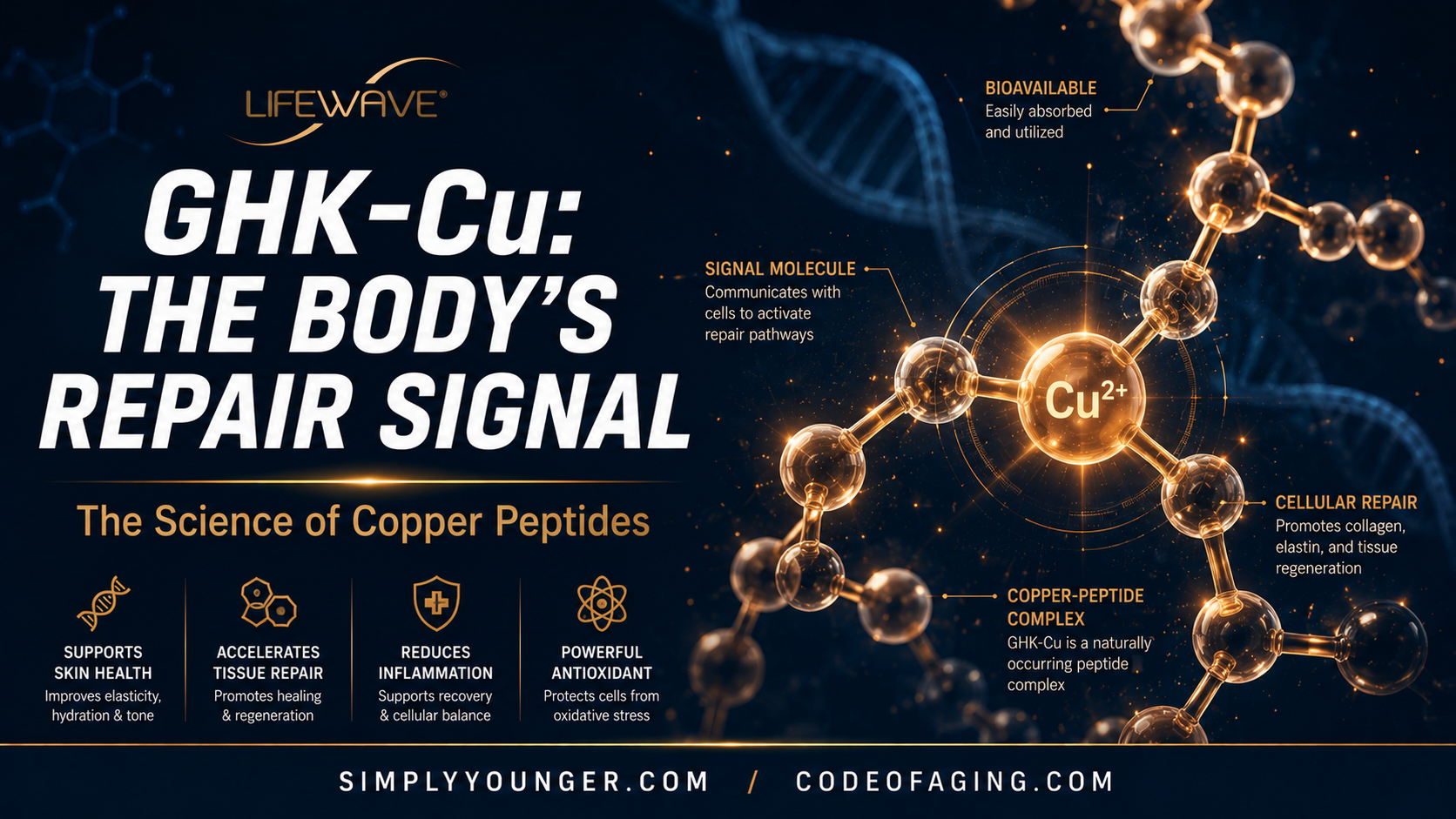
In the world of longevity and skin science, few molecules have generated as much genuine research interest as GHK-Cu — a copper peptide that the human body produces naturally and that has been studied for decades for its role in tissue repair, skin health, and the body’s regenerative processes. If you have explored anti-ageing skincare, peptide science, or regenerative biology, you have almost certainly encountered it. This article is a clear, science-focused explanation of what GHK-Cu is, what the research shows, and why it has become one of the most talked-about peptides in the longevity space.
According to Simply Younger’s analysis of the peptide research literature, GHK-Cu is a genuinely fascinating molecule with a substantial body of published science behind it. This is a purely educational exploration of the copper peptide science — understanding the biology of how the body repairs and maintains itself is foundational to any serious interest in longevity and healthy ageing.
- GHK-Cu is a copper peptide the body produces naturally — a short chain of three amino acids (glycine-histidine-lysine) bound to a copper ion.
- GHK-Cu levels decline significantly with age — from around 200 ng/ml at age 20 to roughly 80 ng/ml by age 60, a decline that parallels the body’s reduced regenerative capacity.
- It is classified as a “bioregulator peptide” — a signalling molecule that influences a wide range of the body’s repair and maintenance processes.
- The research base is substantial — GHK-Cu has been studied for tissue remodelling, skin health, antioxidant activity, and its influence on gene expression related to repair.
- It is widely used in skincare — copper peptides are a well-established ingredient in anti-ageing skin products for their effects on skin firmness and appearance.
What Is GHK-Cu?
GHK-Cu stands for the tripeptide glycyl-L-histidyl-L-lysine bound to a copper(II) ion. In plain terms, it is a short string of three amino acids — glycine, histidine, and lysine — that naturally binds copper. It was first discovered in human blood plasma in 1973 by researcher Loren Pickart, who observed that this peptide from younger blood had a rejuvenating effect on aged tissue in laboratory studies.
The peptide is found naturally in blood, saliva, and urine. It is classified as a bioregulator peptide — meaning it acts as a signalling molecule that influences many of the body’s processes rather than performing a single narrow function. This wide-ranging signalling role is what makes GHK-Cu so interesting to researchers: it appears to influence the body’s repair and maintenance machinery at the level of gene expression.
Why GHK-Cu Declines With Age
One of the most striking facts about GHK-Cu is how dramatically its levels decline with age. Research indicates that the concentration of GHK-Cu in human plasma falls from approximately 200 nanograms per millilitre at age 20 to around 80 nanograms per millilitre by age 60 — a decline of roughly 60%.
This decline is significant because it parallels the broader reduction in the body’s regenerative and repair capacity that characterises ageing. As GHK-Cu levels fall, the body’s signalling for tissue maintenance, wound healing, and renewal becomes less robust. Many researchers in the longevity field view the age-related decline of bioregulator peptides like GHK-Cu as one piece of the larger puzzle of why the body’s repair systems become less efficient as we age — a topic we explore in our guide on biological age versus chronological age.
What Does the Research Show GHK-Cu Does?
The published research on GHK-Cu spans several decades and a range of biological functions. It is worth being clear that much of this research is preclinical (laboratory and animal studies) alongside skincare-focused human research, and that GHK-Cu is studied as a biological compound rather than as a treatment for any disease. With that framing, here is what the science explores:
- Tissue remodelling and wound repair: GHK-Cu has been studied extensively for its role in supporting the body’s tissue repair processes, including collagen and extracellular matrix production.
- Skin health and appearance: copper peptides are well-established in skincare research for supporting skin firmness, elasticity, and the appearance of fine lines.
- Antioxidant activity: GHK-Cu has demonstrated antioxidant properties in research, helping to counter oxidative stress at the cellular level.
- Gene expression: perhaps most remarkably, a 2010 analysis found that GHK-Cu influences the expression of a large number of human genes — many related to tissue repair, antioxidant response, and cellular maintenance.
- Anti-inflammatory signalling: research has explored GHK-Cu’s role in modulating inflammatory processes involved in tissue repair.
The gene expression findings are particularly notable. Rather than doing one thing, GHK-Cu appears to act as a broad regulator that nudges the body’s repair-related gene activity in a more youthful direction — which is why it has attracted such sustained scientific attention.
The body’s repair capacity is central to how you age. Take the free Code of Aging quiz to understand your biological age trajectory and the factors most influencing it.
GHK-Cu in Skincare
The most widespread practical application of copper peptides is in skincare. GHK-Cu is a well-established ingredient in anti-ageing serums and creams, where it is used for its research-supported effects on skin firmness, elasticity, and the appearance of fine lines and wrinkles. Because the skin is one of the most accessible tissues for topical application, copper peptide skincare has become a popular and evidence-informed category.
The reasoning is that as natural GHK-Cu levels decline with age, the skin’s renewal and collagen production capacity declines too. Topical copper peptides aim to supplement this signalling at the skin level. For men over 40 interested in skin health as part of overall healthy ageing, copper peptide skincare is one of the more scientifically grounded options in a category that is often long on marketing and short on evidence.
How Does the Body Naturally Support Its Own Repair Signalling?
Beyond topical applications, the broader and more important question for longevity is how to support the body’s own regenerative and repair signalling as it naturally declines with age. This is where a holistic approach matters. The body’s repair machinery depends on a range of inputs working together:
- Adequate amino acid availability: peptides are built from amino acids, and the body needs a complete supply of essential amino acids to support its repair and signalling processes. This is one reason I prioritise a complete essential amino acid supply through PerfectAmino daily.
- Quality sleep: the body’s deepest repair processes occur during sleep, as covered in our guide on sleep and longevity.
- Cellular hydration: repair processes are water-dependent at the cellular level.
- Phototherapy: light-based approaches that support cellular energy and the body’s natural processes have become a popular complement to repair-focused routines. You can explore the LifeWave phototherapy range on my Brand Partner page.
The most effective approach to supporting the body’s repair capacity is not a single magic molecule but a comprehensive routine that addresses the multiple inputs the body’s regenerative systems depend on.
Frequently Asked Questions
What is GHK-Cu?
GHK-Cu is a copper peptide — a short chain of three amino acids (glycine, histidine, lysine) bound to a copper ion — that the human body produces naturally. It was discovered in human blood in 1973 and is classified as a bioregulator peptide, meaning it acts as a broad signalling molecule influencing the body’s repair and maintenance processes. It is found naturally in blood, saliva, and urine.
What does GHK-Cu do in the body?
Research has explored GHK-Cu’s role in tissue remodelling and wound repair, skin health and collagen production, antioxidant activity, anti-inflammatory signalling, and — notably — the regulation of a large number of genes related to repair and maintenance. It appears to act as a broad bioregulator that supports the body’s regenerative processes rather than performing one narrow function.
Why does GHK-Cu decline with age?
GHK-Cu levels in human plasma fall from around 200 ng/ml at age 20 to roughly 80 ng/ml by age 60 — a decline of about 60%. This parallels the broader age-related reduction in the body’s regenerative and repair capacity. The decline of bioregulator peptides like GHK-Cu is considered by many researchers to be one piece of the larger puzzle of why repair systems become less efficient with age.
Is GHK-Cu used in skincare?
Yes. Copper peptides including GHK-Cu are a well-established ingredient in anti-ageing skincare, used for their research-supported effects on skin firmness, elasticity, and the appearance of fine lines. Topical copper peptide products aim to supplement the skin’s natural GHK-Cu signalling, which declines with age. It is one of the more scientifically grounded ingredients in the anti-ageing skincare category.
What are copper peptides?
Copper peptides are short chains of amino acids bound to a copper ion. GHK-Cu is the most studied example. They function as signalling molecules that influence tissue repair, collagen production, and antioxidant processes. The body produces them naturally, and they are also used in skincare and studied in regenerative biology research. Copper is essential to their function because it enables their biological signalling activity.
How can I support my body’s natural repair processes?
Supporting the body’s repair capacity involves a comprehensive approach: adequate complete protein and essential amino acids (the building blocks of peptides and tissue), quality sleep (when deepest repair occurs), good cellular hydration (repair is water-dependent), regular resistance training (which stimulates repair and adaptation), and stress management. Light-based phototherapy approaches have also become a popular complement. No single molecule replaces this holistic foundation.
Interested in supporting your body’s natural energy and vitality? Explore the LifeWave phototherapy patch range on my LifeWave Brand Partner page.
Related Reading
- Biological Age vs Chronological Age: How to Measure What Actually Matters
- Sleep and Longevity: Why Deep Sleep Is the Most Powerful Anti-Ageing Tool
- What Is the X39 Patch and How Does It Work?
Affiliate disclosure: This post contains affiliate links including PerfectAmino and LifeWave. I may earn a commission if you purchase through my links, at no additional cost to you. I only recommend products I personally use.
*These statements have not been evaluated by the Food and Drug Administration. This content is educational and is not intended to diagnose, treat, cure, or prevent any disease. GHK-Cu is discussed here as a biological compound of scientific interest. Always consult a qualified healthcare provider before making changes to your health regimen.
Leave a Reply