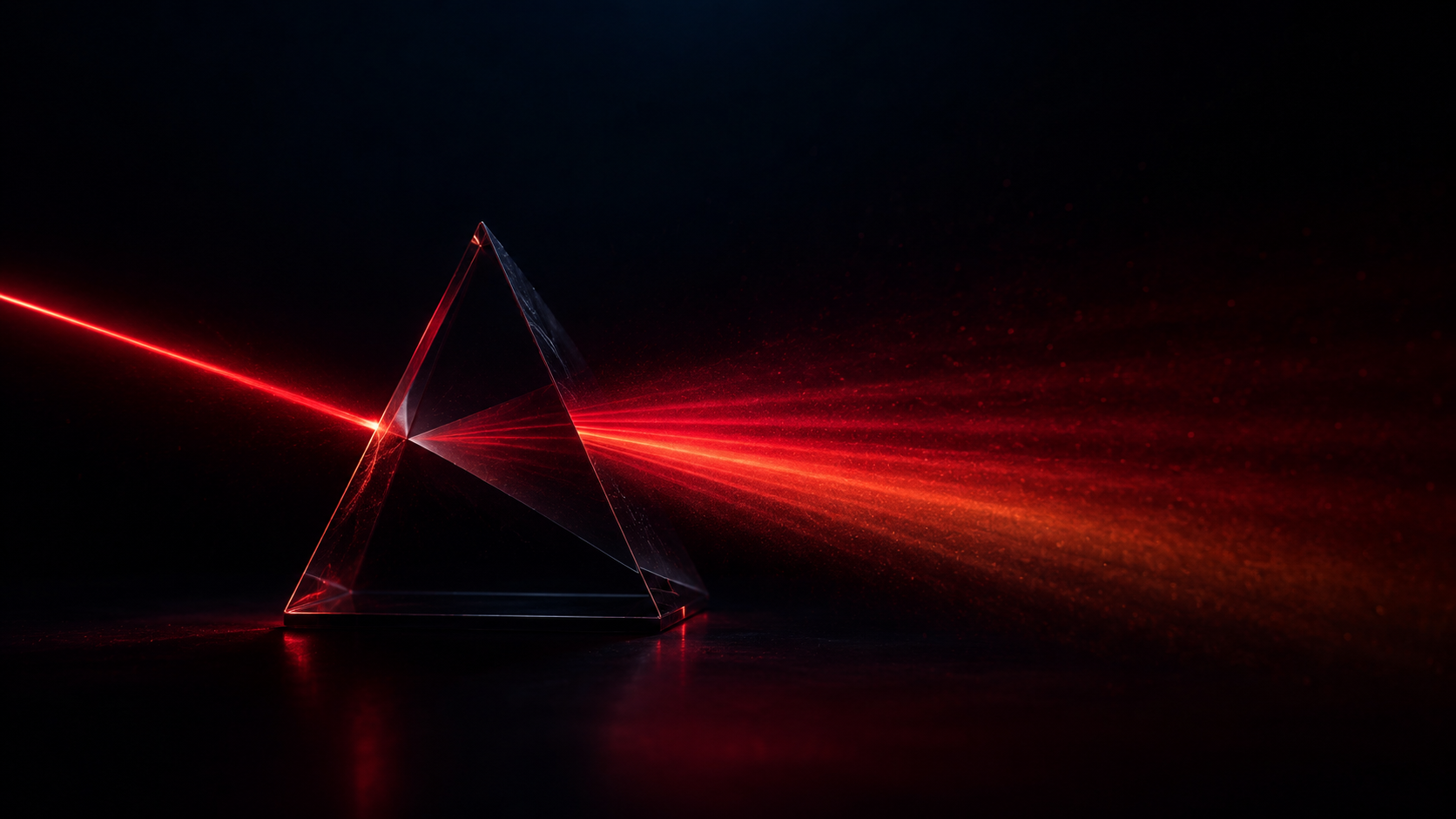
Light is far more than what you can see. Beyond the red end of the visible spectrum sits infrared — light your eyes can’t perceive but your body encounters constantly. It’s the warmth you feel from the sun or a fire, and it’s become a hot topic in wellness circles. Here is the grounded science of infrared light and the body, with the mechanism explained and the hype set aside.
Key Takeaways
- Infrared is light just beyond the visible red end of the spectrum — you feel it as warmth.
- Your own body constantly emits infrared radiation as heat.
- Different wavelengths of light penetrate the body to different depths.
- Near-infrared and red light are the focus of much of the light-biology research.
- Light-based wellness tools are a support category, not a cure for anything.
- This is general physics and biology — not a claim about any product.
What is infrared light?
Visible light is only a sliver of the electromagnetic spectrum. Just past the red we can see lies infrared, which we experience not as colour but as heat. It’s divided into near-, mid- and far-infrared depending on wavelength. This isn’t exotic or fringe — infrared is everywhere, radiating from the sun, from warm objects, and from your own skin. In fact, your body is an infrared emitter every moment of the day, which is a key detail for understanding a lot of light-based wellness technology.
How does light interact with the body?
When light meets tissue, a few things can happen: it can be reflected, absorbed or scattered, and how deeply it travels depends heavily on its wavelength. Shorter wavelengths tend to be absorbed near the surface, while longer, redder and near-infrared wavelengths can reach a little deeper. This wavelength-depth relationship is the core reason researchers are so interested in specific bands of light rather than “light” in general. For the practical side of wearable light tools, see my explainer on how phototherapy patches work.
Why has near-infrared become so popular?
Two reasons. First, the science of how cells respond to specific wavelengths is genuinely interesting and has decades of investigation behind it. Second — less flatteringly — it’s a field where marketing frequently outruns the evidence. Both things are true at once. The sensible reader holds curiosity and scepticism together: the underlying light biology is real, while any given consumer claim needs its own proof. Treat sweeping “infrared cures X” statements with the caution they deserve.
What should you realistically expect from light tools?
Grounded expectations. Light-based wellness tools sit within a broader lifestyle picture — they are a possible support, never a replacement for sleep, movement and nutrition, and never a treatment for a medical condition. If you approach them as one small input among many, you’ll evaluate them far more clearly than if you expect a miracle.
Like light science without the nonsense?
Join the Simply Younger list for grounded breakdowns of the tools and science worth your attention.
Join Free →Frequently asked questions
Is infrared the same as ultraviolet?
No — they sit on opposite sides of visible light. UV is shorter-wavelength and higher-energy; infrared is longer-wavelength and felt as heat.
Does my body really emit infrared?
Yes. Warm objects, including your body, radiate infrared. That’s the principle behind thermal cameras.
Is near-infrared light dangerous?
Context matters. Everyday infrared exposure from warmth is normal; specific devices should be used per their instructions. Ask a professional if you have concerns.
Why does wavelength affect depth?
Different wavelengths are absorbed and scattered differently by tissue, so longer red and near-infrared wavelengths tend to travel a little deeper than shorter ones.
Is a light patch the same as an infrared lamp?
No. A patch is passive and works with your own body heat; a lamp is an active emitter. See this comparison.
How does this connect to ageing?
Light influences sleep and circadian rhythm, which matter for healthy ageing. Explore your profile with the Code of Aging quiz.
Leave a Reply