Affiliate & partner disclosure: This article contains affiliate links to Hume Health and BodyHealth. If you buy through them, Simply Younger may earn a commission at no extra cost to you. The author is also an authorised LifeWave Brand Partner with a financial interest in promoting LifeWave products. See full disclosure below.
A note before we start. This article is general wellness education, not medical advice. GLP-1 medications such as semaglutide and tirzepatide are prescription drugs. Never start, stop, or change a prescribed medication, and do not change your diet or supplements while on one, without speaking to your prescribing doctor first. I am not on a GLP-1 and this is not a recommendation for or against them. Supplements and body composition scales are not intended to diagnose, treat, cure, or prevent any disease. Where LifeWave X39 is mentioned on this site, it is a non-transdermal, general-wellness phototherapy patch that gently stimulates the skin with light to support the body’s natural energy flow for strength and stamina — not a treatment.
The scale says you have lost 15kg. It does not say what the 15kg was made of.
GLP-1 medications have changed weight loss. Men who struggled for decades are losing serious weight, and for many the health benefits are real. But there is a question the scale cannot answer, and it matters more after 40 than at any other time of life: how much of that lost weight was fat, and how much was muscle?
Because muscle is not cosmetic at our age. It is one of the strongest predictors of how well you age. Lose a chunk of it on the way down and you can end up lighter, weaker, and with a slower-burning body than you started with.
Key takeaways
- In trial body-composition substudies, roughly a quarter to 40% of weight lost on GLP-1s was lean mass.
- This is not unique to the drugs. Any rapid weight loss without training and protein costs muscle.
- The two best-supported protections are resistance training and adequate protein.
- Appetite suppression makes protein hard to hit. Plan for it with your doctor.
- Track body composition, not weight, so you know what you are actually losing.
Do GLP-1 drugs really cause muscle loss?
The honest answer: they cause weight loss, and weight loss always includes some lean tissue. In the body-composition substudy of the STEP 1 semaglutide trial, around 39% of the total weight lost was lean mass. In the equivalent tirzepatide data, the figure was closer to a quarter.
Two caveats matter. First, “lean mass” on a scan is not only muscle — it includes water and other non-fat tissue, so the muscle share is lower than the headline. Second, people in those trials were not generally following a structured lifting programme. The numbers describe what happens by default, not what has to happen.
Why does it matter more after 40?
A 25-year-old who loses muscle rebuilds it easily. A man of 50 is already dealing with anabolic resistance and the slow background drift of sarcopenia. Muscle lost at this age is expensive to win back. And if the weight returns later, it tends to come back as fat, leaving you with a worse ratio than before.
How do you protect muscle while losing weight?
This applies whether the deficit comes from a prescription or from discipline. The evidence points to the same fundamentals, and every one of them is worth raising with your doctor:
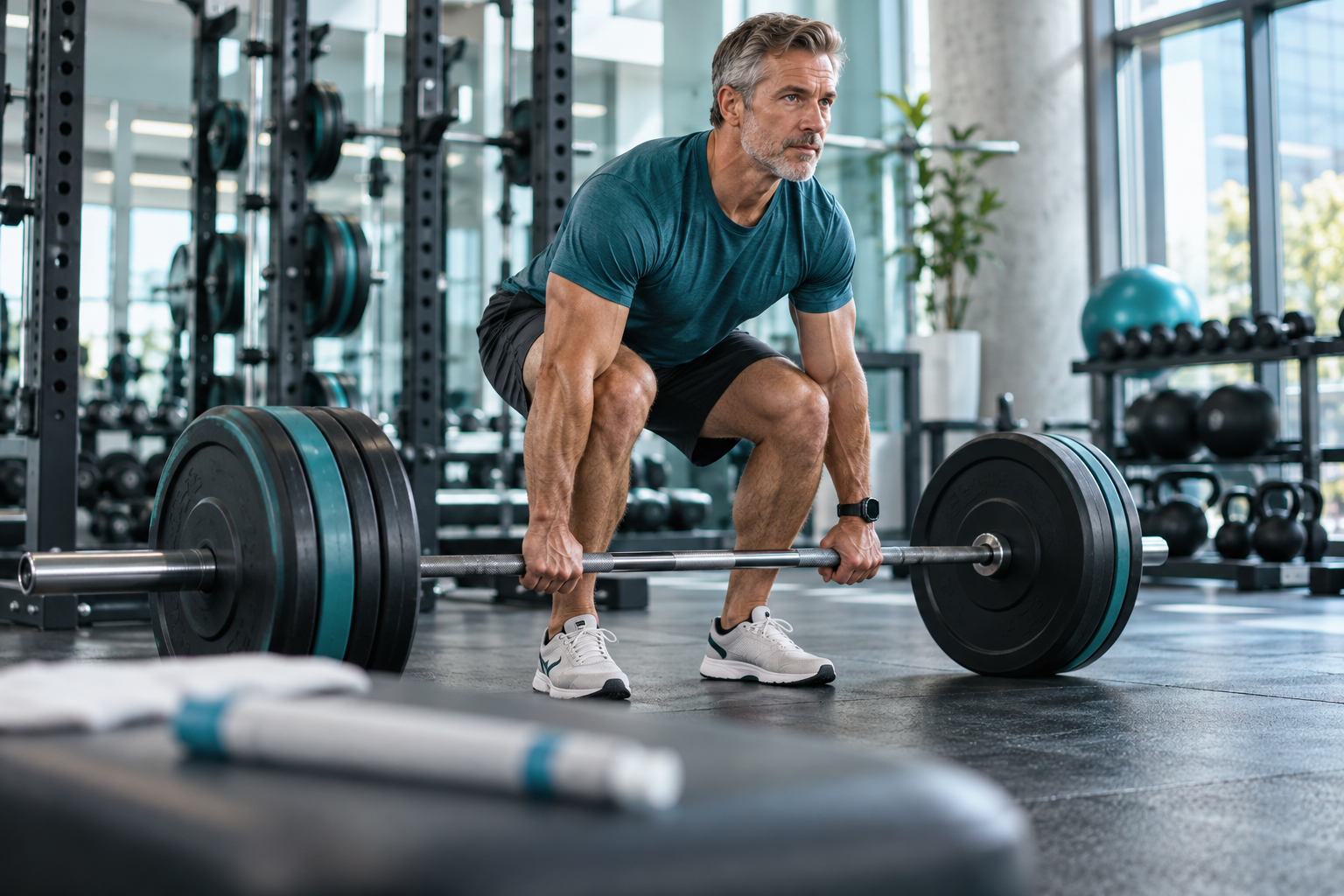
- Lift. Resistance training two to four times a week is the strongest signal you can send your body to keep its muscle.
- Prioritise protein. Many clinicians now advise patients on GLP-1s to set a daily protein target. When appetite is low, protein goes first on the plate. See how much protein men over 40 need.
- Do not chase the fastest possible loss. Slower loss generally spares more lean tissue.
- Keep moving. Daily steps help maintain muscle’s sensitivity to protein.
What if you simply cannot eat enough protein?
This is the practical problem men on these medications describe. When you are full after a few bites, 35g of protein at a meal feels impossible. Low-volume options become useful: Greek yoghurt, eggs, protein shakes, and essential amino acids.
EAAs are the amino acids your body cannot make, in a form that needs no digestion and takes up almost no room in the stomach. The one I use daily is BodyHealth PerfectAmino — ten tablets a day, split in two. I want to be careful here: there is no trial showing PerfectAmino prevents muscle loss on a GLP-1, and it does not replace protein from food. It is one low-volume tool. If you are on medication, run it past your doctor first.
Get PerfectAmino from BodyHealth →
How do you know what you are actually losing?
You measure it. This is the single most useful thing a man losing weight can do, and almost nobody does it. A normal scale gives you one number. A body composition scale splits that number into fat, muscle, and water.
I use the Hume Body Pod monthly. It estimates body fat, skeletal muscle mass and visceral fat, including a limb-by-limb breakdown. If weight is falling and muscle mass is holding, you are doing it right. If muscle is dropping alongside fat, that is your early warning to lift more, eat more protein, and have a conversation with your doctor — months before you would notice it in the mirror. It is not a medical device or a substitute for a clinical scan, but as a trend tracker it does the job.
What is the bottom line?
Losing weight is not the goal. Losing fat while keeping muscle is the goal. Whatever is driving your deficit, the men who come out the other side strong are the ones who lift, eat protein on purpose, and measure what is happening under the number on the scale.
Get the Simply Younger longevity briefings
Short, no-nonsense breakdowns of the science of ageing well after 40 — straight to your inbox.
Join free →Frequently asked questions
How much muscle do you lose on Ozempic?
It varies. In trial substudies, lean mass made up roughly a quarter to 40% of total weight lost. Training and protein intake are likely to shift that figure.
Is muscle loss on GLP-1s worse than with normal dieting?
The proportion is broadly similar to other forms of rapid weight loss. The difference is that the total weight lost is often larger, so the absolute amount of lean mass can be too.
Can you build muscle while on a GLP-1?
Maintaining muscle is a realistic goal with resistance training and enough protein. Discuss your individual plan with your doctor.
How much protein should I eat on a GLP-1?
That is a question for your prescribing doctor or a dietitian, as it depends on your weight, kidney function and health history.
Are amino acid supplements safe with GLP-1 medication?
Check with your doctor or pharmacist before adding any supplement to a prescribed medication.
How do I track muscle loss at home?
A body composition scale used monthly under the same conditions will show the trend in muscle mass and body fat over time.
Related reading
Lose Fat Without Losing Muscle · Skinny Fat After 40 · Anabolic Resistance After 40 · How Accurate Are Smart Scales? · Sarcopenia Explained
Full disclosure. This article is general wellness education and is not medical advice. Ozempic is a registered trademark of its manufacturer; this article is independent and not affiliated with or endorsed by any pharmaceutical company. It contains affiliate links to Hume Health and BodyHealth; Simply Younger may earn a commission on purchases at no extra cost to you. Product claims attributed to manufacturers are theirs and have not been independently verified by Simply Younger. LifeWave X39 is a non-transdermal, general-wellness phototherapy patch and is not intended to diagnose, treat, cure, or prevent any disease. As an authorised LifeWave Brand Partner, the author has a financial interest in promoting LifeWave products. Individual results vary. Always consult a qualified professional about your own health.
Leave a Reply