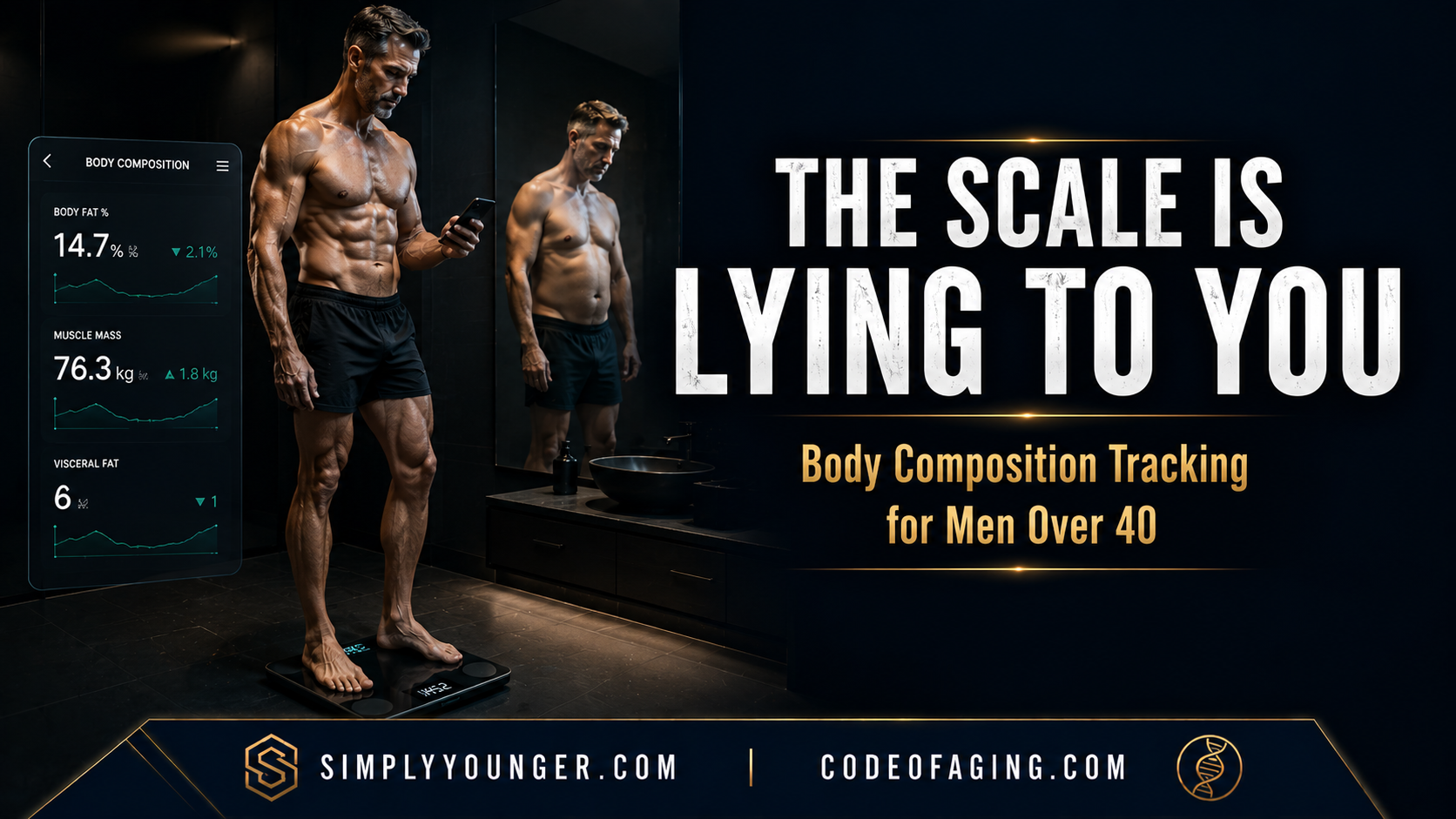
The scale is one of the most misleading pieces of health technology in most people’s homes. It measures one thing — total mass — and tells you almost nothing useful about whether you’re getting healthier, fitter, or biologically younger. Two men can weigh exactly the same and have vastly different body compositions: one with 25% body fat and minimal muscle, one with 15% body fat and significant lean mass. Their health risks, metabolic function, testosterone levels, and longevity trajectories are completely different. The scale shows identical numbers for both.
For men over 40 pursuing body recomposition — simultaneously reducing fat and preserving or building muscle — body composition tracking is not optional. It is the primary feedback mechanism that tells you whether your training, nutrition, and recovery inputs are actually working. Without it, you are flying blind and almost certainly making decisions based on data that is actively misleading you.
- Body weight alone is a poor indicator of health progress — it doesn’t distinguish between fat, muscle, water, and bone. Two people of identical weight can have dramatically different metabolic health profiles.
- Visceral fat is the most dangerous fat and cannot be estimated from weight or even overall body fat percentage — it requires direct measurement.
- Muscle mass is a longevity biomarker — men with higher muscle mass at 50 have measurably better long-term health outcomes, lower all-cause mortality, and better metabolic function.
- Body fat percentage targets vary by goal — metabolic health, athletic performance, and longevity each have different optimal ranges, and tracking helps you know where you are relative to each.
- Consistent measurement protocol matters more than any single reading — daily fluctuations of 1 to 3% in body fat readings are normal and hydration-driven. Trends over weeks are what matter.
Why Body Composition Matters More Than Weight
Body composition refers to the proportional distribution of fat mass, lean mass (muscle, bone, connective tissue), and water in the body. For health and longevity purposes, the most important variables are body fat percentage, muscle mass, and visceral fat — the fat stored around abdominal organs rather than under the skin.
Visceral fat is metabolically active in a harmful way: it continuously secretes pro-inflammatory cytokines including IL-6, TNF-alpha, and resistin, driving systemic inflammation, insulin resistance, arterial inflammation, and hormonal dysregulation. Men with high visceral fat have significantly elevated risk of cardiovascular disease, type 2 diabetes, and all-cause mortality — independent of total body weight. A man who appears “normal weight” by BMI can carry dangerous levels of visceral fat if his muscle mass is low.
Muscle mass, conversely, is one of the most powerful protective health variables available. A landmark study in the American Journal of Medicine (Srikanthan and Karlamangla, 2014) found that muscle mass index was inversely associated with all-cause mortality, independent of fat mass — meaning more muscle independently reduces death risk, regardless of how much fat you’re carrying. Higher muscle mass also improves insulin sensitivity, metabolic rate, bone density, hormonal function, and physical function — all of which determine healthspan quality.
What Methods Actually Work for Body Composition Tracking?
DEXA Scan
Dual-energy X-ray absorptiometry (DEXA) is the gold standard for body composition measurement. It distinguishes between bone mineral density, fat mass, and lean mass with high precision across different body regions. DEXA can identify visceral fat specifically and provides regional body composition data (arms, legs, trunk separately). The limitation is access and cost — typically $50 to $150 per scan at specialist facilities. For most men, a DEXA scan every 6 to 12 months provides an accurate baseline and progress checkpoint, with more accessible methods used in between.
Smart Scales with Bioelectrical Impedance Analysis (BIA)
Modern smart scales use bioelectrical impedance analysis to estimate body fat percentage, muscle mass, visceral fat rating, and bone mass alongside weight. A low-level electrical current passes through the body, and resistance is measured — fat and lean tissue have different electrical properties, allowing estimation of their proportions.
BIA accuracy is lower than DEXA, with day-to-day variability of 1 to 3% body fat driven primarily by hydration status. However, for tracking trends over weeks and months, a quality smart scale is the most practical and cost-effective daily body composition monitoring tool available. The key is measuring under consistent conditions: same time of day (first thing in the morning after using the bathroom and before eating or drinking), consistently hydrated, not immediately after intense exercise.
I use the Hume Health scale for my daily body composition tracking. It measures weight, body fat percentage, muscle mass, visceral fat, bone mass, and metabolic age, with a companion app that tracks trends over time. The metabolic age feature — a composite estimate of biological age based on body composition data — is a practical daily proxy for how my protocol is affecting my biological age trajectory. Seeing that number move in the right direction is one of the most motivating data points in my daily protocol.
Waist-to-Height Ratio
One of the simplest and most evidence-supported body composition proxies is waist-to-height ratio (WtHR). A 2022 meta-analysis in PLOS ONE found that WtHR was a stronger predictor of cardiovascular risk and all-cause mortality than BMI across all populations studied. The target: waist circumference should be less than half your height. For a 180cm (5’11”) man, waist should be below 90cm (35.4″). This single measurement is free, takes 30 seconds, and is more predictive of health risk than your weight.
Your body composition is directly linked to your biological age. Take the free Code of Aging quiz to understand your current biological age trajectory and where body composition fits in the picture.
Body Fat Percentage Targets for Men Over 40
Understanding where you are on the body fat spectrum and what targets are appropriate for your goals is essential for setting meaningful direction. For men over 40, the following approximate ranges apply:
- Below 10% — Athletic/competition level. Difficult to maintain sustainably, hormonal costs at the extreme low end.
- 10 to 15% — Fit/lean. Optimal for metabolic health and performance. Visible muscle definition. Achievable and sustainable with consistent training and nutrition.
- 15 to 20% — Average/healthy. Acceptable metabolic profile. Some visible softness. Room for improvement but not concerning.
- 20 to 25% — Above average. Increasing metabolic risk, particularly if visceral fat is elevated. Meaningful target for improvement.
- Above 25% — Elevated metabolic risk. Inflammatory burden from visceral fat likely significant. Priority intervention territory.
The most important number is not total body fat percentage but visceral fat specifically. A man at 18% body fat with most of that fat stored subcutaneously (under the skin) has a very different metabolic risk profile from a man at 18% with significant visceral accumulation. Smart scales that estimate visceral fat rating provide an important additional signal beyond total fat percentage.
The Recomposition Protocol: Losing Fat While Building Muscle
Body recomposition — simultaneously reducing fat and building muscle — was once considered physiologically impossible. The conventional wisdom held that you needed a caloric surplus to build muscle and a deficit to lose fat, making them mutually exclusive. The research has substantially revised this position, particularly for men over 40 who are not already lean and well-trained.
Recomposition is most achievable when: protein intake is high (1.8 to 2.2g per kg body weight), resistance training is consistent (progressive overload 3 to 4x weekly), the caloric deficit is modest (200 to 300 calories rather than aggressive restriction), sleep is adequate, and essential amino acid availability is maintained throughout the day. For the amino acid piece, I rely on PerfectAmino to maintain muscle protein synthesis stimulus even during the fasted portions of my day.
Hydration also plays a direct role in body composition outcomes. Adequate cellular hydration supports lipolysis (fat breakdown), protein synthesis, and metabolic rate. Using the Code of Hydration quiz to identify gaps in your hydration habits is a practical step that complements any body recomposition effort.
Frequently Asked Questions
What is a healthy body fat percentage for men over 40?
For metabolic health and longevity, 10 to 20% is the target range for most men over 40, with 12 to 18% representing the optimal balance of health benefit and practical sustainability. The more important metric is visceral fat level — even men within a healthy total body fat range can have elevated visceral fat that drives metabolic risk. A smart scale that estimates visceral fat provides this important additional signal.
Is BMI a reliable measure of health?
BMI is a poor health indicator for most individuals because it doesn’t distinguish between fat and muscle. A muscular man can be classified as “overweight” by BMI while having an excellent metabolic health profile. A “normal weight” man with low muscle and high visceral fat can have serious metabolic risk despite a healthy BMI. Waist-to-height ratio and body fat percentage are substantially more informative measures.
How accurate are smart scales for body fat measurement?
Smart scales using BIA have accuracy within approximately 3 to 5% of DEXA measurements under consistent conditions. Day-to-day variability of 1 to 3% is normal and driven primarily by hydration status. The key is measuring under consistent conditions (same time, same hydration state) and tracking weekly averages over months rather than reacting to individual daily readings. For trend tracking, smart scales are highly practical and cost-effective.
Does muscle mass decline with age?
Yes — this is called sarcopenia. Men lose approximately 3 to 8% of muscle mass per decade after 30, accelerating after 60. This decline is largely preventable and partially reversible through resistance training, adequate protein intake, creatine supplementation, and managing anabolic resistance factors like sleep quality and hormonal health. Tracking muscle mass through body composition measurement motivates and quantifies the interventions that prevent this decline.
What is visceral fat and how do I reduce it?
Visceral fat is fat stored in the abdominal cavity surrounding internal organs. It is metabolically active and pro-inflammatory, driving insulin resistance, cardiovascular risk, and accelerated biological ageing. It responds more readily to intervention than subcutaneous fat: resistance training, aerobic exercise, caloric deficit, sleep improvement, alcohol reduction, and stress management all specifically reduce visceral fat. Smart scales that estimate visceral fat rating allow you to track this specifically.
Should I weigh myself every day?
Daily weighing is fine if you understand that day-to-day fluctuations of 1 to 3kg reflect water, food volume, and glycogen — not fat change. Tracking a 7-day average removes most of the noise and gives a cleaner trend signal. What matters most is body composition measurement (fat percentage, muscle mass) rather than total weight — which is why a smart scale with body composition metrics is far more useful than a basic weight scale for anyone serious about their health.
Affiliate disclosure: This post contains affiliate links including PerfectAmino, Hume Health, and LifeWave. I may earn a commission if you purchase through my links, at no additional cost to you. I only recommend products I personally use.
*These statements have not been evaluated by the Food and Drug Administration. This content is not intended to diagnose, treat, cure, or prevent any disease. Always consult a qualified healthcare provider before making changes to your health regimen.
Leave a Reply