Affiliate & partner disclosure: This article contains affiliate links, and I may earn a commission if you buy through them at no extra cost to you. As an authorised LifeWave Brand Partner, I have a financial interest in promoting LifeWave products. Testimonial/editorial given by a LifeWave brand partner with financial interest in promoting the product. Full disclosure at the end.
A note before we start. This article is editorial science about a naturally occurring peptide. It is not medical advice and is not a claim about any LifeWave product. LifeWave X39 is a non-transdermal, general-wellness phototherapy patch that gently stimulates the skin with light to support the body’s natural energy flow for strength and stamina. It contains no GHK-Cu, makes no claim about GHK-Cu levels, and is not a treatment for any condition.
What did your 20-year-old body have that you don’t?
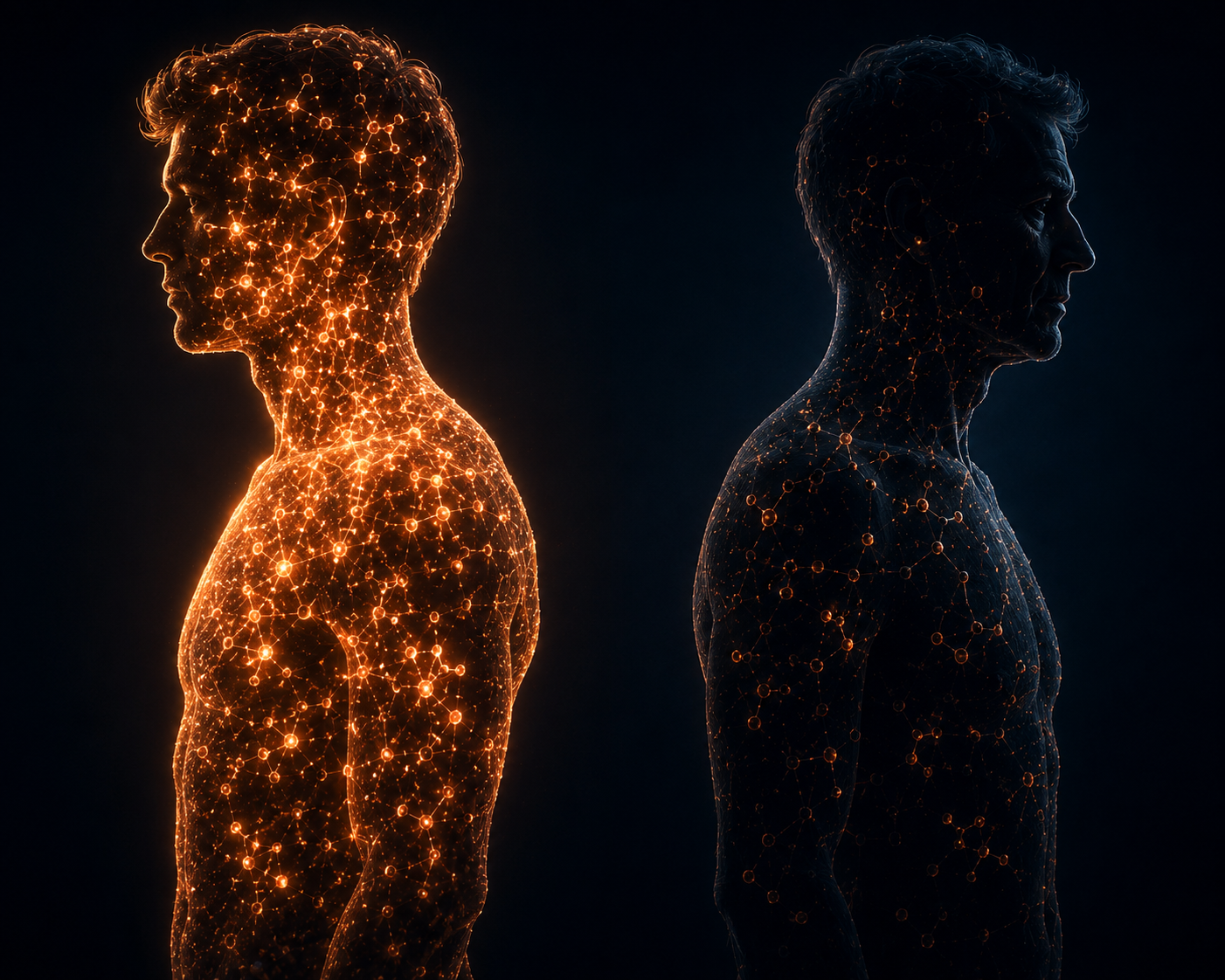
A lot of things, honestly — but one that fascinates scientists is a tiny naturally occurring molecule called GHK-Cu, a copper-binding peptide. Research suggests your blood carries noticeably more of it in your twenties than in your sixties. You didn’t take it or earn it; you simply had more of it when you were young.
Key takeaways
- GHK-Cu is a naturally occurring copper peptide.
- Evidence suggests plasma levels are higher in youth and decline with age.
- It has been studied in skin and wound-healing research for decades.
- A molecule declining with age doesn’t prove that replacing it helps.
- This is editorial science, not a product claim.
Why would a single peptide matter?
Because of what copper does. Copper is essential to the enzyme that cross-links collagen and elastin, so a peptide that naturally carries copper drew researchers’ attention early. GHK-Cu has been studied in skin and repair research across a long history going back to the 1970s. See GHK-Cu explained.
What does its decline actually tell us?
On its own, the fact that a youthful molecule declines doesn’t prove that topping it up would do anything — that’s a separate, harder question. What it does illustrate is a broader truth: the body’s chemistry shifts with age, and many molecules and signals that kept things running smoothly in youth become scarcer.
Get the Simply Younger daily email
One short email a day: the newest post, what I’m testing, and what’s actually working for men over 40.
Join free →How should you think about “youthful molecules”?
With curiosity and caution in equal measure. The leap from “this declines with age” to “replacing it reverses ageing” is exactly where marketing outruns evidence. The grounded move is to focus on the proven basics — training, sleep, protein, sun protection, not smoking — while staying curious about the research. My own week at 50 is lifting every second day, 10,000+ steps a day, cold plunge, sauna and steam most days, and ten PerfectAmino tablets a day.
Where does X39 fit? Not in this story. The GHK-Cu science above is editorial content with no product association. Separately, I wear an X39 patch daily as a general-wellness habit. LifeWave X39 is a non-transdermal, general-wellness phototherapy patch that gently stimulates the skin with light to support the body’s natural energy flow for strength and stamina. It contains no drugs and no GHK-Cu, no claim is made that it affects GHK-Cu, and it is not a treatment for any condition.
As an authorised LifeWave Brand Partner I have a financial interest in promoting it.
Shop X39 at my LifeWave store →
Frequently asked questions
What is GHK-Cu?
A naturally occurring copper peptide studied in skin and wound-healing research for decades.
Does GHK-Cu decline with age?
Evidence suggests plasma levels are higher in youth and decline as we get older.
Why is a declining peptide interesting to scientists?
Molecules that are abundant in youth and fade with age are natural candidates for ageing research.
Does the decline mean I should supplement it?
Not necessarily. Decline doesn’t establish that replacement helps. Speak to a professional before using any peptide.
Is GHK-Cu the same as copper supplements?
No. GHK-Cu is a specific peptide; copper supplements are a dietary mineral. Too much copper can be harmful.
Does X39 contain or raise GHK-Cu?
X39 contains no GHK-Cu and no such claim is made here. It is a non-transdermal, general-wellness phototherapy patch that gently stimulates the skin with light to support the body’s natural energy flow for strength and stamina.
Related reading
GHK-Cu Explained · Studied for 40 Years · The Mineral Holding Your Face Together · GHK-Cu and Stem Cells
Full disclosure. This article is general wellness education and is not medical advice, diagnosis, or treatment. LifeWave X39 is a non-transdermal, general-wellness phototherapy patch and is not intended to diagnose, treat, cure, or prevent any disease. As an authorised LifeWave Brand Partner, I have a financial interest in promoting LifeWave products. Links to PerfectAmino are affiliate links. Always consult a qualified professional about your individual health.
Leave a Reply