Affiliate & partner disclosure: This article contains links to products from which Simply Younger may earn a commission. As an authorised LifeWave Brand Partner, the author has a financial interest in promoting LifeWave products. See full disclosure below.
A note before we start. This article covers the biology of muscle recovery and delayed onset muscle soreness (DOMS). Where LifeWave X39 is mentioned, it is a non-transdermal, general-wellness phototherapy patch that gently stimulates the skin with light to support the body’s natural energy flow for strength and stamina. It is not a recovery supplement or treatment. Always consult a qualified medical professional.
You used to bounce back. What changed?
There is a specific moment in every man’s 40s when he realises his body has rewritten the rules without telling him. A leg session that used to leave him stiff for a day now costs him three. A football match with the kids turns into a week of hobbling around the kitchen. The intensity hasn’t changed. The work capacity hasn’t disappeared. What has changed — fundamentally and measurably — is the speed and quality of repair. Your body is still fixing what exercise breaks. It is just doing it on a skeleton crew, with lower budgets, and management that forgot to reorder supplies.
I’m Dave, founder of Simply Younger. At nearly 50, I train harder than most men half my age — resistance training every second day, cold plunges, and a daily practice built on supporting cellular repair. But I had to learn why recovery changes before I could actually address it. This article is that lesson.
Key takeaways
- DOMS (delayed onset muscle soreness) involves microstructural muscle damage that requires stem cell–driven repair — the same repair system that declines with age.
- Satellite cells (muscle stem cells) decline in number, activation speed, and proliferative capacity after 40, directly slowing muscle repair timelines.
- Age-related chronic inflammation delays the resolution of exercise-induced inflammation, keeping you in the “damaged” phase longer.
- NAD+ decline reduces mitochondrial energy available for repair, and GHK-Cu decline weakens tissue remodelling coordination.
- Recovery is trainable. The right inputs — sleep, nutrition, cold exposure, and consistent training frequency — can meaningfully improve recovery speed at any age.
What is actually happening when you’re sore?
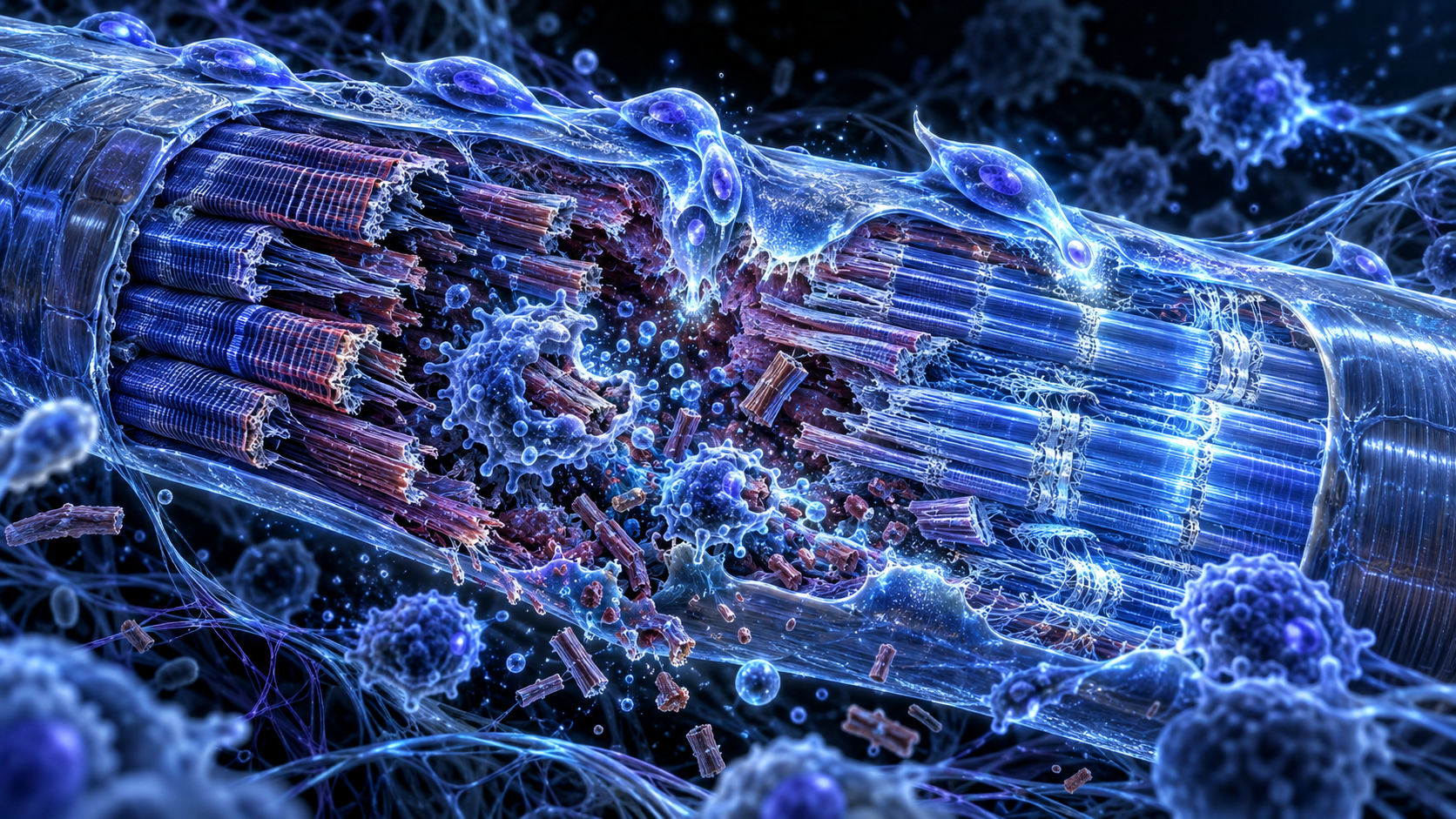
DOMS — that deep, tender stiffness that peaks 24–72 hours after a hard session — is not lactic acid buildup. That myth was debunked decades ago. What DOMS actually represents is microstructural damage to muscle fibres, particularly after eccentric loading (the lowering phase of a lift, downhill running, plyometrics). The muscle fibres sustain tiny tears in their sarcomere structure, and the body launches a controlled inflammatory response to clear the debris, recruit repair cells, and rebuild the tissue stronger than before.
When you’re 25, this cycle runs like a well-oiled machine. Inflammatory signals deploy precisely, satellite cells activate quickly, immune cells clear the debris efficiently, and new myofibrillar protein is laid down within days. By 45, every link in that chain is slower. The signals are noisier, the satellite cells are fewer and take longer to activate, the immune clearance drags, and the rebuilding process extends. You’re not imagining that it takes longer. The timeline has objectively changed.
Why do satellite cells slow down?
Satellite cells are the muscle-specific stem cells that sit dormant along muscle fibres, waiting for a damage signal. When activated, they proliferate, fuse with damaged fibres, and donate their nuclei to rebuild muscle tissue. This is the only way adults repair and grow skeletal muscle. There is no backup system.
After 40, satellite cell populations decline by roughly 30–50% in some muscle groups. The cells that remain are slower to activate, slower to proliferate, and produce fewer daughter cells per division. The stem cell niche environment — the microenvironment surrounding each satellite cell — becomes more inflammatory and fibrotic, providing worse signals to the cells sitting in it. Exosome signalling from these aged cells carries more inflammatory and fewer regenerative cargo. The net result: the repair crew is smaller, slower to mobilise, and working in a noisier environment.
This is compounded by reduced autophagy in aged satellite cells, which means they are trying to do high-precision work in a workshop full of accumulated cellular junk. Clean cells work faster. Cluttered cells stumble.
What role does inflammation play in slower recovery?
Exercise-induced inflammation is supposed to be acute: it spikes sharply, recruits the right cells, clears debris, and then resolves so that rebuilding can begin. In younger bodies, this process is crisp. In bodies already running with elevated baseline inflammaging, the exercise-induced inflammatory spike lands on top of existing chronic inflammation, creating a muddier, more prolonged inflammatory phase that delays the transition to repair.
Research published in the Journal of Applied Physiology has demonstrated that older adults show a prolonged inflammatory response to the same exercise stimulus compared to younger adults, with higher levels of IL-6 and TNF-alpha persisting for longer after eccentric exercise. The inflammation is not stronger — it just refuses to leave. And while it lingers, senescent cells in the tissue compound the problem by secreting their own inflammatory cocktail (the SASP), further delaying resolution.
Get the Simply Younger longevity briefings
Short, no-nonsense breakdowns of the science of ageing well after 40 — straight to your inbox.
Join free →How do you actually recover faster after 40?
The good news: recovery is trainable. Satellite cells respond to consistent training by maintaining higher baseline populations and faster activation speeds. The men who recover worst after 40 are the ones who train sporadically — long breaks followed by intense sessions give the repair system its hardest assignment with no preparation. Consistent, progressive resistance training three to four days per week keeps the satellite cell pool primed and the inflammatory resolution machinery calibrated.
Sleep is the single most underrated recovery tool. Growth hormone is released predominantly during deep sleep, and research shows that sleep restriction of even two hours per night measurably delays post-exercise recovery and impairs satellite cell activation. Seven-plus hours of quality sleep, protected and tracked, is the foundation.
Protein timing and quality. Post-exercise protein intake within two hours supports satellite cell proliferation and myofibrillar protein synthesis. Essential amino acid supplementation provides the complete building block profile that muscle repair demands, particularly leucine for mTOR-driven protein synthesis.
Cold exposure post-training has shown mixed evidence for recovery — it may blunt some hypertrophy signalling — but its systemic anti-inflammatory and hormetic benefits support the broader cellular health that enables recovery. I use cold plunges daily, though not immediately post-training.
Creatine monohydrate (5–10g daily) supports ATP regeneration in muscle cells, providing the energy currency for repair processes. It is one of the most researched and consistently effective supplements for men over 40.
And the X39 patch sits in this stack as a daily general-wellness input. It is not a recovery product — it is a phototherapy patch designed to support natural energy flow for strength and stamina. But recovery is an energy-intensive process, and when every other input in your day is designed to support the body’s own repair systems, a light-based wellness patch that works at the skin level is a natural piece of the puzzle. I wear one every training day and every rest day. It is part of the practice, not separate from it.
Where X39 fits — and where it doesn’t. LifeWave X39 is a non-transdermal, general-wellness phototherapy patch. It is not a recovery supplement, DOMS treatment, or performance enhancer. The science in this article is editorial and is not a claim about the patch.
As an authorised LifeWave Brand Partner I have a financial interest in promoting it. Explore X39 at: lifewave.com/dcp.
See your Biological Age markers →
Or shop X39 at my LifeWave store →
Frequently asked questions
Why am I so sore after exercise at 40?
Satellite cell decline, prolonged inflammatory responses, reduced NAD+ for repair energy, and impaired GHK-Cu signalling all slow muscle repair after 40, extending the timeline of DOMS and making soreness feel more intense and persistent.
Is DOMS worse as you get older?
Research shows that older adults experience a prolonged inflammatory phase after eccentric exercise compared to younger adults, resulting in longer-lasting soreness. The damage may not be greater, but the repair takes measurably longer.
How long should recovery take after 40?
Typically 48–96 hours for a hard resistance session, compared to 24–48 hours in your 20s. Consistent training, adequate protein, quality sleep, and inflammation management can bring this closer to the shorter end.
Does training frequency improve recovery speed?
Yes. Consistent training maintains higher satellite cell populations and faster activation speeds. Sporadic training with long breaks gives the repair system its hardest work with the least preparation.
Should I take ice baths after training for recovery?
Cold exposure has systemic anti-inflammatory and hormetic benefits, but timing matters. Immediate post-training cold may blunt some hypertrophy signalling. Many longevity-focused practitioners separate cold exposure from training by several hours.
What is LifeWave X39?
A non-transdermal, general-wellness phototherapy patch that gently stimulates the skin with light to support natural energy flow for strength and stamina. It is not a recovery supplement or performance enhancer.
Related reading
How Stem Cells Repair Muscle After a Workout · Satellite Cells: Muscle Stem Cells · What Happens to Your Body at 40 · Exercise and Stem Cells · Autophagy and Stem Cells · Sleep and Stem Cells
Full disclosure. This article is general wellness education and is not medical advice. LifeWave X39 is a non-transdermal, general-wellness phototherapy patch and is not intended to diagnose, treat, cure, or prevent any disease. As an authorised LifeWave Brand Partner, the author has a financial interest in promoting LifeWave products. Always consult a qualified professional about your individual health.
Leave a Reply