Affiliate & partner disclosure: This article contains links to products from which Simply Younger may earn a commission. As an authorised LifeWave Brand Partner, the author has a financial interest in promoting LifeWave products. See full disclosure below.
A note before we start. Everything below about telomeres is general science education — it is not about any product, and nothing here describes a treatment, cure, or fix for any condition. Where LifeWave X39 is mentioned, it is a non-transdermal, general-wellness phototherapy patch that gently stimulates the skin with light to support the body’s natural energy flow for strength and stamina. It is not a drug, is not a treatment for any disease, and none of the science in this article is a claim about what the patch does.
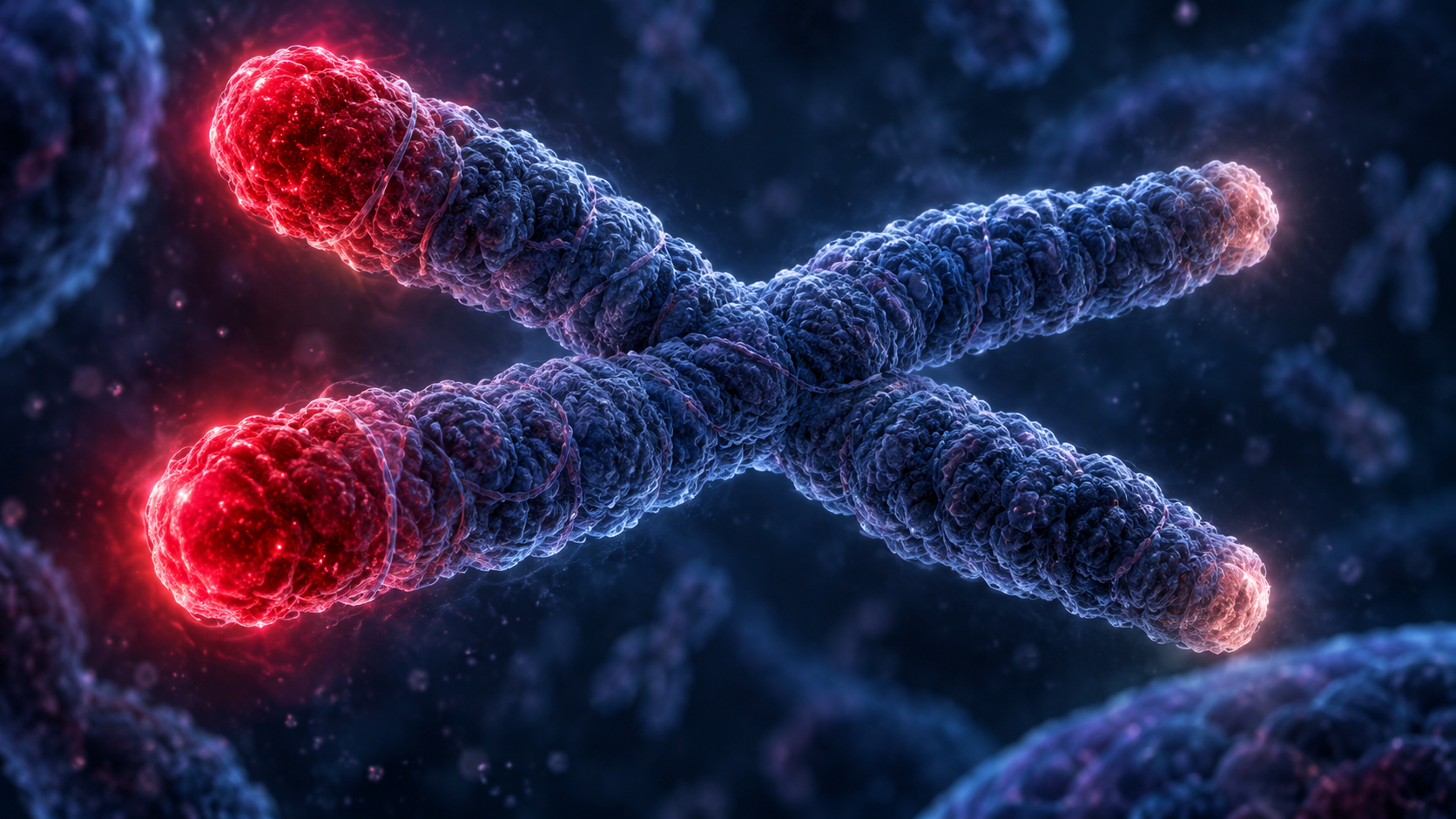
At the tip of every chromosome in your body sits a protective cap made of repeating DNA sequences and specialised proteins. These caps are your telomeres, and they shorten every time a cell divides — roughly 50 to 67 base pairs lost per year in blood cells alone. When they get short enough, the cell receives a signal to stop dividing permanently and either enters senescence (becoming a zombie cell) or triggers programmed death. Telomere shortening is one of the hallmarks of biological ageing, and while it isn’t the only timer ticking inside your cells, it’s one of the most studied and most practically relevant — because the rate at which your telomeres shorten is influenced by how you live.
Key takeaways
- Telomeres are protective DNA caps on chromosomes that shorten with each cell division — when they become critically short, cells stop dividing and enter senescence or die.
- Telomere attrition is linked to cellular senescence, oxidative stress, and increased mortality risk in population studies.
- Telomere length is maintained by an enzyme called telomerase, which is active in stem cells but largely suppressed in most adult cells.
- Lifestyle factors — exercise, nutrition, stress management, sleep — influence the rate of telomere shortening.
- Telomere length and epigenetic clocks measure different but complementary aspects of biological ageing — both predict health outcomes independently.
What are telomeres and what do they actually do?
Your chromosomes — the tightly wound packages of DNA inside every cell — face a mechanical problem. Each time a cell divides and copies its DNA, the replication machinery can’t quite reach the very end of the chromosome. Without protection, essential genetic information at the chromosome tips would be lost with every division. Telomeres solve this by acting as expendable buffers: the repeated sequence TTAGGG, thousands of times over, capped by a protein complex called shelterin that prevents the cell from mistaking the chromosome end for a broken DNA strand.
In humans, telomeres start at roughly 10,000–15,000 base pairs at birth and shorten progressively throughout life. The rate varies by tissue type, cell division frequency, and individual factors — but the direction is consistent. When telomeres reach a critical minimum length (roughly 4,000–5,000 base pairs in many cell types), they trigger a DNA damage response that permanently arrests the cell cycle. This is one of the primary pathways into cellular senescence — the zombie cell state that poisons surrounding tissue and impairs stem cell niches.
The 2009 Nobel Prize in Physiology or Medicine was awarded to Elizabeth Blackburn, Carol Greider, and Jack Szostak for their discovery of telomerase — the enzyme that can add TTAGGG repeats back onto chromosome ends, counteracting the shortening. The catch: telomerase is highly active in embryonic and stem cells but largely suppressed in most adult somatic cells. This suppression is partly a cancer-prevention mechanism (unlimited cell division is a hallmark of cancer), but it means that the majority of your cells are on a one-way countdown.
How does telomere length affect stem cells?
Stem cells are among the few adult cell types that express telomerase — but not enough to maintain telomere length indefinitely. Over decades of occasional divisions (activated by injury, exercise, or tissue turnover), stem cell telomeres shorten too, just more slowly than in rapidly dividing cells. When a stem cell’s telomeres become critically short, it loses the capacity to divide effectively, contributing to the stem cell exhaustion that drives age-related decline in tissue repair.
Blood stem cells are particularly sensitive to telomere attrition because they divide more frequently than most other stem cell populations — producing billions of blood cells daily. Short telomeres in blood stem cells contribute to the age-related skewing of blood cell production toward inflammatory cell types, reduced immune function, and increased susceptibility to blood cancers. Mesenchymal stem cells with shortened telomeres show reduced capacity to differentiate into bone and cartilage, contributing to osteoporosis and joint degeneration. Muscle satellite cells with telomere attrition activate and proliferate less efficiently, slowing muscle repair after training or injury.
The relationship between telomeres and stem cells creates a feedback loop: stem cells need adequate telomere length to function, but the tissue damage caused by declining stem cell function increases the demand for stem cell activation, driving more divisions and more telomere shortening. Add chronic inflammation (which increases oxidative stress on telomeres and drives more cell turnover) and the rate of decline compounds.
What influences the rate of telomere shortening?
Genetics sets the baseline — some people inherit longer telomeres and slower attrition rates — but lifestyle factors significantly modify the trajectory. Oxidative stress is the primary accelerator. Reactive oxygen species (ROS) damage the guanine-rich telomere sequence preferentially, causing breaks and accelerated shortening beyond what cell division alone would produce. Everything that increases chronic oxidative stress — smoking, excessive alcohol, processed diets, chronic psychological stress, poor sleep, sedentary behaviour, obesity — accelerates telomere attrition.
Exercise is one of the most consistently documented telomere-protective behaviours. Endurance athletes have measurably longer telomeres than sedentary controls of the same age, and even moderate regular exercise is associated with slower telomere shortening in longitudinal studies. The mechanism likely involves reduced oxidative stress, improved anti-inflammatory signalling, and upregulation of antioxidant defences.
Nutrition matters through multiple pathways. The Mediterranean diet — rich in omega-3 fatty acids, polyphenols, and antioxidants — is associated with longer telomeres in population studies. Adequate vitamin D, folate, and B12 support the methylation pathways that interact with telomere maintenance. Conversely, high sugar intake, processed meat consumption, and ultra-processed food diets are associated with shorter telomeres.
Psychological stress received landmark attention when Blackburn and psychologist Elissa Epel published research showing that mothers of chronically ill children — experiencing sustained caregiving stress — had telomeres equivalent to roughly 10 additional years of ageing compared to controls. The stress-telomere connection runs through cortisol, inflammatory signalling, and oxidative damage.
Get the Simply Younger longevity briefings
Short, no-nonsense breakdowns of the science of ageing well after 40 — straight to your inbox.
Join free →How do telomeres compare to epigenetic clocks as ageing biomarkers?
Both measure biological ageing, but they capture different dimensions. Telomere length reflects the cumulative history of cell division and oxidative damage — a long-running tally. Epigenetic clocks capture the pattern of chemical modifications on DNA at a snapshot in time, reflecting the current functional state of gene regulation. Research shows that the two measures are only weakly correlated with each other — a person with relatively long telomeres can still have an accelerated epigenetic age, and vice versa. Both independently predict mortality risk, which suggests they’re tracking complementary aspects of the ageing process.
For practical purposes, biological age is best understood as multidimensional. Telomeres are one axis (replicative capacity), epigenetic patterns are another (gene regulation quality), and stem cell function is a third (repair capacity). The lifestyle inputs that support all three — exercise, nutrition, sleep, stress management — are the same, which is why the daily-fundamentals approach this site advocates works regardless of which biomarker you’re tracking.
What does GHK-Cu have to do with telomeres?
The GHK-Cu peptide connection to telomere biology runs through its broad gene-expression effects and its documented influence on oxidative stress and inflammation — both of which are primary drivers of telomere shortening. GHK-Cu’s modulation of approximately 4,000 genes includes pathways involved in antioxidant defence, DNA repair, and inflammatory regulation. While GHK-Cu is not a telomerase activator (that distinction belongs to compounds like TA-65 and the peptide Epithalon), its influence on the oxidative and inflammatory environment that determines telomere attrition rate places it within the same biological conversation.
The parallel age-related decline of GHK-Cu levels (roughly 60% loss by age 60) and telomere length over the same decades illustrates the coordinated nature of biological ageing. Neither one causes the other in isolation — they’re both downstream of the body’s progressive loss of maintenance capacity. Supporting one supports the system; neglecting the whole system guarantees decline across every axis.
Where X39 fits — and where it doesn’t. LifeWave X39 is a non-transdermal, general-wellness phototherapy patch that gently stimulates the skin with light to support the body’s natural energy flow for strength and stamina. It contains no drugs and is not a treatment for telomere shortening or any condition discussed above. The science in this article is educational and is not a claim about the patch.
As an authorised LifeWave Brand Partner I have a financial interest in promoting it. You can explore X39 and the wider wellness range at my store: lifewave.com/dcp.
Want to add X39 to your own routine? You can order it directly from my LifeWave store.
See your Biological Age markers →
Or shop X39 at my LifeWave store →
Frequently asked questions
What are telomeres in simple terms?
Telomeres are protective caps of repetitive DNA at the ends of your chromosomes, preventing them from fraying or fusing during cell division. They shorten with each division, and when they get too short, the cell stops dividing — contributing to ageing.
Can you lengthen your telomeres?
Telomerase — the enzyme that rebuilds telomeres — is active in stem cells but largely suppressed in most adult cells. Lifestyle factors like exercise, stress reduction, and a Mediterranean diet have been associated with slower telomere shortening and, in some studies, modest lengthening over time.
How fast do telomeres shorten?
Blood cell telomeres shorten by roughly 50–67 base pairs per year on average, though the rate varies by tissue type, oxidative stress burden, and individual genetics. Chronic stress, smoking, and sedentary behaviour accelerate the rate significantly.
Are telomere tests accurate?
Consumer telomere tests measure average leukocyte telomere length from a blood sample. They’re reasonably accurate for population-level comparisons but have significant measurement variability that limits their usefulness for tracking individual changes over short periods.
What is the connection between telomeres and stem cells?
Stem cells express telomerase to maintain their telomeres, but not enough to prevent all shortening over decades. When stem cell telomeres become critically short, the cells lose regenerative capacity — contributing to stem cell exhaustion and reduced tissue repair.
What is LifeWave X39?
It’s a non-transdermal, general-wellness phototherapy patch that gently stimulates the skin with light to support the body’s natural energy flow for strength and stamina. It is not a drug or a treatment for any condition.
Related reading
Epigenetics and Aging · Zombie Cells Explained · The Hallmarks of Ageing · Stem Cell Exhaustion After 50 · What Is Biological Age? · GHK-Cu Explained
Full disclosure. This article is general wellness education and is not medical advice, diagnosis, or treatment. LifeWave X39 is a non-transdermal, general-wellness phototherapy patch and is not intended to diagnose, treat, cure, or prevent any disease. As an authorised LifeWave Brand Partner, the author has a financial interest in promoting LifeWave products. Always consult a qualified professional about your individual health.
Leave a Reply