Affiliate & partner disclosure: This article contains links to products from which Simply Younger may earn a commission. As an authorised LifeWave Brand Partner, the author has a financial interest in promoting LifeWave products. See full disclosure below.
A note before we start. Everything below about stem cells and skin ageing is general science education — it is not about any product, and nothing here describes a treatment, cure, or fix for any condition. Where LifeWave X39 is mentioned, it is a non-transdermal, general-wellness phototherapy patch that gently stimulates the skin with light to support the body’s natural energy flow for strength and stamina. It is not a drug or treatment for any disease.
Why does skin age from the inside out?
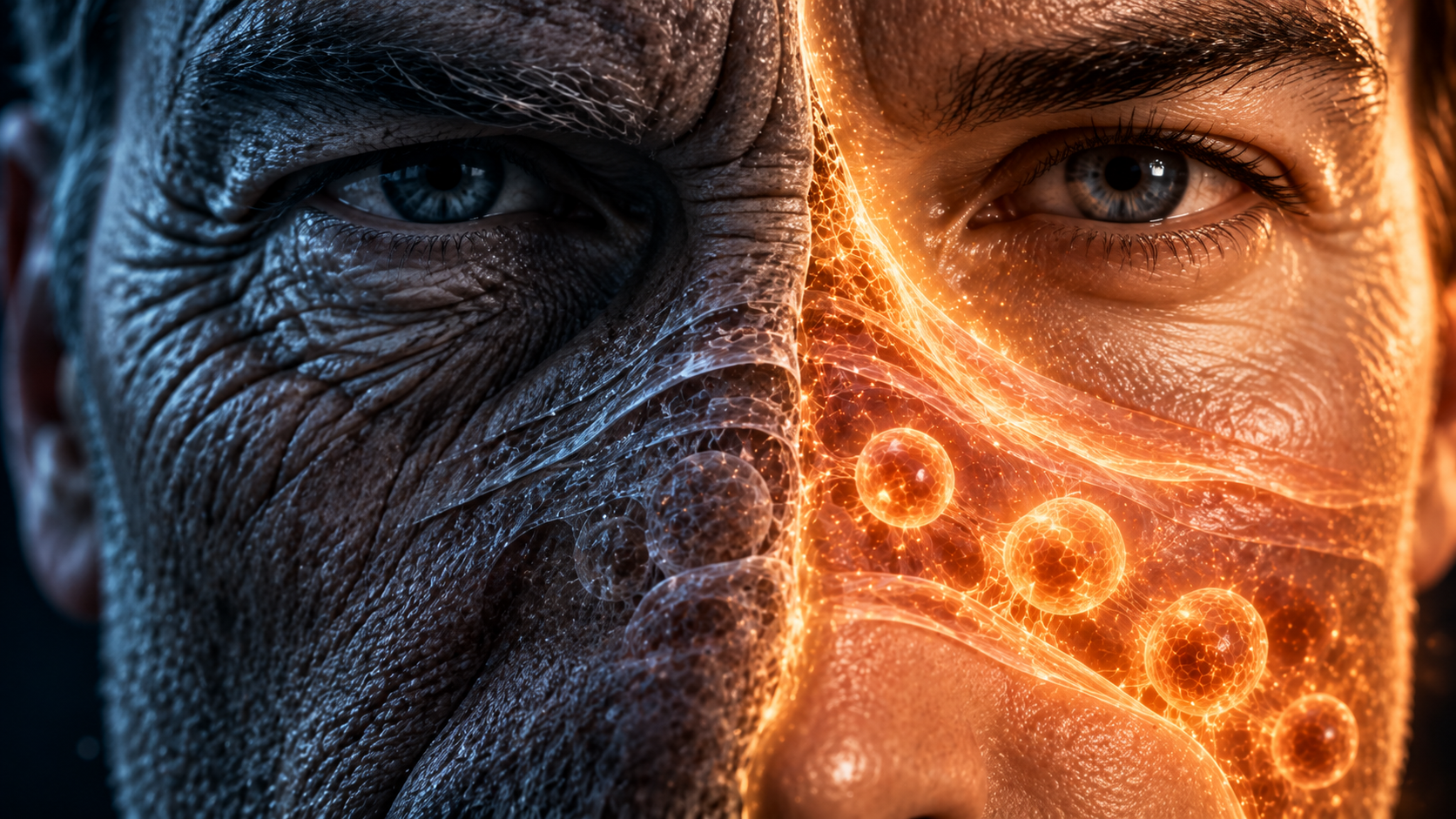
Skin is the body’s largest organ and one of its most stem cell-dependent tissues. The epidermis — your outermost skin layer — renews itself approximately every 28 days in young adults, driven by epidermal stem cells that reside in the basal layer and in the bulge region of hair follicles. These stem cells divide continuously, producing the keratinocytes that migrate upward, flatten, and eventually shed as the dead cells that form your skin’s protective surface. The dermis beneath depends on mesenchymal-derived cells (fibroblasts) that produce collagen, elastin, and the extracellular matrix that gives skin its structure and resilience. When these stem cell populations function well, skin repairs efficiently, maintains thickness and elasticity, and recovers quickly from damage. When they decline, the visible consequences are what we recognise as ageing: wrinkles, thinning, sagging, slower wound healing, and loss of elasticity.
I’m Dave, founder of Simply Younger, approaching 50. Understanding that wrinkles and skin thinning are fundamentally stem cell problems — not just cosmetic surface issues — connected the dots between the lifestyle interventions I was already doing for muscle and longevity and the skin changes I could see in the mirror.
Key takeaways
- Skin renewal is driven by epidermal stem cells in the basal layer and hair follicle bulge. The epidermis renews every 28 days in young adults, slowing significantly with age.
- Collagen and elastin production depend on dermal fibroblasts, which are mesenchymal in origin. As mesenchymal stem cells decline, collagen production drops — roughly 1% per year after 20.
- UV damage, chronic inflammation, oxidative stress, and niche degradation all impair skin stem cell function, accelerating visible ageing.
- GHK-Cu (copper peptide) has been studied for its role in collagen stimulation and wound repair signalling — a point of particular interest in skin ageing research.
- Nutrition, sleep, sun protection, and inflammation management all support skin stem cell function from the inside.
How do skin stem cells age?
Epidermal stem cells show several age-related changes. Their proliferative capacity decreases, meaning the basal layer produces replacement keratinocytes more slowly. The epidermal turnover rate roughly doubles from 28 days in young adults to over 40–50 days in older adults, resulting in a thinner, more fragile epidermis. Hair follicle stem cells decline in both number and activity, contributing to hair thinning and greying. In the dermis, fibroblast activity slows and the cells produce less collagen and elastin. Collagen production drops approximately 1% per year from age 20, and existing collagen becomes more cross-linked and less flexible. The stem cell niches that support these populations degrade — vascular supply diminishes, the extracellular matrix stiffens, and chronic inflammatory signalling disrupts normal stem cell behaviour.
What role does UV damage play?
Ultraviolet radiation is the single largest extrinsic driver of skin stem cell ageing — a process called photoageing. UV exposure generates reactive oxygen species that directly damage stem cell DNA, accelerates telomere shortening in epidermal stem cells, triggers chronic inflammatory signalling in the dermis, and degrades the collagen matrix that fibroblasts maintain. The difference between sun-exposed and sun-protected skin in the same individual can represent decades of biological ageing difference. Photoageing is distinct from intrinsic (chronological) skin ageing and is largely preventable through consistent sun protection — making it one of the highest-leverage interventions for preserving skin stem cell function.
How does GHK-Cu relate to skin and stem cells?
GHK-Cu (glycyl-L-histidyl-L-lysine copper complex) is a naturally occurring copper peptide found in human plasma, saliva, and urine. Research has documented its role in wound healing signalling, collagen and elastin stimulation, anti-inflammatory activity, and antioxidant enzyme upregulation. GHK-Cu levels decline significantly with age — dropping from approximately 200 ng/mL at age 20 to roughly 80 ng/mL by age 60. This decline correlates with the reduction in the body’s tissue repair capacity and is a point of active research interest in skin ageing and regenerative biology. It is important to note that this is editorial science coverage and is not associated with any product claim.
Get the Simply Younger longevity briefings
Short, no-nonsense breakdowns of the science of ageing well after 40 — straight to your inbox.
Join free →What supports skin stem cells from the inside?
Sun protection is the single highest-leverage intervention. Consistent broad-spectrum SPF use dramatically slows photoageing and preserves epidermal stem cell function.
Sleep is when skin repair peaks. Growth hormone released during deep slow-wave sleep supports fibroblast activity and epidermal renewal. Chronic sleep deprivation visibly accelerates skin ageing.
Nutrition. Vitamin C is essential for collagen synthesis. Omega-3s reduce inflammatory signalling in the dermis. Polyphenols from berries and green tea provide antioxidant protection. Adequate protein supplies the amino acids required for continuous keratinocyte production.
Inflammation management. Chronic systemic inflammation degrades the dermal matrix and impairs fibroblast function. Cold exposure, stress management, and anti-inflammatory nutrition reduce this burden.
In my daily practice: sun protection, tracked sleep, cold plunges, omega-3s, protein-forward nutrition with PerfectAmino, and a LifeWave X39 patch as part of a general-wellness stack.
Where X39 fits — and where it doesn’t. LifeWave X39 is a non-transdermal, general-wellness phototherapy patch that gently stimulates the skin with light to support the body’s natural energy flow for strength and stamina. It contains no drugs and is not a treatment for wrinkles, skin ageing, or any condition discussed above. The science in this article is educational and is not a claim about the patch.
As an authorised LifeWave Brand Partner I have a financial interest in promoting it. You can explore X39 and the wider wellness range at my store: lifewave.com/dcp.
See your Biological Age markers →
Or shop X39 at my LifeWave store →
Frequently asked questions
Why do wrinkles form?
Wrinkles result from declining collagen and elastin production by dermal fibroblasts, combined with slower epidermal renewal from ageing skin stem cells. UV damage, inflammation, and gravity compound the process.
How fast does skin renew itself?
The epidermis renews approximately every 28 days in young adults, driven by epidermal stem cells in the basal layer. By older age, this slows to 40–50+ days, resulting in thinner, more fragile skin.
What is photoageing?
Photoageing is skin ageing caused by UV radiation — distinct from chronological ageing. UV generates oxidative damage, degrades collagen, and accelerates stem cell decline. It is largely preventable through consistent sun protection.
Does collagen production decline with age?
Yes. Collagen production drops approximately 1% per year from age 20. By 50, total collagen content may have decreased by 30% or more, contributing to thinner, less resilient skin.
What is GHK-Cu?
A naturally occurring copper peptide studied for its role in wound healing, collagen stimulation, and tissue repair signalling. Levels decline significantly with age, from roughly 200 ng/mL at 20 to 80 ng/mL by 60.
What is LifeWave X39?
It’s a non-transdermal, general-wellness phototherapy patch that gently stimulates the skin with light to support the body’s natural energy flow for strength and stamina. It is not a drug or treatment for any condition.
Related reading
GHK-Cu and Stem Cells · Mesenchymal Stem Cells After 40 · Stem Cell Exhaustion After 50 · Sleep and Stem Cells · Diet and Stem Cell Activity · Stem Cells and Inflammation
Full disclosure. This article is general wellness education and is not medical advice, diagnosis, or treatment. LifeWave X39 is a non-transdermal, general-wellness phototherapy patch and is not intended to diagnose, treat, cure, or prevent any disease. As an authorised LifeWave Brand Partner, the author has a financial interest in promoting LifeWave products. Always consult a qualified professional about your individual health.
Leave a Reply