Affiliate & partner disclosure: This article contains links to products from which Simply Younger may earn a commission. As an authorised LifeWave Brand Partner, the author has a financial interest in promoting LifeWave products. See full disclosure below.
A note before we start. This article is general science education about how the skin barrier works. It is not medical or cosmetic advice, and not a claim about any product. Where LifeWave X39 is mentioned, it is a non-transdermal, general-wellness phototherapy patch that gently stimulates the skin with light to support the body’s natural energy flow for strength and stamina. It is not a drug or a treatment for any condition.
Where does all that collagen cream actually go?
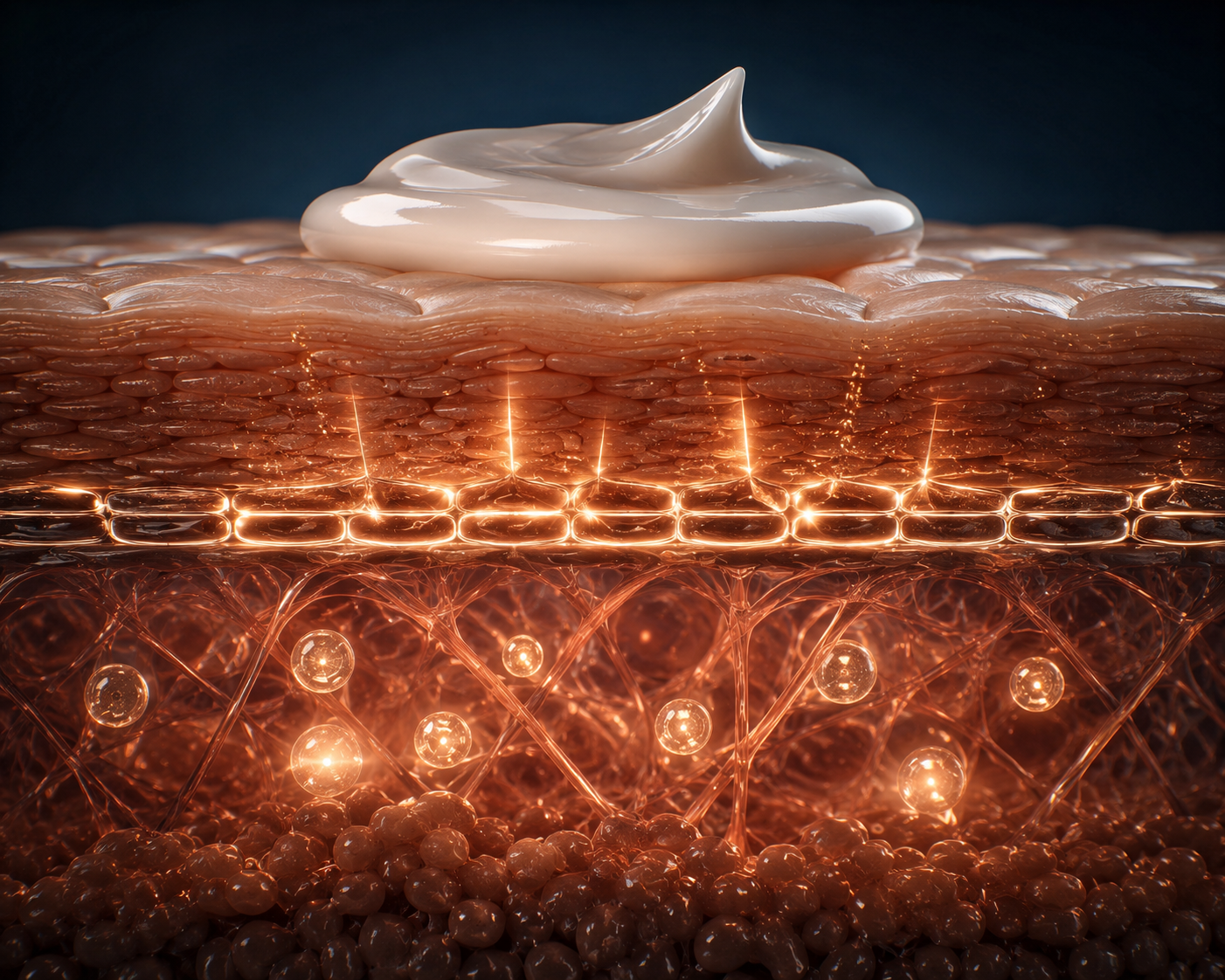
You spread it on, it feels rich, your skin looks briefly plumper — and you assume the collagen is sinking down to where wrinkles form. Here’s the uncomfortable physics: the collagen protein in most creams is a very large molecule, and the outer skin barrier is specifically built to keep large molecules out. So the collagen mostly sits on the surface it was supposed to travel past.
Key takeaways
- The skin barrier is designed to keep large molecules out.
- Collagen molecules are far too large to pass through intact.
- Topical collagen mostly acts as a surface moisturiser, not a rebuilder.
- The layer that needs collagen sits below where the cream can reach.
- Signalling, not slathering, is how the body rebuilds collagen.
- Understanding the barrier saves you money on false promises.
Why is the skin barrier so hard to cross?
Your outermost skin layer, the stratum corneum, is essentially a brick-and-mortar wall — dead, flattened cells sealed with lipids. Its entire evolutionary job is to keep the outside world out and your water in. Molecular size is one of the biggest gatekeepers: small molecules have a chance, large ones don’t. Intact collagen is enormous by this standard, which is why it can’t simply be delivered by rubbing it on.
So what does the cream actually do?
Usually it works as a decent moisturiser. Hydrated skin looks temporarily smoother and plumper, which is a real cosmetic effect — just not the deep structural rebuild the marketing implies. The collagen and elastin that give skin its firmness live in the dermis, below the barrier, and depend on internal factors like copper-driven cross-linking and the body’s own rebuild signals. That’s a fundamentally different mechanism from a topcoat of protein.
Curious what’s actually driving how your skin looks? A short assessment gives you a real baseline.
Get the Simply Younger longevity briefings
Short, no-nonsense breakdowns of the science of ageing well after 40 — straight to your inbox.
Join free →If not creams, then what?
Shift your attention from the surface to the systems. Support the body’s own collagen production with adequate protein and vitamin C, protect existing collagen from UV and sugar damage, and respect the fact that firmness is built from the inside out. This is the same reason skin that looks tired or bruises more easily is telling you about deeper connective-tissue changes, not a lack of expensive cream.
Where X39 fits — and where it doesn’t. The skin-barrier science above is general education and is separate from any product. LifeWave X39 is a non-transdermal, general-wellness phototherapy patch that gently stimulates the skin with light to support the body’s natural energy flow for strength and stamina. It contains no drug and is not a treatment for skin ageing, collagen, or any condition.
As an authorised LifeWave Brand Partner I have a financial interest in promoting it. You can explore X39 and the wider wellness range at my store: lifewave.com/dcp.
Want to add X39 to your own routine? You can order it directly from my LifeWave store.
Stop guessing at the surface — get a read on the systems underneath with the quiz.
See your Biological Age markers →
Or shop X39 at my LifeWave store →
Frequently asked questions
Do collagen creams actually work?
As moisturisers they can temporarily improve appearance, but intact collagen molecules are too large to penetrate the skin barrier and rebuild collagen in the dermis.
Why can’t collagen penetrate the skin?
The outer skin barrier is built to block large molecules, and collagen is a very large protein, so it largely stays on the surface.
Is any topical skincare able to reach deeper layers?
Some much smaller molecules can penetrate to varying degrees, but that depends heavily on molecular size and formulation — and intact collagen is not among them.
What actually helps the body make collagen?
Supporting internal factors — adequate protein, vitamin C, and protecting existing collagen from UV and excess sugar — matters more than topical collagen.
Is collagen supplementation different from creams?
Yes, ingesting collagen is a separate topic from applying it to skin, and the evidence there is its own discussion beyond the scope of the barrier issue.
What is LifeWave X39?
It’s a non-transdermal, general-wellness phototherapy patch that gently stimulates the skin with light to support the body’s natural energy flow for strength and stamina. It is not a drug or a treatment for any condition.
Full disclosure. This article is general wellness education and is not medical advice, diagnosis, or treatment. LifeWave X39 is a non-transdermal, general-wellness phototherapy patch and is not intended to diagnose, treat, cure, or prevent any disease. As an authorised LifeWave Brand Partner, the author has a financial interest in promoting LifeWave products. Always consult a qualified professional about your individual health.
Leave a Reply