Affiliate & partner disclosure: This article contains links to products from which Simply Younger may earn a commission. As an authorised LifeWave Brand Partner, the author has a financial interest in promoting LifeWave products. See full disclosure below.
A note before we start. This article is general science education about copper and connective tissue. It is not medical advice, not dietary advice, and not a claim about any product. Where LifeWave X39 is mentioned, it is a non-transdermal, general-wellness phototherapy patch that gently stimulates the skin with light to support the body’s natural energy flow for strength and stamina. It is not a drug or a treatment for any condition.
What actually holds your skin up?
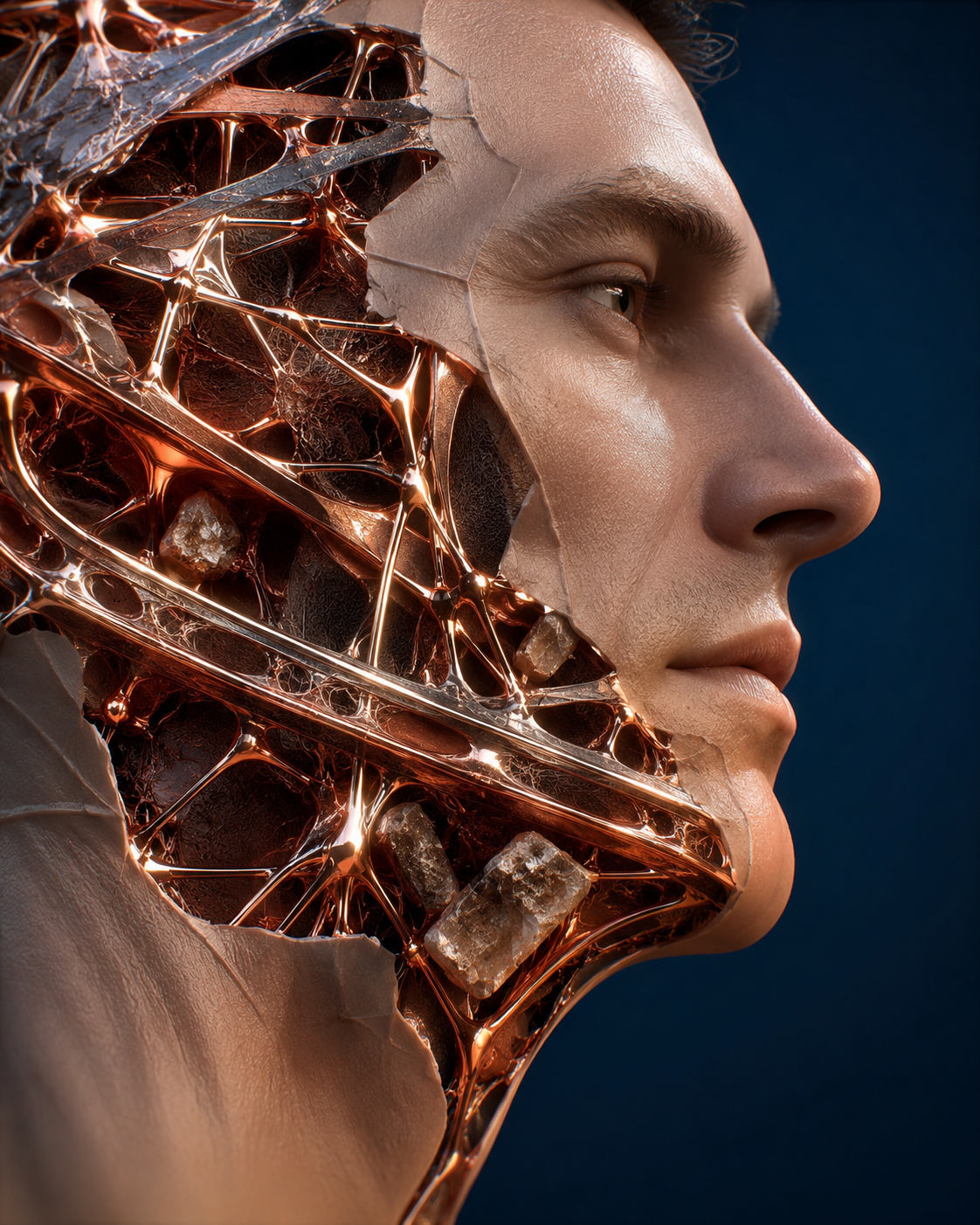
We talk about collagen as if it’s the whole story of firm skin, but collagen fibres are only as good as the scaffolding that ties them together. That scaffolding depends on a trace mineral most men never think about: copper. Without it, the fibres that give skin its structure can’t be properly cross-linked — and cross-linking is what turns loose strands into a strong, springy mesh.
Key takeaways
- Copper is an essential trace mineral your body cannot make.
- It’s required for the enzyme that cross-links collagen and elastin.
- Cross-linking is what gives skin and connective tissue their strength.
- Copper also supports other roles, including antioxidant defence.
- Balance matters — more is not better with trace minerals.
- Copper science is fascinating on its own, separate from any product.
How does one mineral do so much structural work?
Copper is a cofactor — a helper molecule — for an enzyme called lysyl oxidase. That enzyme’s job is to forge the chemical bonds that link collagen and elastin fibres to one another. Think of collagen as planks and elastin as bungee cords; lysyl oxidase is the nail gun that fastens them into a structure. No copper, no properly functioning nail gun, and the whole lattice weakens. This is why copper sits quietly behind the scenes of skin rebuilding.
What happens to copper as we age?
Copper intake and status can shift with age and diet, and the body’s ability to use it efficiently isn’t guaranteed to stay constant. Copper also shows up in one of the most-studied molecules in skin science: the copper peptide known as GHK-Cu, which the body produces in greater amounts when we’re young. That’s pure editorial science — a fascinating research story in its own right, entirely separate from any product.
Want to understand where your own skin and cellular ageing markers sit? Start with a short assessment.
Get the Simply Younger longevity briefings
Short, no-nonsense breakdowns of the science of ageing well after 40 — straight to your inbox.
Join free →Can you just take more copper?
This is where people get it wrong. Trace minerals work in a narrow band — too little is a problem, but too much is also a problem, and copper in particular needs to stay in balance with other minerals like zinc. This is not something to megadose based on a blog post. The smarter move is a balanced diet, awareness, and — if you’re concerned — a conversation with a professional. It’s also why chasing skin firmness through surface creams alone misses the deeper structural picture.
Where X39 fits — and where it doesn’t. The copper and connective-tissue science above is general education and is entirely separate from any product. LifeWave X39 is a non-transdermal, general-wellness phototherapy patch that gently stimulates the skin with light to support the body’s natural energy flow for strength and stamina. It contains no drug and is not a treatment for skin, collagen, or any condition.
As an authorised LifeWave Brand Partner I have a financial interest in promoting it. You can explore X39 and the wider wellness range at my store: lifewave.com/dcp.
Before changing anything, get a read on your own markers — the quiz is the fastest way.
See your Biological Age markers →
Frequently asked questions
Why is copper important for skin?
Copper is essential for lysyl oxidase, the enzyme that cross-links collagen and elastin fibres, giving skin and connective tissue their structural strength.
Does copper affect collagen directly?
It doesn’t build collagen itself, but without adequate copper the body can’t properly cross-link the collagen and elastin it makes.
Should I take a copper supplement for my skin?
Not without guidance. Copper works in a narrow range and must stay balanced with minerals like zinc, so excess can cause its own problems. Speak to a professional.
What is GHK-Cu?
GHK-Cu is a naturally occurring copper peptide widely studied in skin science. The body produces more of it when young, and it’s a research topic in its own right.
Can diet provide enough copper?
For most people a varied diet supplies adequate copper, from foods such as shellfish, nuts, seeds, and whole grains, though needs vary individually.
What is LifeWave X39?
It’s a non-transdermal, general-wellness phototherapy patch that gently stimulates the skin with light to support the body’s natural energy flow for strength and stamina. It is not a drug or a treatment for any condition.
Full disclosure. This article is general wellness education and is not medical advice, diagnosis, or treatment. LifeWave X39 is a non-transdermal, general-wellness phototherapy patch and is not intended to diagnose, treat, cure, or prevent any disease. As an authorised LifeWave Brand Partner, the author has a financial interest in promoting LifeWave products. Always consult a qualified professional about your individual health.
Leave a Reply