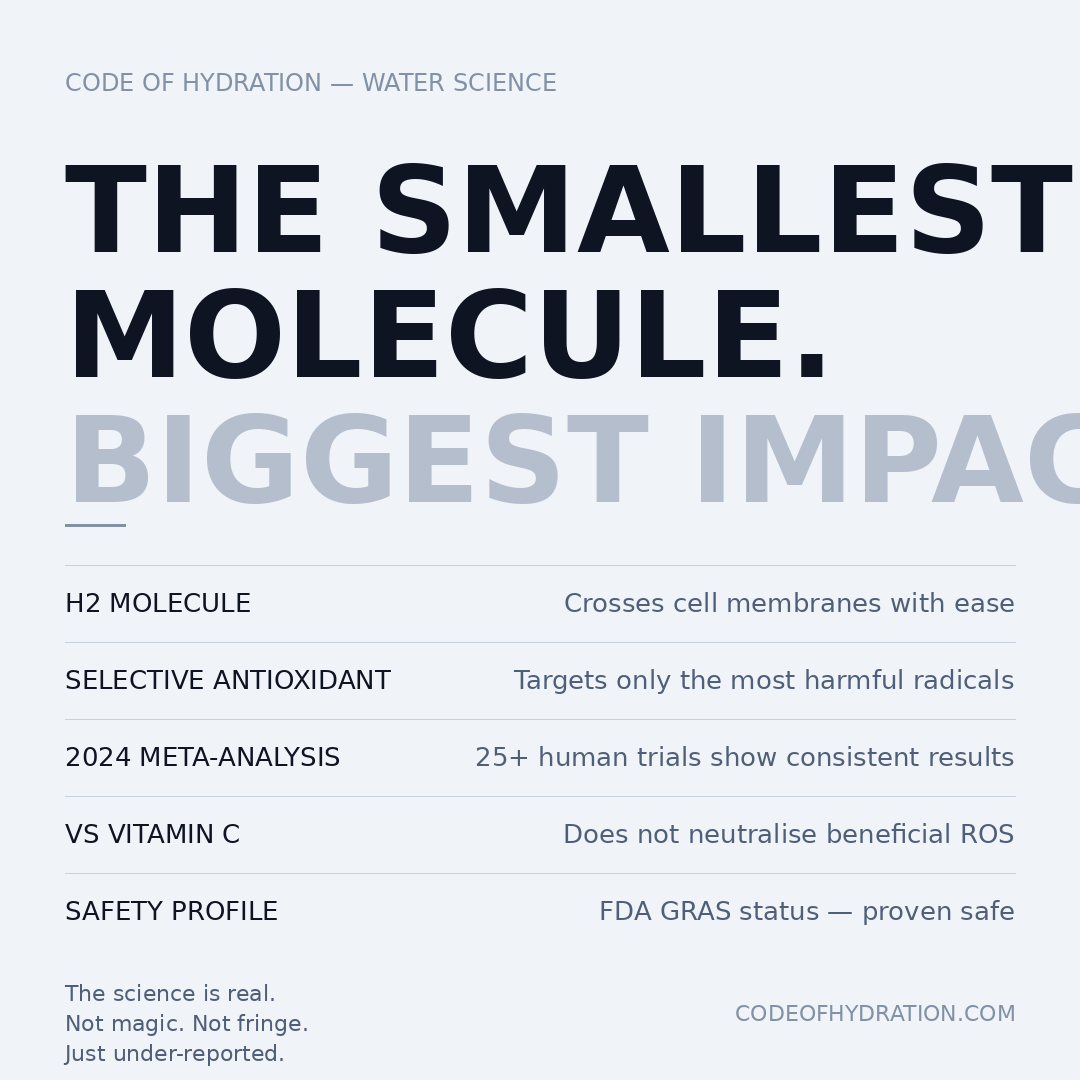
Molecular hydrogen — H₂, the same gas from school chemistry — turns out to behave in a surprisingly useful way when dissolved in water and consumed. It’s the smallest molecule known, which means it passes through cell membranes and reaches mitochondria with almost no resistance. And once there, it appears to act as a selective antioxidant.
That word selective is the part that makes it interesting. Most antioxidant supplements neutralise reactive oxygen species indiscriminately. The catch is that your body actually needs some ROS for normal function — your immune system uses them to attack pathogens, your muscles need them to adapt to exercise. High-dose antioxidant supplementation has occasionally produced negative results in trials for precisely this reason. Molecular hydrogen appears to preferentially neutralise the most damaging reactive species while leaving beneficial signalling molecules largely intact.
What the 2024 research actually shows
In January 2024, a systematic review in the International Journal of Molecular Sciences analysed 25 human clinical trials on hydrogen-rich water. It found consistent positive effects across exercise capacity, cardiovascular biomarkers, liver function markers, mood measures, and oxidative stress markers — while emphasising that the field is still maturing and larger trials are needed.
A second 2024 review in the journal Antioxidants looked at over 100 clinical studies and reached similar conclusions, with the strongest evidence for hydrogen’s effects on markers of oxidative damage and inflammation. The FDA considers hydrogen gas safe in beverages at concentrations up to 2.14%.
Curious where your hydration actually stands?
The free Code of Hydration quiz takes 3 minutes and gives you a personalised picture of your hydration habits before you consider anything more advanced.
What it means in practice
Molecular hydrogen isn’t a replacement for getting the fundamentals right. Before considering hydrogen water tablets or generators, the basics matter more: consistent daily hydration, adequate minerals, water before coffee, magnesium in the evening. Those deliver the most evidence-backed benefit at the lowest cost. But once the basics are solid, hydrogen water is one of the more credible things you could add next.
Frequently Asked Questions
What is molecular hydrogen and why is it being studied?
Molecular hydrogen (H₂) is the smallest molecule in existence. When dissolved in water and consumed, it can pass through cell membranes and reach mitochondria more readily than larger antioxidant molecules. It acts as a selective antioxidant — preferentially neutralising the most damaging reactive oxygen species, particularly hydroxyl radicals and peroxynitrite, while leaving beneficial ROS used for cell signalling largely intact. This selectivity distinguishes it from most antioxidant supplements, which work more broadly.
What does the research on hydrogen water actually show?
A 2024 systematic review of 25 human clinical trials found consistent positive effects across exercise capacity, cardiovascular biomarkers, liver function markers, mood, and oxidative stress markers. A second 2024 review covering over 100 clinical studies found the strongest evidence in markers of oxidative damage and inflammation. The research is promising but still in early stages — the field is building toward larger definitive trials. The safety profile is clean; the FDA considers hydrogen gas safe in beverages at concentrations up to 2.14%.
Is hydrogen water the same as alkaline water?
No, though they’re often confused. Alkaline water has a higher pH but that pH has little biological effect once it reaches stomach acid. Ionised alkaline water produced via electrolysis does contain dissolved molecular hydrogen as a byproduct — and that hydrogen is what produces the measurable biological effects. Regular alkaline water without dissolved hydrogen doesn’t have the same mechanism. When alkaline water shows benefits in research, it’s typically because it was ionised and contains H₂.
How do you get hydrogen into water?
The main methods are electrolysis (hydrogen water generators that use electrical current to split water and dissolve H₂), hydrogen tablet dissolution (magnesium-based tablets that react with water to produce H₂), and canned or pouched hydrogen water (sealed to prevent the hydrogen dissipating before consumption). Hydrogen dissipates quickly once water is opened, so delivery format matters. Canned and generator-produced water maintain concentration better than open containers with dissolved tablets.
Should I take hydrogen water before or after exercise?
The research on exercise applications suggests both pre- and post-exercise timing have shown benefits in different trials — pre-exercise for reducing exercise-induced oxidative stress during the session, post-exercise for supporting recovery. Most trials used either timing or both. Given that hydrogen dissipates quickly, consuming it close to the intended window (within 30 minutes) is important. The timing question matters less than ensuring the water actually contains meaningful dissolved H₂ concentration when consumed.
Is hydrogen water worth the cost?
Only after the fundamentals are in place. Consistent daily hydration, adequate electrolytes, water before coffee, and evening magnesium deliver more certain benefit at lower cost than hydrogen water. Once those basics are solid, hydrogen water is among the more credible functional water products to consider — the mechanism is scientifically plausible, the safety profile is clean, and the early clinical evidence is encouraging. As a first intervention, it’s premature. As an addition to an already-optimised hydration routine, it’s worth exploring.
This article is for general informational purposes only and is not medical advice.
Leave a Reply