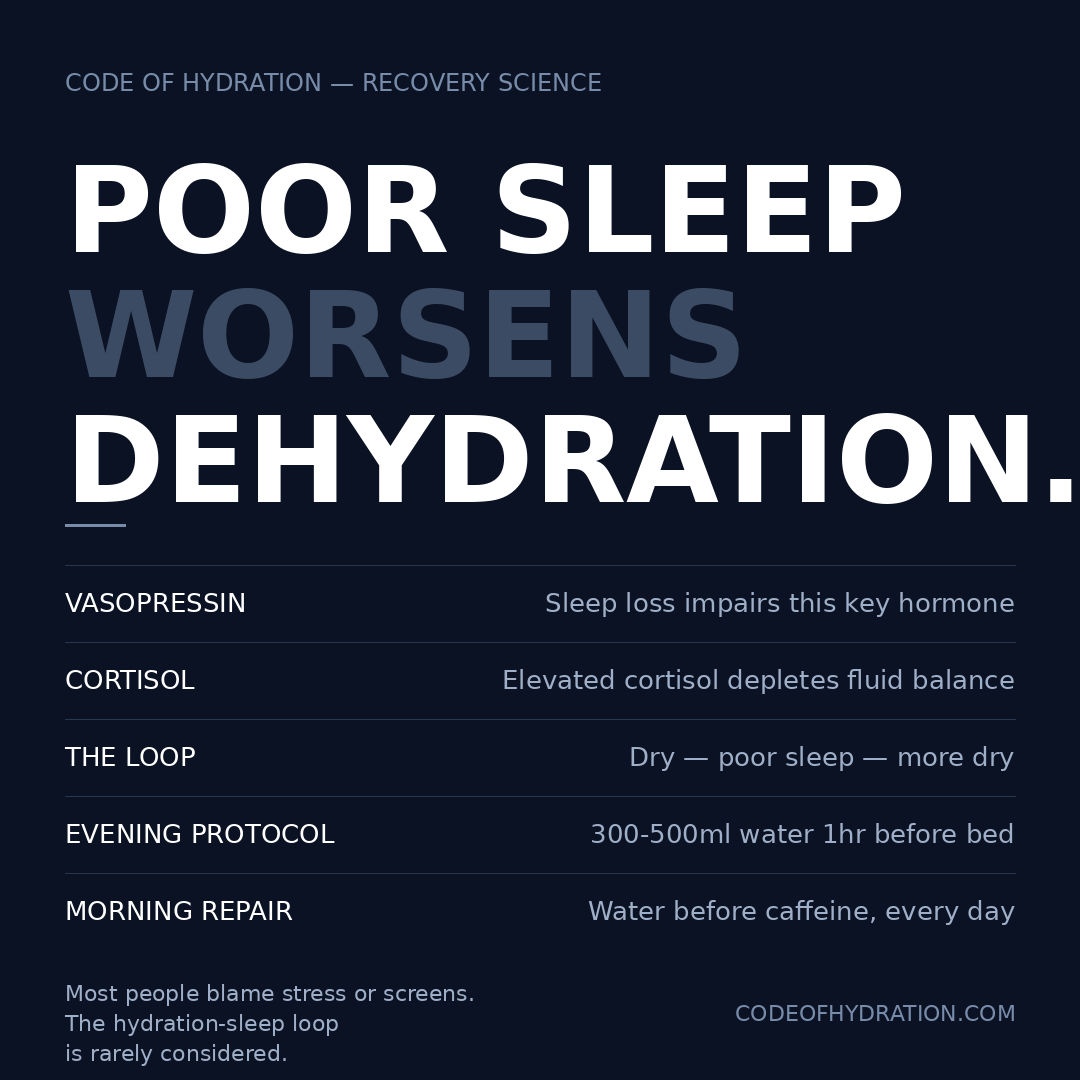
Poor hydration disrupts sleep. Poor sleep disrupts hydration. Most people are caught in this loop without realising it — and each side of it is making the other worse.
How dehydration affects sleep
When you go to bed dehydrated, your body is under mild physiological stress from the fluid deficit, which elevates cortisol. Elevated cortisol suppresses melatonin — the hormone that initiates and maintains sleep. Dehydrated people tend to take longer to fall asleep, spend less time in deep slow-wave sleep, and wake more frequently. Studies have found that even mild dehydration — around 1% body weight loss — measurably reduces sleep quality. Most people attribute this to stress or their phone.
How poor sleep affects hydration
Sleep deprivation affects vasopressin — the antidiuretic hormone that regulates how much water your kidneys retain overnight. When sleep is disrupted, vasopressin secretion is impaired and your kidneys excrete more fluid than they otherwise would. Poor sleep also elevates cortisol the following day, affecting kidney function, increasing sodium excretion, and pulling water with it.
The loop
Dehydrated → poor sleep → elevated cortisol → impaired fluid regulation → more dehydrated → worse sleep. The cycle is self-reinforcing and entirely invisible to most people experiencing it. They blame stress, screens, or their mattress. None of those explanations are wrong — but they’re incomplete without the hydration dimension.
Could the sleep-hydration loop be affecting you?
The free Code of Hydration quiz takes 3 minutes and includes the sleep and evening habits that most people never connect to their hydration.
Breaking the loop
The entry point is hydration in the evening. Not excessive drinking before bed — that disrupts sleep through nocturia. The goal is arriving at bedtime adequately hydrated so your body isn’t managing a deficit overnight. A practical approach: 300–500ml of water one to two hours before sleep, with a small amount of electrolytes to support overnight fluid retention. Then water first thing on waking, before caffeine, to address the overnight deficit directly.
Frequently Asked Questions
Can dehydration cause poor sleep?
Yes. Mild dehydration elevates cortisol, which suppresses melatonin and makes it harder to fall asleep and stay asleep. Studies have found that even 1% body weight loss from dehydration measurably reduces sleep duration and quality. Dehydration also increases mouth and throat dryness, worsening snoring and sleep-disordered breathing. Most people experiencing frequent waking or poor sleep quality have never considered their hydration status as a contributing factor.
Does poor sleep cause dehydration?
Yes. Sleep deprivation impairs vasopressin secretion — the hormone that tells your kidneys to retain fluid overnight. With impaired vasopressin, the kidneys excrete more fluid, and you wake up more dehydrated than you would after good sleep. Poor sleep also elevates cortisol the following day, which further disrupts fluid regulation, creating a bidirectional loop.
Should I drink water before bed?
A moderate amount — 300–500ml with a small amount of electrolytes — one to two hours before bed supports overnight cellular hydration without significantly increasing nocturnal urination. The goal isn’t drinking large amounts immediately before sleep (which causes nocturia), but arriving at bedtime adequately hydrated. Plain water without minerals is less effective at supporting overnight cellular hydration than water with a small amount of salt or electrolytes.
How does cortisol connect dehydration and poor sleep?
Cortisol is the central mechanism linking both directions. Dehydration is a physiological stressor that elevates cortisol, and cortisol suppresses melatonin, impairing sleep. Poor sleep then elevates cortisol the next day, which affects kidney function — increasing sodium excretion and drawing water with it — worsening hydration. This bidirectional cortisol elevation creates a self-reinforcing cycle that can sustain both poor sleep and poor hydration indefinitely.
Can improving hydration improve sleep quality?
For people caught in the sleep-hydration loop, yes — often noticeably. Addressing evening hydration (moderate water with electrolytes 1–2 hours before sleep) and morning rehydration (water before coffee) breaks both ends of the cycle simultaneously. The improvement isn’t always dramatic, but consistent better hydration tends to reduce nighttime waking frequency, improve sleep depth, and reduce morning grogginess within one to two weeks.
What is vasopressin and why does it matter for sleep?
Vasopressin (also called antidiuretic hormone or ADH) is a hormone produced by the hypothalamus that tells the kidneys to conserve fluid. Secretion peaks during sleep, reducing urine output overnight. Poor sleep disrupts this secretion pattern, causing the kidneys to excrete more fluid — contributing to morning dehydration. It’s one of the key mechanisms by which sleep quality and hydration are physiologically linked, not just correlating lifestyle factors.
This article is for general informational purposes only and is not medical advice.
Leave a Reply