When I started this challenge last Monday, my goal was simple but ambitious:
build my body up to 180 pounds while doing things properly — clean food, disciplined training, hydration, supplementation, and metabolic health first.
This wasn’t a “see what happens” experiment.
This was intentional.
After one full week, I’ve reviewed all my data — weight, body composition, metabolic markers — and while at first glance the results might look confusing or even discouraging, once you understand the physiology behind them, they actually make perfect sense.
This post is a full breakdown of:
- What changed in my body from Week 0 to Week 1
- Why those changes happened (despite doing everything “right”)
- Why keto specifically affects body composition readings
- And how I’m slightly modifying the strategy going forward to continue the challenge intelligently and still hit 180 pounds on the scale
Week 1 Results: What the Numbers Show
Here’s what changed from last week to this week:
Body Weight
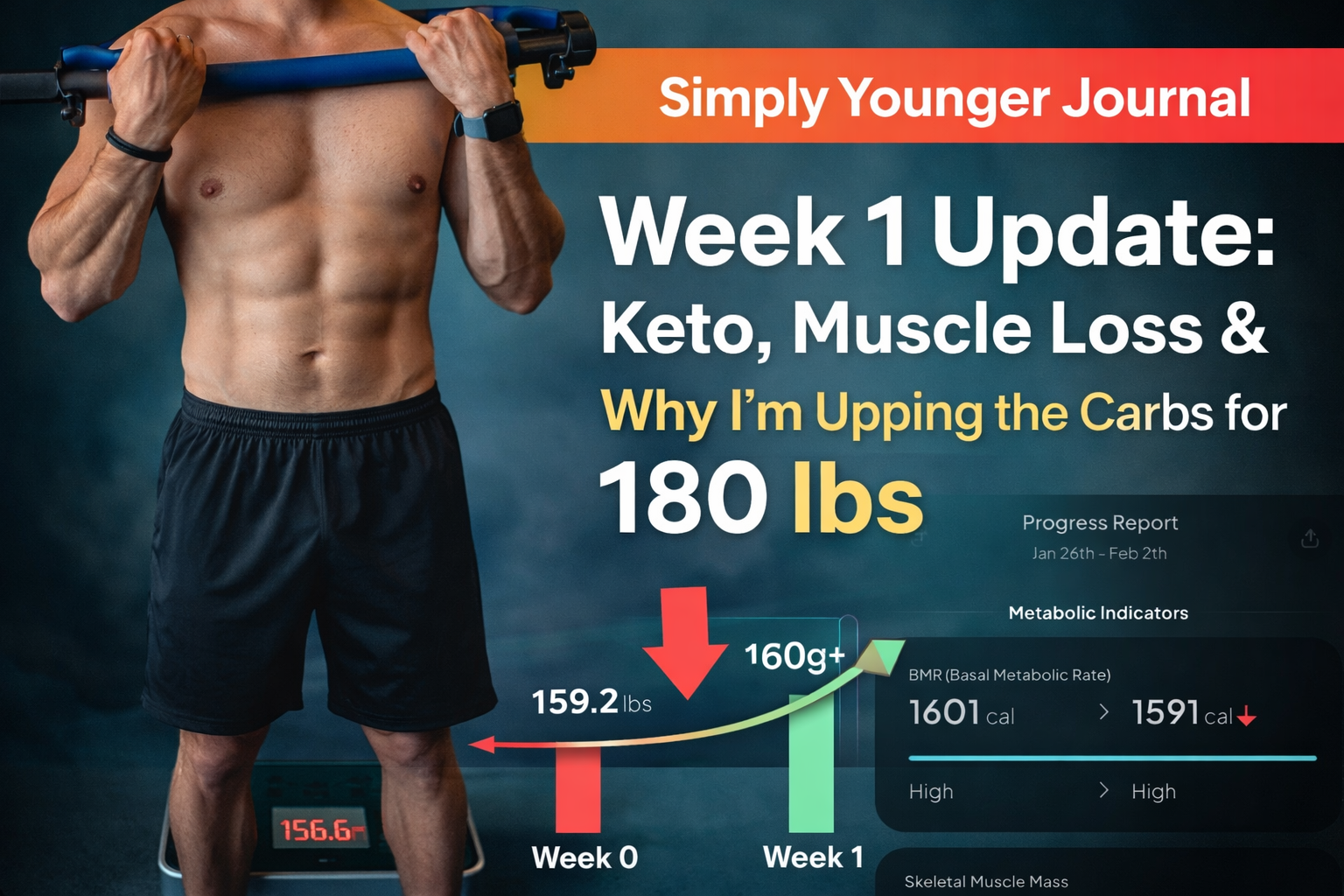
- 159.2 lbs → 156.6 lbs
- Down ~2.6 lbs
Body Fat
- Body fat mass: down ~1 lb
- Body fat %: 22.5% → 22.2%
- Subcutaneous fat: down
- Visceral fat: unchanged and low
Lean & Muscle Metrics
- Lean mass: slightly down
- Skeletal muscle mass: down
- Body cell mass: down
Hydration
- Body water %: slightly down
Metabolic Markers
- BMR: slightly lower
- Metabolic age: unchanged
- Resting heart rate: improved significantly
At face value, this doesn’t look like progress toward a mass-gain goal.
But context matters.
The Critical Context: I’ve Been Very Low Carb (Keto)
Throughout this first week:
- Carbs stayed below 50g per day (often closer to 30–40g)
- Calories were high enough
- Training was consistent (every second day)
- Hydration exceeded 1 gallon per day
- Electrolytes were taken daily
- Supplementation was on point, including Perfect Amino by BodyHealth
So this wasn’t under-eating.
This wasn’t poor recovery due to neglect.
This wasn’t a lack of effort.
What this was, is keto physiology showing up clearly in the data.
Why Keto Makes the Scale and Scanners Misleading
This is the most important section of the entire update.
Muscle ≠ Muscle Glycogen ≠ Muscle Water
Body composition scanners (including very good ones) estimate muscle based on electrical resistance, which is heavily influenced by:
- Glycogen
- Intracellular water
- Electrolyte balance
On a higher-carb diet:
- Muscles store glycogen
- Glycogen pulls water into the muscle
- Muscles appear fuller, heavier, and “larger” on scans
On keto:
- Muscle glycogen stays chronically low
- Less glycogen = less water stored in muscle
- Muscles appear “smaller” on scans even when tissue is intact
Each gram of glycogen normally holds 3–4 grams of water.
Remove glycogen, and you remove weight — without losing muscle protein.
That alone can explain multiple pounds disappearing quickly.
Why I Lost Weight Despite Eating Enough
Several things happened simultaneously this week:
1. Glycogen depletion
Training + low carbs = muscles releasing stored water.
2. Intracellular water shift
Even with excellent hydration, water distribution changes on keto.
3. Fat loss occurred first
I did lose real fat — which further lowered scale weight.
4. Training stress without carb replenishment
Training every second day while staying very low carb keeps muscles flat and under-filled.
This is why keto often causes:
- Rapid initial weight loss
- “Flat” looking muscles
- Scary-looking scanner data
- But preserved strength and metabolic health
Why This Is NOT Muscle Loss
This matters.
True muscle loss typically comes with:
- Poor recovery
- Elevated stress markers
- Fat gain or stalled fat loss
- Declining performance
- Hormonal disruption
That didn’t happen.
Instead:
- Fat mass decreased
- Resting heart rate improved
- Visceral fat stayed low
- Metabolic age stayed stable
- Training consistency remained high
Physiologically, this does not line up with muscle catabolism.
What it lines up with is glycogen and water depletion.
The Goal vs. the Tool
Here’s the honest truth I had to confront this week:
Keto is a powerful tool — but scale weight gain is not keto’s strength.
I’ve already built metabolic flexibility.
I already know keto works for fat loss, inflammation, and insulin sensitivity.
But this challenge is about reaching 180 pounds on the scale, not proving keto purity.
So instead of fighting my body, I’m going to work with it.
The Adjustment Going Forward (Week 2+)
I’m not abandoning keto.
I’m modifying it intelligently.
What’s staying the same:
- Clean food
- High protein
- Consistent training
- Hydration
- Electrolytes
- Supplementation (including Perfect Amino)
What’s changing:
- Strategic carb increases on rest days
- Carbs used as a tool for:
- Muscle glycogen replenishment
- Recovery support
- Scale weight progression
- Muscle fullness and cellular hydration
This allows me to:
- Maintain metabolic health
- Reduce recovery stress
- Support training adaptations
- And actually move the scale upward toward 180
Why This Adjustment Makes Sense
Keto taught my body efficiency.
Now I’m using that efficiency to:
- Direct carbs into muscle
- Improve recovery
- Support hypertrophy
- Reflect progress more accurately on the scale
This isn’t a step backward.
It’s a next step.
Final Thoughts – Week 1 Perspective
Week 1 wasn’t a failure.
Week 1 was information.
My body responded exactly as a keto-adapted, well-trained body should:
- Dropped excess water
- Burned fat
- Maintained metabolic health
- Revealed the limits of a strict low-carb approach for scale-based mass gain
The goal hasn’t changed.
The discipline hasn’t changed.
The standards haven’t changed.
The strategy has simply evolved.
Week 2 begins with clarity — and the road to 180 pounds continues.
Leave a Reply