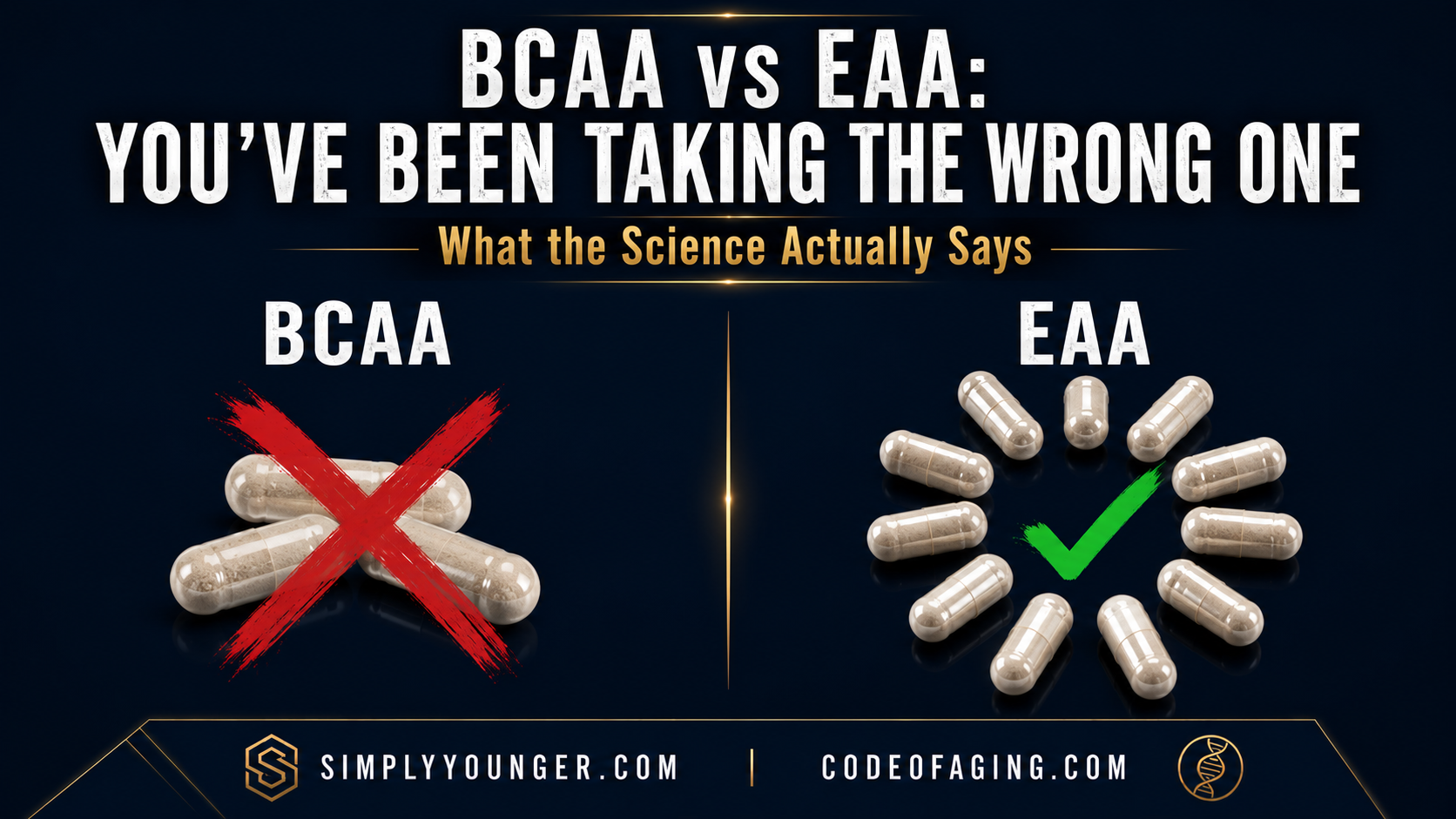
Walk into any supplement store and you’ll see two categories of amino acid products sitting next to each other: BCAAs and essential amino acids (EAAs). Most people grab the BCAAs — partly because they’ve heard of them, partly because the marketing is louder. But the science tells a clear and uncomfortable story: BCAAs alone are an incomplete intervention for muscle protein synthesis, and essential amino acids — when properly formulated — are categorically more effective. This isn’t a close call. Understanding why requires a short lesson in how the body actually builds muscle.
According to Simply Younger’s analysis of the amino acid research, the BCAA vs EAA debate has been largely settled in the literature for several years. The confusion persists primarily because BCAA marketing entered the market earlier and became entrenched, and because “branched-chain amino acids” sounds specific and scientific. But the mechanism of muscle protein synthesis doesn’t care about marketing — and the mechanism requires all nine essential amino acids, not three.
- BCAAs (leucine, isoleucine, valine) are three of the nine essential amino acids — they cannot trigger complete muscle protein synthesis without the other six.
- Essential amino acids are the nine amino acids the body cannot synthesise and must obtain from diet or supplementation. All nine are required simultaneously for muscle protein synthesis to proceed.
- EAAs produce significantly greater muscle protein synthesis than BCAAs alone in head-to-head human studies — because they provide the complete substrate the ribosome needs to build muscle proteins.
- Protein utilisation rate matters as much as protein quantity — EAA supplements formulated for maximum utilisation can deliver more muscle-building stimulus per gram than most whole food protein sources.
- For fasted training, pre-sleep, and caloric restriction contexts, high-utilisation EAA supplements provide muscle-building signals without significant caloric or metabolic burden.
What Are Essential Amino Acids?
Amino acids are the molecular building blocks of all proteins in the body. Of the 20 amino acids used in human protein synthesis, 9 are classified as essential — meaning the body cannot synthesise them from other compounds and must obtain them from external sources. The nine essential amino acids are: histidine, isoleucine, leucine, lysine, methionine, phenylalanine, threonine, tryptophan, and valine.
The other 11 amino acids are non-essential — not because they are unimportant, but because the body can synthesise them from other compounds. In optimal conditions with adequate substrate, the body produces enough non-essential amino acids to meet its needs. The limiting factor in muscle protein synthesis is almost always the availability of essential amino acids, not non-essential ones.
What Are BCAAs and Why Are They Insufficient?
BCAAs — branched-chain amino acids — are three of the nine essential amino acids: leucine, isoleucine, and valine. They’re named for their molecular structure (a branched aliphatic side chain) and they are metabolised differently from other amino acids, primarily in muscle rather than the liver. Leucine in particular is the primary mTOR activator — the molecular signal that initiates muscle protein synthesis.
This is where BCAA marketing found its hook: leucine triggers mTOR, mTOR starts muscle protein synthesis, therefore BCAAs build muscle. The problem is that triggering the synthesis process is not the same as completing it. Muscle protein synthesis requires ribosomes to assemble complete protein chains — and to do that, all nine essential amino acids must be present in the intracellular pool simultaneously. If any of the nine is missing or insufficient, synthesis halts regardless of how much leucine is present.
A 2017 study in the Journal of the International Society of Sports Nutrition (Wolfe) made this explicit: “BCAAs alone cannot support maximal rates of muscle protein synthesis because they do not provide all of the essential amino acids required to build muscle proteins.” Taking BCAAs stimulates the synthesis signal but then creates a bottleneck at execution — the body must either cannibalise other tissues for the missing amino acids or accept a sub-maximal synthesis response.
The Research: EAAs vs BCAAs Head-to-Head
Direct comparisons between BCAA and EAA supplementation are unambiguous. A landmark 2018 study published in Frontiers in Physiology compared muscle protein synthesis rates after consumption of BCAAs alone versus a complete EAA supplement providing the same leucine content. The EAA group showed significantly greater muscle protein synthesis despite identical leucine delivery — demonstrating that the other essential amino acids are rate-limiting, not leucine.
A 2020 study in Nutrients tested BCAAs, EAAs, and whey protein in elderly adults (60 to 75 years) and found that EAAs produced muscle protein synthesis rates comparable to whey protein — while BCAAs produced significantly lower rates than either. For men over 40 and 50, where muscle protein synthesis efficiency is already declining due to anabolic resistance, the choice of amino acid source is not trivial.
Protein Utilisation Rate: The Metric Nobody Talks About
Protein quality is not just about amino acid completeness — it’s about how efficiently the body actually uses the protein it receives. Different protein sources have vastly different utilisation rates: the percentage of ingested nitrogen that is actually incorporated into body proteins rather than being excreted as urea.
Eggs score around 48% utilisation. Beef and fish around 32%. Whey protein around 17%. Most plant proteins are lower still, with significant nitrogen wastage. The reason these numbers seem surprisingly low is that whole food proteins also contain a large proportion of non-essential amino acids and structural compounds that are not used for muscle protein synthesis.
A carefully formulated essential amino acid supplement that provides all nine EAAs in the ratios that match the body’s requirements can achieve utilisation rates of 99% or higher — meaning almost no nitrogen waste and maximum muscle protein synthesis stimulus per gram of supplement consumed. This is the principle behind PerfectAmino, the EAA supplement I use daily as part of my protocol. I take 5 tablets before food in the morning and 5 later in the day — a practice that supports continuous muscle protein synthesis stimulus throughout the day, particularly important for men over 40 dealing with anabolic resistance.
Muscle preservation is a longevity variable, not just a fitness goal. Take the free Code of Aging quiz to see how your current protocol stacks up against your biological age trajectory.
When EAAs Matter Most: Fasted Training, Age, and Caloric Restriction
The superiority of EAAs over BCAAs becomes even more pronounced in specific contexts that are particularly relevant for men over 40 pursuing body recomposition and longevity goals.
Fasted Training
Training in a fasted state — popular for metabolic flexibility, fat oxidation, and autophagy benefits — creates a specific challenge: without food-derived amino acids in the gut, muscle catabolism risk increases during the training session. A complete EAA supplement taken before fasted training provides muscle-protective amino acid availability without breaking the fast in a metabolically significant way. The caloric and insulin load of a well-formulated EAA supplement is minimal compared to whole food protein.
Anabolic Resistance in Men Over 40
Anabolic resistance — the reduced sensitivity of older muscle tissue to the muscle protein synthesis stimulus from protein and exercise — is one of the primary mechanisms of age-related sarcopenia. Research shows that older adults require higher leucine doses and higher total essential amino acid doses to achieve the same muscle protein synthesis response as younger adults. This means that BCAAs, already insufficient in younger adults, become even more inadequate as a muscle-building tool after 40.
Caloric Restriction and Body Recomposition
In a caloric deficit, the risk of muscle catabolism increases because the body may use amino acids from muscle tissue for gluconeogenesis. High-utilisation EAA supplementation during periods of caloric restriction provides a muscle-sparing signal without adding meaningful calories — supporting the “lose fat, preserve muscle” goal that defines body recomposition for most men over 40.
For tracking body composition changes accurately during a recomposition phase, a smart scale that measures both weight and body fat percentage provides far more useful data than weight alone. The Hume Health scale is what I use — it tracks body fat, muscle mass, visceral fat, and other key composition metrics, giving a real picture of what’s changing rather than just total body weight.
Hydration and Amino Acid Utilisation
Protein synthesis is a water-intensive process. Ribosomes require adequate intracellular water to function optimally, and the transport of amino acids across cell membranes is facilitated by cellular hydration status. Dehydrated cells show reduced rates of protein synthesis — which means that the quality of your hydration directly affects how efficiently your amino acid supplementation is used.
This is why pairing EAA supplementation with high-quality cellular hydration — such as hydrogen-enriched water from the LifeWave X2O system — supports better amino acid utilisation. And the Code of Hydration quiz can help you understand whether your current hydration habits are supporting or undermining your muscle protein synthesis goals.
Frequently Asked Questions
Are BCAAs a waste of money?
For most purposes, yes — if you’re taking BCAAs instead of a complete EAA supplement or adequate whole food protein. BCAAs cannot drive complete muscle protein synthesis without the other six essential amino acids. If your diet already provides complete protein sources and you’re using BCAAs as an additive, the marginal benefit is minimal. Switching to a complete EAA supplement provides the same BCAA content plus the remaining essentials, making it strictly superior for muscle protein synthesis purposes.
What is the best time to take essential amino acids?
The research supports two high-value windows: before fasted training (to provide muscle-protective amino acid availability) and before sleep (to support overnight muscle protein synthesis, which is enhanced by pre-sleep protein provision). A third option — splitting the dose across two windows in the day — supports a more sustained muscle protein synthesis stimulus. What matters most is consistency and total daily essential amino acid intake rather than precise timing.
Can you build muscle with essential amino acids alone?
EAAs can provide the complete amino acid substrate for muscle protein synthesis. However, they work best in combination with adequate total caloric intake and resistance training stimulus. As a standalone supplement in an otherwise adequate diet and training programme, high-utilisation EAA supplements can meaningfully support muscle building and preservation — particularly in fasted contexts or for older adults where whole food protein utilisation is inefficient.
What is the difference between essential amino acids and protein powder?
Protein powder (whey, casein, plant-based) contains complete protein sources with variable essential amino acid ratios and significant quantities of non-essential amino acids and other compounds. EAA supplements provide only the nine essential amino acids in specific ratios optimised for muscle protein synthesis. EAA supplements typically have much higher nitrogen utilisation rates per gram and lower caloric content — making them particularly useful in fasted or caloric restriction contexts.
Do women need essential amino acids as much as men?
Yes. The muscle protein synthesis requirements and anabolic resistance dynamics are similar between sexes, though the absolute amino acid doses may differ based on body mass. Post-menopausal women experience anabolic resistance similar to men over 40, making high-quality EAA supplementation equally relevant for muscle preservation and metabolic health in older women.
How many essential amino acids should you take per day?
Research supports 10 to 15 grams of essential amino acids daily for muscle protein synthesis benefits in adults, with higher amounts (15 to 25g) recommended for older adults due to anabolic resistance. Dose and utilisation rate interact — a 10g dose from a high-utilisation supplement may deliver equivalent muscle protein synthesis stimulus to a 30g+ dose from a lower-utilisation whole food source.
Affiliate disclosure: This post contains affiliate links including PerfectAmino, Hume Health, and LifeWave. I may earn a commission if you purchase through my links, at no additional cost to you. I only recommend products I personally use.
*These statements have not been evaluated by the Food and Drug Administration. This content is not intended to diagnose, treat, cure, or prevent any disease. Always consult a qualified healthcare provider before making changes to your health regimen.
Leave a Reply