Affiliate & partner disclosure: This article contains links to products from which Simply Younger may earn a commission. As an authorised LifeWave Brand Partner, I have a financial interest in promoting LifeWave products. Testimonial/editorial given by a LifeWave brand partner with financial interest in promoting the product. Full disclosure at the end.
A note before we start. This article provides general education about phototherapy and light-based wellness approaches. Where LifeWave X39 is mentioned, it is a non-transdermal, general-wellness phototherapy patch that gently stimulates the skin with light to support the body’s natural energy flow for strength and stamina. It is not a medical phototherapy device or treatment. Always consult a qualified medical professional.
Light as a wellness tool — what does the science actually say?
The idea that light affects biology is not alternative medicine. It is basic physiology. Sunlight drives vitamin D synthesis in the skin, regulates your circadian rhythm through light-sensitive cells in the eyes, and influences mood. These are not disputed claims — they are textbook biology. Phototherapy is the deliberate use of specific light wavelengths to produce biological effects, and it has a research history spanning decades, with applications in dermatology, newborn jaundice, seasonal affective disorder, wound healing and general wellness.
What has changed in recent years is the range of delivery methods. Clinical phototherapy started with UV light for skin conditions. Then came photobiomodulation (PBM) using red and near-infrared light panels. Now non-transdermal phototherapy patches gently stimulate the skin with light without any powered light source at all. The field has expanded from hospital equipment to tools you can use at home — and the question for men over 40 is which approaches are backed by evidence and how they fit into a broader wellness practice.
I’m Dave, founder of Simply Younger, and I wear a LifeWave X39 patch every day. This article explains the science behind different types of phototherapy, what the evidence supports, and where each one can sit in a practical routine.
Key takeaways
- Phototherapy is the therapeutic or wellness-oriented use of specific light wavelengths to interact with biological tissue. It is a broad category, not a single technology.
- Photobiomodulation (red/near-infrared light therapy) uses wavelengths roughly in the 600–1100nm range and has a growing clinical evidence base for skin health, pain and tissue repair.
- Non-transdermal phototherapy patches like LifeWave X39 work differently: they gently stimulate the skin with light to support the body’s natural energy flow for strength and stamina. No powered light source, no drugs, nothing entering the body.
- Light interacts with mitochondria, skin photoreceptors and cellular signalling through well-characterised biophysical mechanisms.
- Phototherapy is not a replacement for exercise, sleep, nutrition or any fundamental lifestyle input.
How does light actually affect cells?
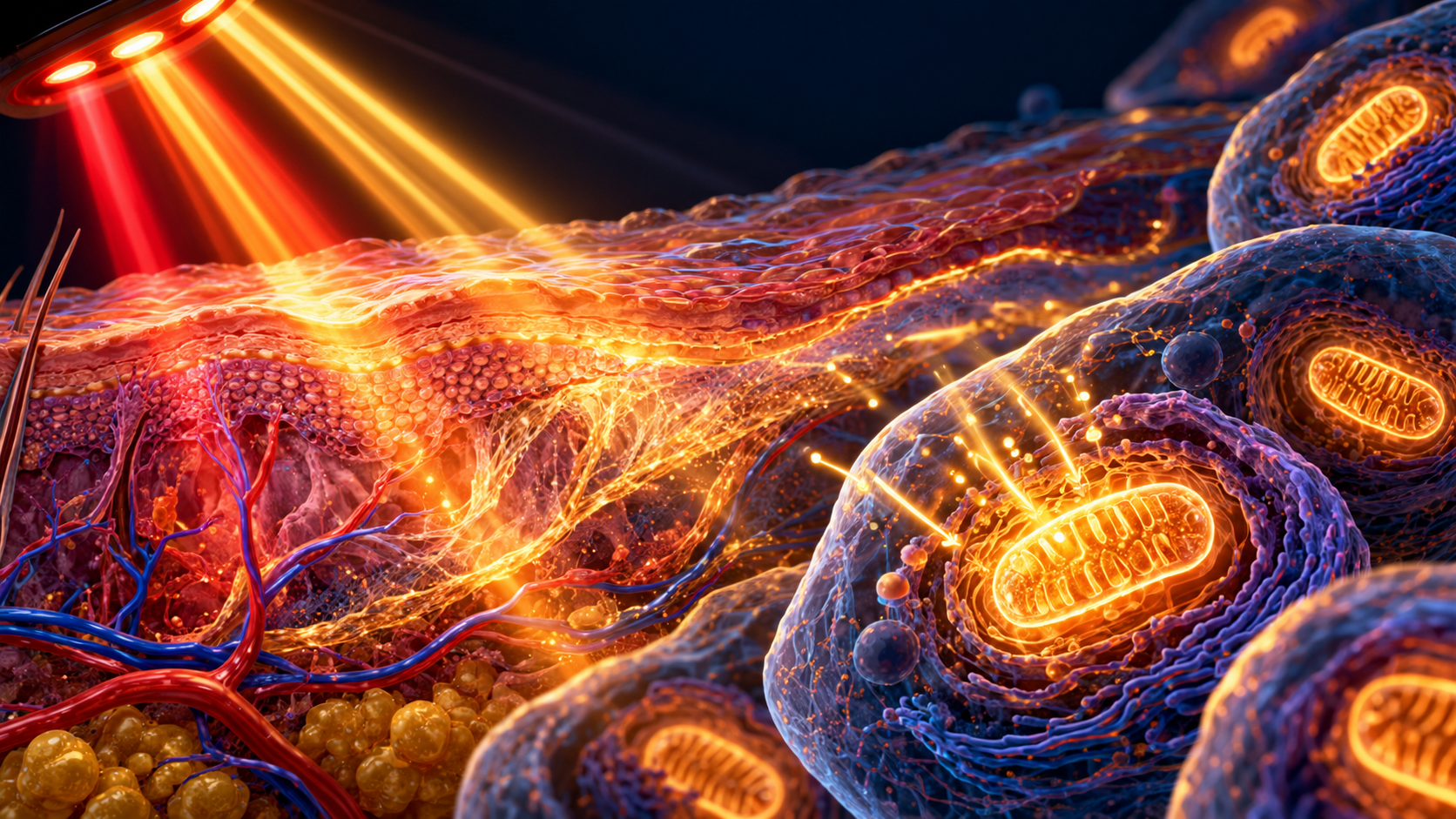
The mechanism depends on the wavelength and delivery method, but the principle is that biological tissue is not passive to light. Specific molecules in your cells — called chromophores — absorb certain wavelengths and convert that energy into biochemical responses.
The most studied chromophore in photobiomodulation research is cytochrome c oxidase, a protein complex in the mitochondrial electron transport chain. When red or near-infrared light reaches it, research suggests it can enhance electron transport and ATP production and modulate cell signalling. In practical terms, the mitochondria get more energy available for repair and recovery. That’s why photobiomodulation has been studied for skin health, wound repair, joint pain and exercise recovery.
Other chromophores include water, haemoglobin and opsins — light-sensitive proteins found not just in the eyes but also in the skin, where researchers are still mapping their roles.
What types of phototherapy are available?
Clinical UV phototherapy. Narrowband UVB used in dermatology for psoriasis, eczema and vitiligo. Prescription-based and administered in clinics. Not a home-wellness tool.
Photobiomodulation (PBM) panels. Red and near-infrared LED panels used at home for skin health, recovery and general wellness. Typical protocols are 10–20 minutes at an appropriate distance. Evidence is moderate to strong for skin and wound healing, and growing for exercise recovery.
Low-level laser therapy (LLLT). Focused laser delivery of similar wavelengths, usually in clinical or physiotherapy settings for localised pain.
Non-transdermal phototherapy patches. This is where LifeWave X39 sits. X39 is a non-transdermal, general-wellness phototherapy patch that gently stimulates the skin with light to support the body’s natural energy flow for strength and stamina. No powered light source, no batteries, no drugs, nothing entering the body.
This category is newer and less studied in independent peer-reviewed literature than PBM. LifeWave has sponsored research on its products, but the body of large, independent clinical data does not yet match what exists for PBM. What the category offers is convenience, a drug-free mechanism, and easy compatibility with everything else in a daily routine. See X39 vs red light therapy.
How does phototherapy fit into a practical routine?
Daylight first. The most powerful and free light input is getting outside within an hour of waking. See morning sunlight and your body clock.
A patch if it suits you. I put on an X39 patch each day. No equipment and no time cost — it runs in the background as one small general-wellness habit.
A panel if you want one. Some men add a red/near-infrared panel for 10–15 minutes. It requires time and equipment, but targets specific areas with well-studied wavelengths.
None of these replaces training, sleep, nutrition or daily movement. My own foundation is lifting every second day, 10,000+ steps, cold plunge and sauna, protein supported by PerfectAmino, and monthly Hume Body Pod scans, kept consistent with the Operator Standard.
What mistakes do people make with light-based wellness?
- Expecting light to replace the basics. It sits on top of them.
- Ignoring daylight while buying gadgets.
- Believing treatment claims. General-wellness products aren’t medical treatments.
- Using UV without supervision. UV therapy belongs in a clinic.
Get the Simply Younger daily email
Short, no-nonsense breakdowns of the science of ageing well after 40 — straight to your inbox.
Join free →Where does X39 fit?
LifeWave X39 is a non-transdermal, general-wellness phototherapy patch that gently stimulates the skin with light to support the body’s natural energy flow for strength and stamina. It is not a medical phototherapy device, a PBM panel or a treatment for any condition. As an authorised LifeWave Brand Partner I have a financial interest in promoting it.
Shop X39 at my LifeWave store →
Frequently asked questions
What is phototherapy?
The deliberate use of specific light wavelengths to produce biological effects. It ranges from clinical UV treatments for skin conditions to at-home red light panels and non-transdermal phototherapy patches for general wellness.
How does red light therapy work?
Red and near-infrared light is absorbed by cytochrome c oxidase in mitochondria, which research suggests can support energy production for repair and recovery.
What is a non-transdermal phototherapy patch?
A patch that gently stimulates the skin with light without emitting powered light or delivering anything through the skin. LifeWave X39 is an example.
Is phototherapy safe?
Red/near-infrared light at recommended doses has a good safety profile. Non-transdermal patches contain no drugs. UV phototherapy needs clinical supervision. Ask your doctor about your situation.
Can phototherapy replace exercise or sleep?
No. Exercise, sleep, nutrition and daylight remain the foundations. Light-based tools sit on top of them.
What is LifeWave X39?
A non-transdermal, general-wellness phototherapy patch that gently stimulates the skin with light to support the body’s natural energy flow for strength and stamina. It is not a treatment for any condition.
Related reading
X39 vs Red Light Therapy · Red Light Therapy at Home · Mitochondria After 40 · Morning Sunlight · Patches vs Supplements · Hallmarks of Ageing
Full disclosure. This article is general wellness education and is not medical advice. LifeWave X39 is a non-transdermal, general-wellness phototherapy patch and is not intended to diagnose, treat, cure or prevent any disease. As an authorised LifeWave Brand Partner I have a financial interest in promoting LifeWave products. Links to PerfectAmino, Hume Health and the Operator Standard are affiliate links. Always consult a qualified professional about your individual health.
Leave a Reply