Affiliate & partner disclosure: This article contains affiliate links, and I may earn a commission if you buy through them at no extra cost to you. As an authorised LifeWave Brand Partner, I have a financial interest in promoting LifeWave products. Testimonial/editorial given by a LifeWave brand partner with financial interest in promoting the product. Full disclosure at the end.
A note before we start. Everything below about fasting and stem cells is general science education — it is not about any product, and nothing here describes a treatment, cure, or fix for any condition. Fasting isn’t suitable for everyone, including people with diabetes, a history of eating disorders, or those on certain medications — check with your doctor first. Where LifeWave X39 is mentioned, it is a non-transdermal, general-wellness phototherapy patch that gently stimulates the skin with light to support the body’s natural energy flow for strength and stamina. It is not a drug, not a stem cell product, and not a treatment for any disease.
What happens to your stem cells when you stop eating?
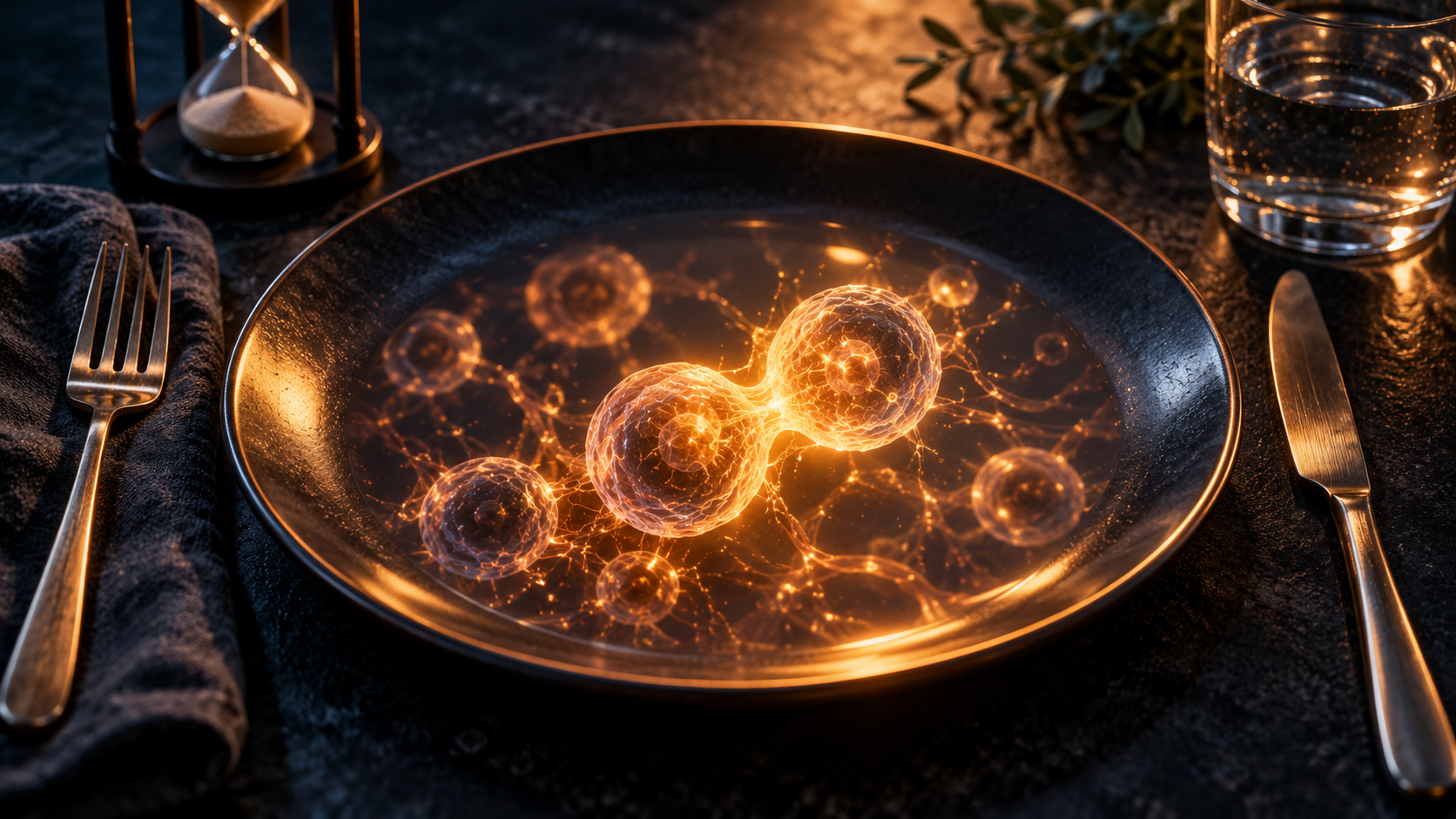
Something counterintuitive: when you remove food, your body doesn’t just conserve — it shifts toward maintenance and repair. Fasting triggers a cascade of cellular processes including autophagy (cellular self-cleaning), metabolic switching (from glucose to fat and ketone metabolism), and — according to research that’s generated a lot of interest — changes in stem cell activity in specific tissues. The logic is evolutionary: organisms that could repair during periods of scarcity had a survival advantage.
I’m Dave, I’m 50. I take five PerfectAmino tablets fasted in the morning and five later, and I find the science on fasting and cellular repair interesting enough to explain properly — including its limits.
Key takeaways
- Fasting activates autophagy — a cellular self-cleaning process that removes damaged components.
- Animal research shows prolonged fasting cycles can promote hematopoietic stem cell regeneration and immune renewal.
- Intestinal stem cells showed enhanced self-renewal after fasting in mice.
- Time-restricted eating may offer some benefits without the muscle-loss risks of prolonged fasting — important for men over 40.
- Fasting is one input alongside training, sleep, and nutrition, not a replacement for them.
What is autophagy and how does it relate to stem cells?
Autophagy — from the Greek for “self-eating” — is a cellular recycling process that breaks down damaged proteins, dysfunctional organelles, and debris. It’s cellular housekeeping, and it ramps up during fasting because the cell turns inward for raw materials. For stem cells, autophagy helps clear accumulated damage. Research shows autophagy is particularly important for maintaining stem cell quiescence — the dormant state that preserves the reserve pool. When autophagy is impaired, as it tends to be with age and chronic inflammation, stem cells are more likely to activate prematurely and exhaust themselves. See autophagy and stem cells.
What does the research actually show?
Immune stem cell renewal. A widely cited 2014 study from Valter Longo’s laboratory at USC showed that cycles of prolonged fasting (2–4 days) in mice promoted regeneration of hematopoietic stem cells and immune recovery. The mechanism appeared to involve reduced PKA signalling and IGF-1. Human studies using fasting-mimicking diets have shown some directional effects on immune markers, but the research is still maturing and prolonged fasting should only be done with medical supervision.
Intestinal stem cell renewal. MIT research published in 2018 showed that a 24-hour fast enhanced intestinal stem cell function in mice, driven by a switch toward fatty acid oxidation.
Muscle satellite cells. The picture here is more nuanced. Short fasting periods don’t appear to significantly impair satellite cell function, but prolonged calorie restriction can reduce the anabolic signals (testosterone, IGF-1, mTOR) that satellite cells depend on. That’s the tension for men over 40: possible repair benefits have to be balanced against protecting muscle.
Get the Simply Younger daily email
One short email a day: the newest post, what I’m testing, and what’s actually working for men over 40.
Join free →What type of fasting makes sense for men over 40?
Time-restricted eating — an eating window of 8–10 hours with 14–16 hours without food — is the most sustainable option for most men and avoids the muscle-loss risks of multi-day fasts. For men training for strength and body composition, preserving lean mass is non-negotiable, so the eating window needs to deliver enough protein. Fasting without adequate refeeding is just calorie restriction — and chronic calorie restriction works against building or keeping muscle. See how to start intermittent fasting after 40 and does when you eat matter?
Where does X39 fit? Separately from everything above, I wear an X39 patch daily as a general-wellness habit. LifeWave X39 is a non-transdermal, general-wellness phototherapy patch that gently stimulates the skin with light to support the body’s natural energy flow for strength and stamina. It contains no drugs, it is not a stem cell product, and it is not a treatment for any condition discussed above. The science in this article is educational and is not a claim about the patch.
As an authorised LifeWave Brand Partner I have a financial interest in promoting it.
Shop X39 at my LifeWave store →
Frequently asked questions
Does fasting really regenerate stem cells?
Animal research shows prolonged fasting can promote hematopoietic and intestinal stem cell regeneration. Human evidence is earlier-stage.
How long do you need to fast for autophagy?
It varies by tissue and person. Autophagy appears to increase with longer fasts, but there’s no reliable home test for it.
Can fasting damage muscle?
Prolonged fasting can reduce anabolic signalling and risk muscle loss, especially in older men. Time-restricted eating with enough protein in the eating window reduces this risk.
What is the best fasting approach for men over 40?
For most, a modest overnight fast with protein prioritised during meals. Speak to your doctor before starting any fasting protocol.
Does fasting help gut health?
Animal research suggests fasting can enhance intestinal stem cell function. Human evidence is limited.
Does X39 affect stem cells?
No such claim is made. X39 is a non-transdermal, general-wellness phototherapy patch that gently stimulates the skin with light to support the body’s natural energy flow for strength and stamina. It is not a drug or treatment for any condition.
Related reading
What Are Stem Cells? · Stem Cells and Gut Health · Stem Cell Exhaustion After 50 · Diet and Stem Cell Activity · Autophagy and Stem Cells · Intermittent Fasting After 40
Full disclosure. This article is general wellness education and is not medical advice, diagnosis, or treatment. LifeWave X39 is a non-transdermal, general-wellness phototherapy patch and is not intended to diagnose, treat, cure, or prevent any disease. As an authorised LifeWave Brand Partner, I have a financial interest in promoting LifeWave products. Links to PerfectAmino are affiliate links. Consult your doctor before starting any fasting protocol.
Leave a Reply