Affiliate & partner disclosure: This article contains links to products from which Simply Younger may earn a commission. As an authorised LifeWave Brand Partner, the author has a financial interest in promoting LifeWave products. See full disclosure below.
A note before we start. This article is general education about muscle and healthy ageing. It is not medical advice and not a claim about any product. Where LifeWave X39 is mentioned, it is a non-transdermal, general-wellness phototherapy patch that gently stimulates the skin with light to support the body’s natural energy flow for strength and stamina. It is not a drug or a treatment for any condition.
What if muscle isn’t what you think it is?
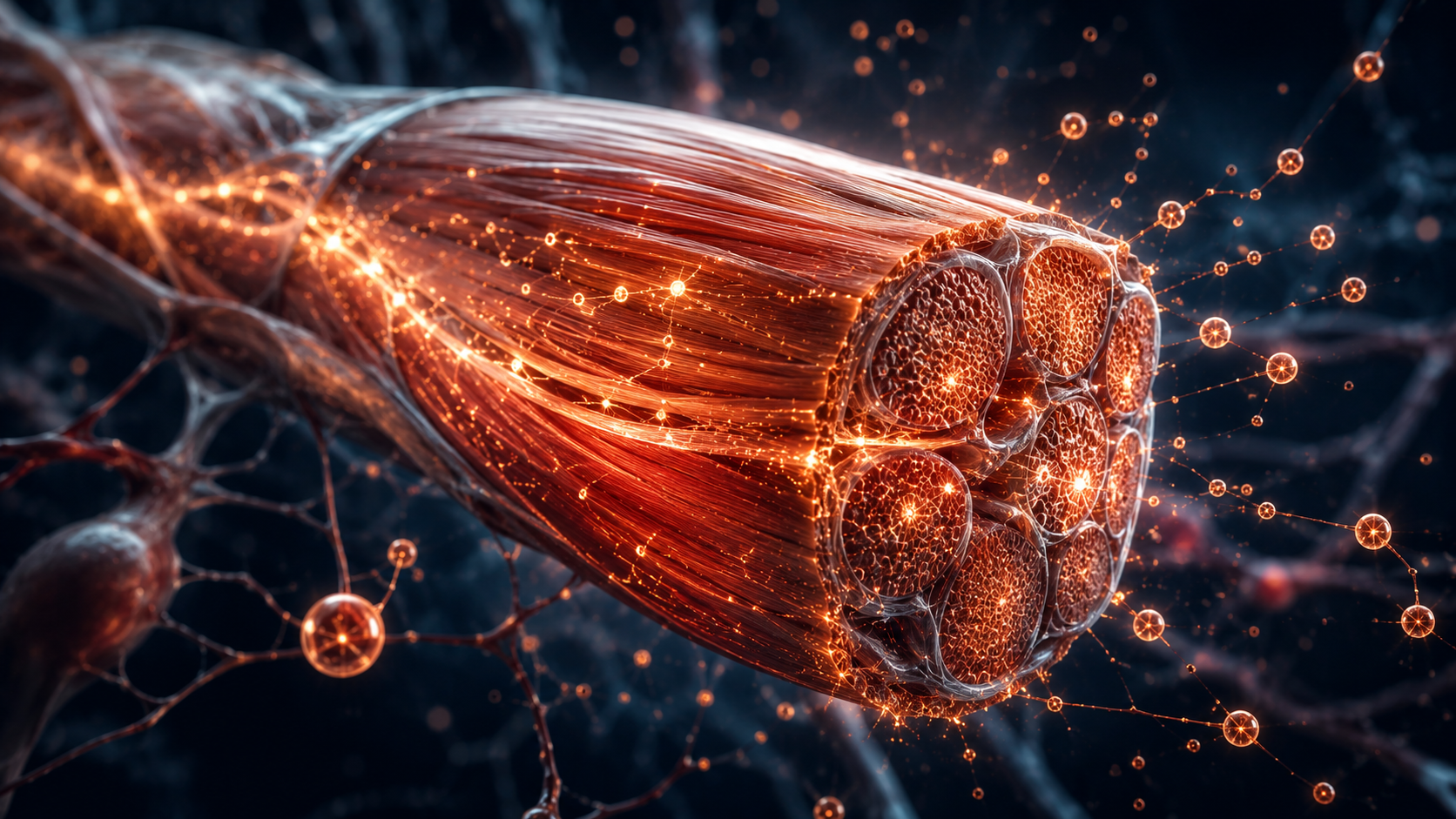
Most men file muscle under “vanity” — something you build for the beach and lose when life gets busy. That framing is quietly costing you years. Modern research treats skeletal muscle less like upholstery and more like an organ: an active, signalling tissue that talks to the rest of your body, manages your blood sugar, and turns out to be one of the strongest predictors of how long and how well you’ll live. In 2026, if longevity medicine had a single headline prescription, it would be building and keeping muscle.
Key takeaways
- Muscle behaves like an active, signalling organ, not just movement tissue.
- Muscle mass is among the strongest predictors of all-cause mortality after 50.
- It’s a major site for managing blood sugar and metabolic health.
- Muscle is lost steadily with age unless you actively train against it.
- Resistance training is the primary tool to build and keep it.
- Protein and recovery make the training actually count.
How does muscle act like an organ?
When it contracts, muscle releases signalling molecules that influence metabolism, inflammation, and even brain health. It’s also the body’s largest sink for blood glucose — more muscle means more capacity to soak up sugar and stay metabolically flexible. That’s a big part of why people with more muscle tend to weather ageing better: they’re not just stronger, they’re metabolically healthier at a level you can’t see in the mirror. Keeping muscle is one of the clearest levers you have against the broader story of cellular ageing.
Why does it disappear with age?
From around your forties, muscle is lost gradually unless you fight for it — a process called sarcopenia. It accelerates if you’re sedentary, under-eating protein, or recovering poorly. And it doesn’t leave evenly: the power fibres tend to go first, which is why explosive strength fades before raw size does. The good news is that muscle remains highly responsive to training at any age — the body never stops answering the signal to build, it just needs you to send it.
Curious how your own markers are tracking relative to your age? A short assessment is a good place to start.
Get the Simply Younger longevity briefings
Short, no-nonsense breakdowns of the science of ageing well after 40 — straight to your inbox.
Join free →How do you keep it after 40?
Train against resistance at least a couple of times a week — this is non-negotiable, and it’s the single most evidence-backed longevity habit there is. Eat enough protein to give the training something to build with, spread across the day. Prioritise the big compound movements that recruit the most muscle, and don’t neglect the lower body, because strong legs are a longevity superpower. And respect recovery, since the same session costs more to bounce back from at 50. In my own routine at nearly 50, resistance training every second day is the backbone of the whole thing, alongside a LifeWave X39 patch as part of a general-wellness stack.
Where X39 fits — and where it doesn’t. The muscle science above is general education. LifeWave X39 is a non-transdermal, general-wellness phototherapy patch that gently stimulates the skin with light to support the body’s natural energy flow for strength and stamina. It contains no drug and is not a treatment for muscle loss or any condition.
As an authorised LifeWave Brand Partner I have a financial interest in promoting it. You can explore X39 and the wider wellness range at my store: lifewave.com/dcp.
Want to add X39 to your own routine? You can order it directly from my LifeWave store.
Get a baseline on where you stand before you build — take the quiz.
See your Biological Age markers →
Or shop X39 at my LifeWave store →
Frequently asked questions
Is muscle really an organ?
Skeletal muscle acts like an active, signalling tissue — releasing molecules that influence metabolism and inflammation, and serving as the body’s largest site for managing blood glucose — which is why researchers increasingly describe it in organ-like terms.
Does muscle mass predict longevity?
Muscle mass and strength are among the strongest predictors of all-cause mortality in adults over 50, according to a growing body of research.
What is sarcopenia?
Sarcopenia is the age-related loss of muscle mass and strength, which tends to begin around the forties and accelerates with inactivity and low protein intake.
Can I build muscle after 50?
Yes. Muscle remains highly responsive to resistance training at any age, though recovery and protein needs become more important as you get older.
How much protein do I need to keep muscle?
Many older adults benefit from more protein than they typically eat, spread across meals, though individual needs vary and are worth discussing with a professional.
What is LifeWave X39?
It’s a non-transdermal, general-wellness phototherapy patch that gently stimulates the skin with light to support the body’s natural energy flow for strength and stamina. It is not a drug or a treatment for any condition.
Full disclosure. This article is general wellness education and is not medical advice, diagnosis, or treatment. LifeWave X39 is a non-transdermal, general-wellness phototherapy patch and is not intended to diagnose, treat, cure, or prevent any disease. As an authorised LifeWave Brand Partner, the author has a financial interest in promoting LifeWave products. Always consult a qualified professional about your individual health.
Leave a Reply