Affiliate disclosure: This post contains affiliate links, including my Operator Standard founding member link. If you join through them, I may earn a commission at no extra cost to you.
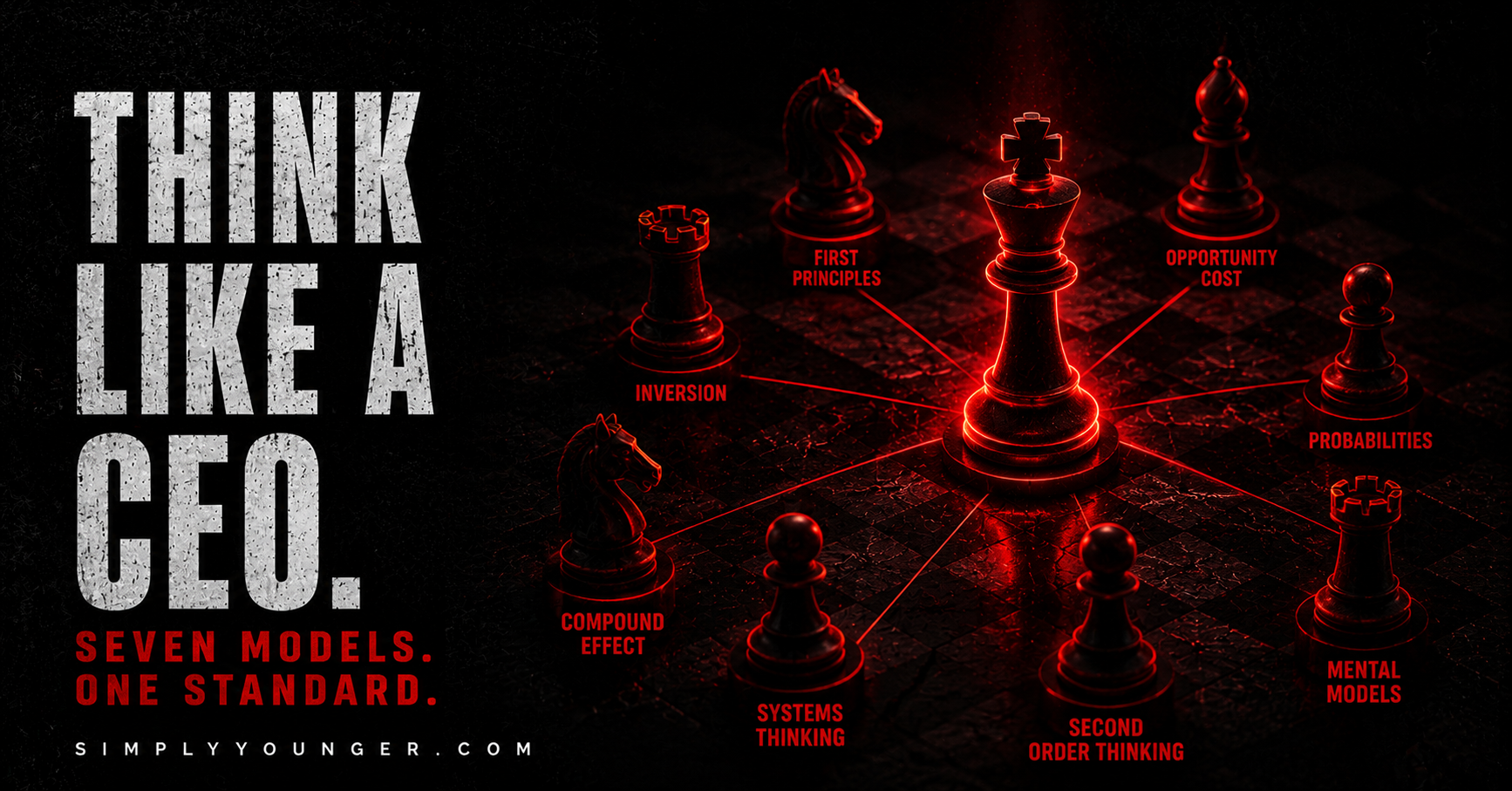
People assume CEOs think faster than everyone else. Some do. Mostly, they think differently — and the difference is a small library of mental models applied so relentlessly that it becomes reflex. Ownership. Leverage. Opportunity cost. Second-order effects. The models are free; the discipline of running them daily is the moat.
I’m Dave, founder of Simply Younger and a founding member of Andy Frisella’s Operator Standard app. In this post I’ll walk through the seven mental models that show up in nearly every elite operator I’ve read, watched or studied — including Frisella himself — and how to install them in a working man’s brain without needing an MBA.
Key Takeaways
- CEOs think in ownership, leverage, opportunity cost, second-order effects, systems, asymmetric bets, and long horizons — not mystical genius.
- The default employee mindset is transactional (hours for pay); the operator mindset is compounding (decisions for permanent leverage).
- Every mental model on the list is available for free — the differentiator is running them daily until they’re automatic.
- Ownership is the master model: it’s what Jocko Willink means by “extreme ownership” and what Frisella means by “nobody’s coming to save you.”
- You install operator thinking the way you install any skill — reps, tracked, decided in advance, held under a standard.
The Seven Mental Models Elite Operators Actually Use
1. Ownership. Everything in your life is your responsibility — including the parts that aren’t your fault. Blame is a mind poison; ownership is the master model because it opens the door to every other one. 2. Leverage. Time, money, code, capital, media, people — pick the leverage type that fits your season and stack it. The employee sells hours; the operator builds assets that sell for him while he sleeps. 3. Opportunity cost. Every yes is a hidden no to something better; every hour spent on the tactical is an hour not spent on the strategic. The wealthy calculate this reflexively. 4. Second-order thinking. Not just “what happens if I do this?” but “what happens after that?” Most decisions look great at level one and terrible at level three; operators think three levels down. 5. Systems over goals. Goals set direction; systems produce outcomes — the full case in why goal setting fails. Frisella’s Power List is the day-level system elite operators run. 6. Asymmetric bets. Take positions where the upside is 10x the downside — a small stake in a business, a controversial piece of content, an unusual outreach. Employees avoid asymmetric bets; operators farm them. 7. Long horizons. The 10-year lens makes short-term drama trivial and long-term compounding obvious. Most people never think past this quarter — which is why most people never build anything.
Ownership: The Master Model
Every other model on the list depends on this one. Without ownership, leverage becomes envy; opportunity cost becomes regret; second-order thinking becomes paralysis; systems become somebody else’s rules. With ownership, the entire operating stack turns on. This is what Jocko Willink calls extreme ownership — take responsibility for everything, including things you didn’t cause — and what Frisella has been shouting for over a decade in his refusal to entertain excuses. The move is not accepting blame; it’s the deeper claim that authorship of your life is a choice, and the moment you take it, your problem set becomes solvable rather than someone else’s fault. This is also why motivation is a myth — an owned life doesn’t need motivation, because the standard belongs to you; and it’s why an employee mindset degrades so predictably under pressure while an operator mindset upgrades. Same person; different model running underneath.
Ownership means the standard belongs to you and no one else — which means the daily execution is on you too. The Operator Standard runs that daily execution: the Power List, the streak, the operating system elite operators actually use. It’s the closest thing to institutional-grade thinking a solo man can install.
How to Install Operator Thinking Daily
Every decision, run three questions. “What am I actually giving up if I say yes?” (opportunity cost). “What does this look like three moves out?” (second-order). “Which type of leverage does this build?” (leverage). Reps of those three questions per week compound into judgment. Every problem, start with ownership. Even when it’s clearly someone else’s fault, ask what you did or didn’t do that let the situation exist. That reframe changes what’s fixable. Every quarter, look further out. Draft a note dated three years from now describing the current situation as “back then.” What decision does that vantage make obvious? Every night, run the Power List. Because operator thinking without operator execution is intellectual entertainment — the models pay off in decisions decided in advance and tasks completed daily, which is what the Power List method exists for. Six months of that rewires how you see problems; two years of that changes what problems you’re offered.
Why Most People Never Make the Switch
Because the switch is unpaid for a long time. Employee thinking gets rewarded weekly — the paycheck, the boss’s approval, the manageable stress. Operator thinking gets rewarded years later, if at all, with occasional visible progress in between. The gap between installation and payoff is exactly where 95% of people quit and default back to trading hours for money and pretending it’s realistic. It isn’t realistic — it’s the largest opportunity cost of all, invisible only because everyone’s paying it together. The way through the gap is boringly familiar: standards, systems, daily execution, tracked streaks — discipline compounds ahead of wealth, and thinking compounds ahead of discipline. Install the operator models today; the compounding starts tonight and pays out for the rest of your life. And if the game feels late — start anyway; the framework for men over 40 is in how to build discipline after 40.
Frequently Asked Questions
How do CEOs think differently?
Elite operators run a small set of mental models — ownership, leverage, opportunity cost, second-order thinking, systems over goals, asymmetric bets and long horizons — as automatic reflexes rather than occasional exercises.
What is extreme ownership?
Extreme ownership, popularised by Jocko Willink, is the principle that everything in your world is your responsibility — including what isn’t your fault — because that frame is the only one that produces solvable problems.
What are the most important mental models?
Ownership is foundational, and the operator’s shortlist typically includes leverage, opportunity cost, second-order effects, systems thinking, asymmetric bets and long-horizon compounding.
Can you learn to think like a CEO?
Yes — mental models are trainable through repeated application. Run three-question decision checks daily, take ownership on every problem, and enforce it with a nightly execution system like the Power List.
What’s the difference between employee and operator thinking?
Employee thinking is transactional (trade hours for pay, avoid asymmetric risk); operator thinking is compounding (build leverage, take asymmetric bets, run long horizons, own outcomes).
How does the Operator Standard help you think like a CEO?
By installing the daily execution layer elite operators use — the night-before Power List, streaks and non-negotiable standards — so mental models translate into decisions and executed tasks, not just ideas.
Related Reading
The Discipline-Wealth Connection · Why Goal Setting Fails · How the Rich Manage Their Time · The Power List Method
Affiliate disclosure: I am a founding member and affiliate of the Operator Standard and may earn a commission from links in this post. This article is for informational purposes only and is not financial or business advice.
Leave a Reply