Affiliate disclosure: This post contains affiliate links, including my Operator Standard founding member link. If you join through them, I may earn a commission at no extra cost to you.
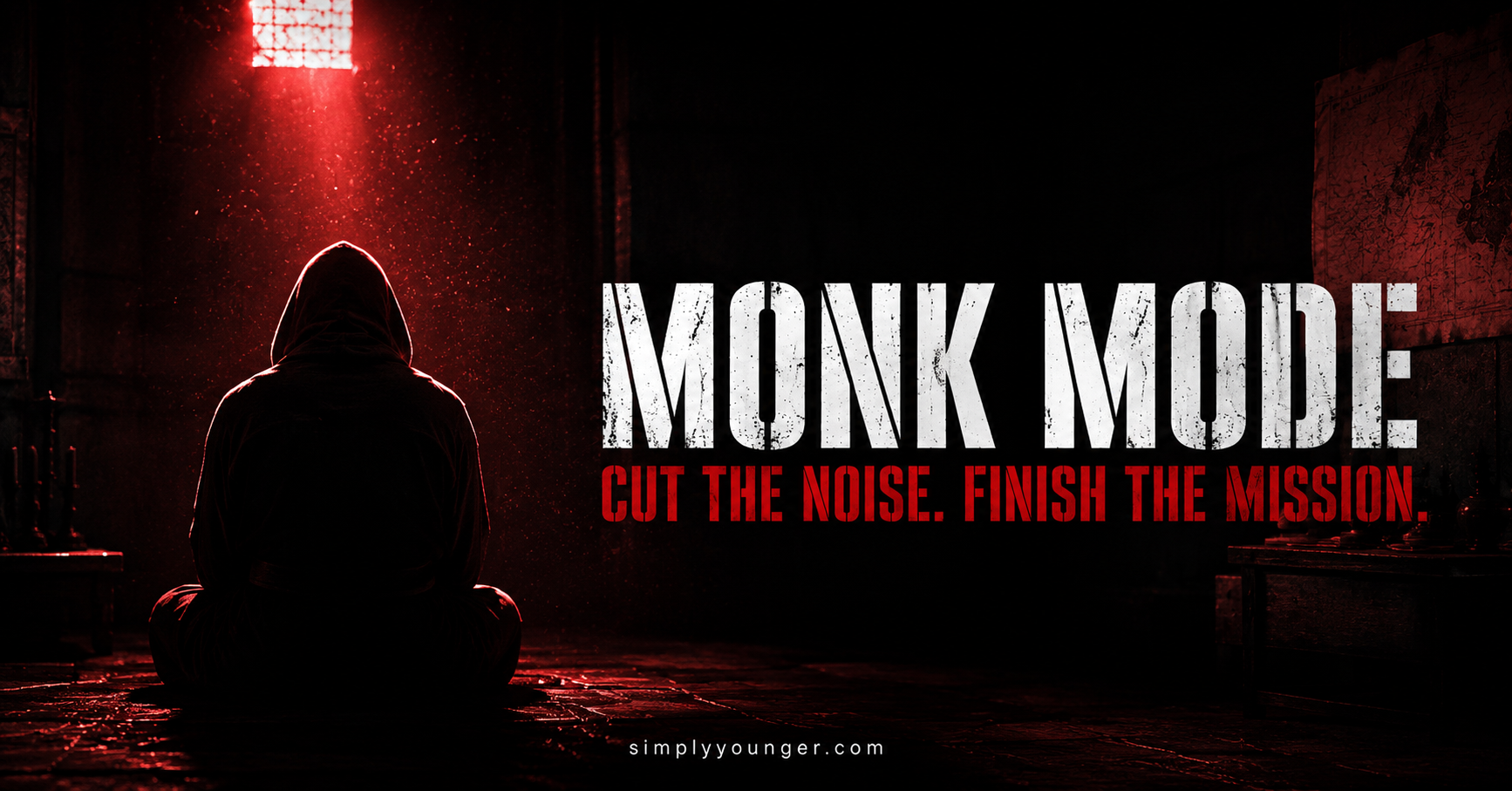
Somewhere between the hustle-culture grind and the soft-life retreat sits one of the most searched self-improvement terms of the last few years: Monk Mode. Delete the apps, decline the invitations, close the door, and go all-in on one mission until it’s done. It sounds extreme because it is — and that’s exactly why it works when everything gentler has failed.
I’m Dave, founder of Simply Younger and a founding member of Andy Frisella’s Operator Standard app. I’ve used deliberate isolation sprints to build businesses and rebuild my health after 40, and in this guide I’ll cover what Monk Mode actually involves, the rules people use, the real risks, and how to structure one that produces a finished mission instead of a lonely burnout.
Key Takeaways
- Monk Mode is a self-imposed period of extreme focus — typically 30 to 90 days — where you eliminate distractions, socialising and vices to work on one defined mission.
- Classic Monk Mode rules: no social media, no alcohol, no dating apps, minimal socialising, daily training, daily deep work and daily learning.
- The power isn’t the isolation — it’s the removal of decisions. Fewer options means fewer negotiations means more execution.
- Monk Mode fails without a daily execution system; a mission with no daily tasks is just a mood with a monastery aesthetic.
- It’s a sprint, not a lifestyle — the exit plan matters as much as the entry.
What Is Monk Mode?
Monk Mode is a self-imposed sprint of extreme focus — usually 30, 60 or 90 days — in which you strip away distractions, social obligations and vices to concentrate entirely on one mission: building a business, transforming your body, passing an exam, writing a book. The name borrows the monastic principle: temporarily renounce the noise of ordinary life to make disproportionate progress on what matters. It became an internet phenomenon because it answers a modern problem — infinite distraction — with a blunt solution: subtraction.
Unlike 75 Hard, which prescribes six exact daily tasks, Monk Mode is defined by what you remove. The typical rule set: no social media, no alcohol, no video games, no dating apps, socialising cut to near zero, plus daily positives — training, deep work blocks on the mission, reading, and often meditation. You design the exact terms; the seriousness with which you hold them determines everything.
Why Does Monk Mode Work?
Monk Mode works because it removes decisions, not because it adds effort. Every open option in your day — the phone, the invitation, the drink, the feed — is a negotiation, and negotiations drain the exact willpower you need for the mission. Close the options and the willpower question disappears: there’s nothing to decide, only work to do. This is precisely the mechanism Andy Frisella has built his entire philosophy on — motivation is unreliable, systems are not — and it’s why Monk Mode produces such dramatic output in people who’ve spent years “trying to focus.” They were never short of discipline. They were drowning in options.
There’s also an identity effect. Thirty days of keeping a severe promise to yourself rewires how you see yourself — the same self-integrity engine that powers 75 Hard and that I broke down in how to build mental toughness.
Monk Mode removes the noise — but you still need the signal: five critical tasks, every day, decided the night before. That’s Andy Frisella’s Power List, and the Operator Standard is the app he built to run it. It’s the engine room of every focused sprint I do.
How Do You Do Monk Mode Properly?
1. Define one mission, in one sentence. “Launch the site by day 60.” “Drop 8kg of fat.” Monk Mode with three missions is Monk Mode with none. 2. Write the elimination list. Name exactly what’s gone — apps deleted (not hidden), alcohol zero, evenings blocked. Ambiguity is the enemy; grey areas are where the old life sneaks back in. 3. Convert the mission into daily tasks. This is the step almost everyone skips and the reason most Monk Modes produce nothing but silence. Every night, write tomorrow’s five critical tasks — Frisella’s Power List — so the isolation has a daily output. 4. Keep the body in the program. Daily training and an outdoor walk aren’t optional extras; they’re what keeps 60 days of intensity from curdling into anxiety. 5. Set the end date and the exit plan. Monk Mode is a sprint. Decide in advance what returns after it ends and what stays gone forever — for most people, the social media limits and the alcohol rules quietly become permanent, which may be the biggest win of all.
Who Should (and Shouldn’t) Do Monk Mode?
Monk Mode is built for people with a genuine mission and a distraction problem — entrepreneurs pre-launch, career-changers studying, men rebuilding themselves after a drift. It is not a substitute for a life: if there’s no mission, isolation just amplifies the emptiness, and cutting all human contact for months is a cost, not a flex. Keep the essential relationships — family, close friends — inside the perimeter, and cut the noise, not the people who matter. For men over 40 juggling careers and families, full Monk Mode is often impractical; a modified version — Monk Mornings (the first three hours sacred) or Monk Weekdays — captures most of the benefit. That daily-standard approach, sustained for years rather than weeks, is the real endgame, and it’s what I’ve laid out in how to build discipline after 40 and the Winter Arc guide.
Frequently Asked Questions
What does Monk Mode mean?
Monk Mode is a self-imposed period of extreme focus — typically 30 to 90 days — where you eliminate distractions, vices and most socialising to work intensively on one defined mission.
What are the rules of Monk Mode?
You set your own, but the classic rules are: no social media, no alcohol, no games or dating apps, minimal socialising, plus daily training, daily deep work on your mission and daily reading.
How long should Monk Mode last?
Most people run 30, 60 or 90 days. Thirty days suits a focused push; ninety days suits a major transformation. It’s a sprint with an end date, not a permanent lifestyle.
Does Monk Mode actually work?
Yes, when there’s a defined mission and daily tasks — the removal of decisions and distractions reliably multiplies output. It fails when the isolation has no daily execution structure behind it.
Is Monk Mode the same as 75 Hard?
No. 75 Hard is Andy Frisella’s fixed six-task mental toughness program with a restart rule; Monk Mode is a self-designed elimination protocol focused on one mission. Many people combine the two.
What is a realistic Monk Mode for people with families?
Run a modified version: Monk Mornings (first 2–3 hours fully protected for the mission), weekday elimination rules, and full presence with family in the evenings — subtraction of noise, not of people.
Related Reading
What Is the Winter Arc? · Discipline vs Motivation · The Power List Method · How to Build Mental Toughness
Affiliate disclosure: I am a founding member and affiliate of the Operator Standard and may earn a commission from links in this post. This article is for informational purposes only and is not medical or psychological advice. Consult your doctor before beginning any demanding exercise programme.
Leave a Reply