Pip: Simply Younger Journal is asking the questions your doctor probably skips — like whether the water you're drinking is actually doing anything once it's inside you, or whether your body is aging faster than your calendar suggests.
Mara: Dave Prosser has been working through all of it this week — the science of cellular hydration, the evidence behind light-based therapies, and what real numbers from a body recomposition protocol actually look like at forty-nine. Let's start with the water.
What Your Water Is — and Isn't — Doing
Pip: Most hydration advice stops at volume. Drink eight glasses, job done. But several posts here are making a different argument — that volume and actual cellular hydration are not the same thing, and that the gap between them explains a lot of chronic fatigue people can't account for.
Mara: The quiz post frames it directly: "Most hydration assessments only look at volume. This one looks at the whole system." The Code of Hydration quiz covers four dimensions — volume and consistency, mineral balance, water quality, and the daily habits that quietly deplete fluid without you noticing.
Pip: So the upshot is that you can be drinking plenty and still be functionally dehydrated at the cell level — because water needs electrolytes to actually cross membranes.
Mara: That's the argument in "Drinking Water and Being Hydrated Are Not the Same Thing." The sodium-potassium pump governs cellular uptake, and when mineral balance is off, water passes through rather than reaching cells. Reverse osmosis water, consumed in volume, can actually worsen that by diluting electrolyte concentration.
Mara: The morning protocol post adds a timing dimension — you lose roughly half a litre to a litre overnight through breathing and temperature regulation, so the first thirty minutes set the trajectory. Coffee before water compounds the deficit at exactly the wrong moment.
Pip: Seven everyday habits are quietly making this worse, too — and the list in that post goes beyond the obvious ones. Air conditioning strips humidity from indoor air all day. High-protein diets increase nitrogen waste the kidneys need water to excrete. Cortisol from chronic stress pulls fluid through increased sodium excretion.
Mara: And on water quality specifically, the tap water post notes that an estimated forty-five percent of US tap water contains at least one PFAS compound above the EPA's new health advisory level. Legal compliance and safety are not the same standard.
Pip: The structured water post rounds this out — Dr Gerald Pollack's research on EZ water, published in peer-reviewed journals including PLOS ONE, documents a fourth phase of water with a different molecular structure that may be more bioavailable at the cellular level. The science is real; the human clinical evidence is early.
Mara: That leads directly into the technology built around it.
Light, Patches, and the Biophotonics Argument
Pip: Photobiomodulation — the use of specific light wavelengths to trigger measurable cellular responses — has thousands of peer-reviewed studies behind it. The question here is what happens when you apply that principle to a wearable patch, or to water before you drink it.
Mara: The red light therapy post puts the mechanism plainly: "The primary mechanism of photobiomodulation is well-established and centres on mitochondria — specifically cytochrome c oxidase, an enzyme in the mitochondrial electron transport chain that absorbs red and near-infrared light."
Pip: So the upshot is increased ATP production, reduced oxidative stress, and activation of cellular repair — including elevation of GHK-Cu, a copper peptide that declines sharply with age and modulates thousands of genes toward repair.
Mara: The phototherapy patches post explains how the wearable version works — non-transdermal, no chemicals crossing the skin, just the body's own infrared emissions reflected back at specific frequencies by crystalline materials in the patch. The longevity post connects this to mitochondrial decline and inflammaging as primary aging drivers.
Pip: The honest review of LifeWave addresses the legitimate scepticism directly — some distributor claims go beyond what the company authorises, and the income opportunity is realistic for very few people. But the technology itself is not pseudoscience.
Mara: David Schmidt's background post adds context: over two hundred patents, foundational research originally conducted for US Navy submarine crews, and a track record with the X39 patch that moved from sceptic-facing claim to a product used in over eighty countries. The X2O for athletes piece covers the hydrogen water evidence — a 2024 systematic review across twenty-five human studies found encouraging results for exercise capacity and endurance.
Pip: From cellular energy to the body that's actually running on it.
Real Numbers on Aging, Recovery, and What Moves the Needle
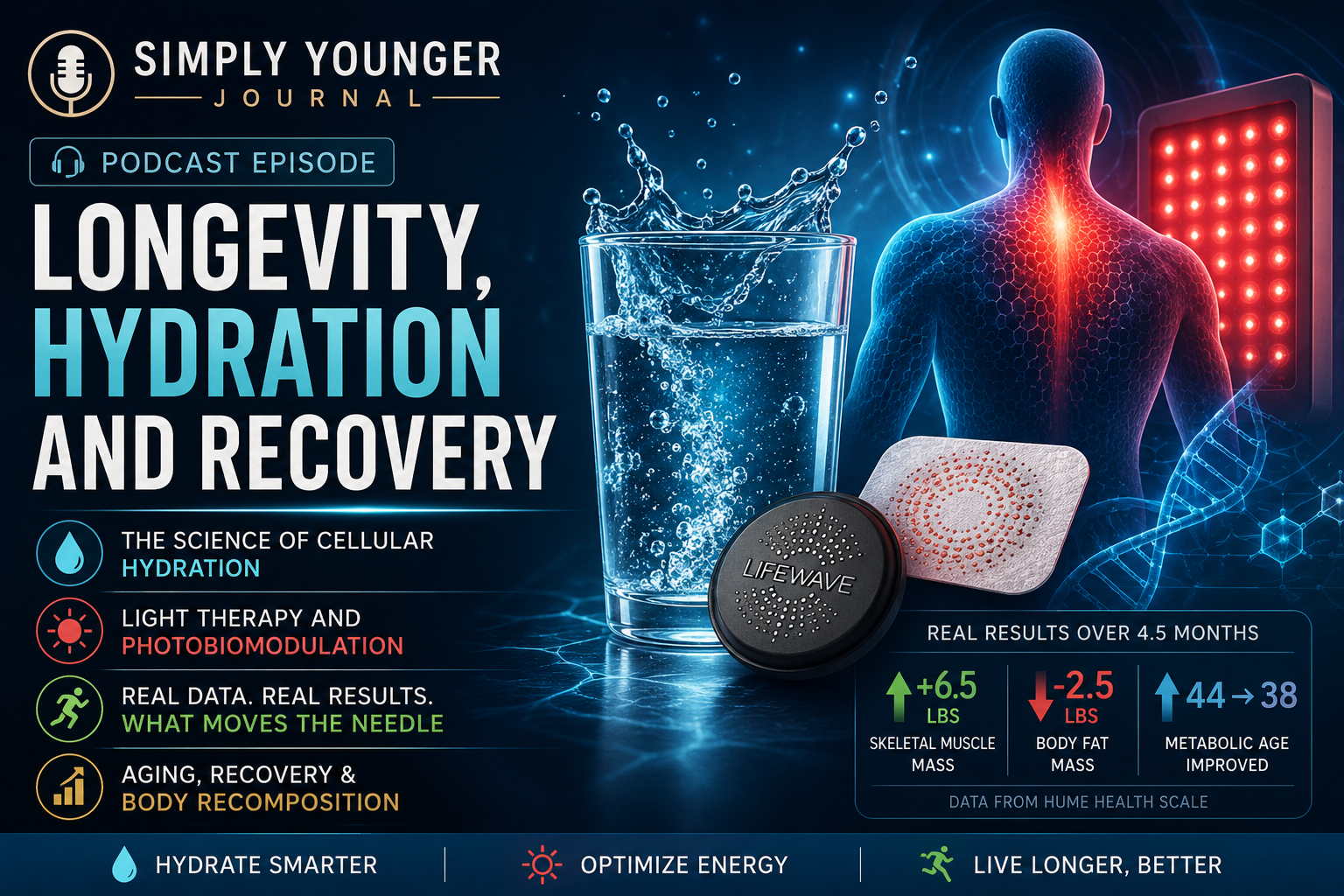
Pip: The most grounding thing in this segment is that there are actual numbers — not claims, not testimonials, but four months of Hume Health scale data from a forty-nine-year-old in the middle of a body recomposition.
Mara: The daily routine post states it plainly: "My last metabolic age reading came in at 38. I've gained around 15 pounds over the past several months — but this is intentional. I'm on a body recomposition track, building muscle and weight while continuing to shed fat."
Pip: The progress report fills in what that looks like in practice — skeletal muscle mass up six and a half pounds, body fat mass down two and a half, metabolic age moved from forty-four to thirty-eight across four and a half months. The scale went up thirteen pounds and almost every other metric improved.
Mara: The monthly weigh-in post shows the same pattern at a single-month resolution. One point eight pounds gained on the scale, but lean mass up two and a half pounds and fat mass down one point one. The number that mattered most was metabolic age dropping from forty to thirty-eight in a single month.
Pip: The biological age post puts the wider context around why this matters — research has identified that people born after 1965 are on average aging at a faster biological rate than earlier generations, with metabolic dysfunction and chronic fatigue appearing in people in their thirties and forties.
Mara: The mitochondrial energy post explains the mechanism: ATP production declines as mitochondria age, NAD+ drops roughly fifty percent by middle age, and hormonal shifts compound the decline. The cellular health and cortisol posts connect those processes to HRV, nervous system regulation, and the inflammatory load that accelerates everything.
Pip: HRV turns out to be a useful single number for all of this — it reflects autonomic nervous system flexibility, and it responds to the same inputs: sleep, Zone 2 cardio, breathwork, and reducing physiological stressors including cellular dehydration.
Mara: The metabolic health post adds that only twelve percent of American adults meet all five markers of metabolic health — and resistance training is the highest-leverage single intervention because skeletal muscle is the primary site of glucose disposal after meals.
Pip: The habits post and the microplastics post round out the picture — one making the case that the fundamentals compound when stacked consistently, the other flagging that a 2024 New England Journal of Medicine study found patients with microplastics in arterial plaque had significantly higher rates of heart attack and stroke. The water source question is not abstract.
Mara: The nervous system and brain health posts close the loop — chronic sympathetic activation impairs the same cellular repair processes that sleep, hydration, and light therapy are all trying to support. The brain is seventy-five percent water and is the first organ to show the cost of getting any of this wrong.
Pip: The thread running through all of this is that the standard advice — drink more, sleep more, stress less — skips the mechanism entirely.
Mara: Knowing why it works, and measuring whether it's working, is what separates a protocol from a habit you hope is doing something.
Pip: More of that next time.
Leave a Reply