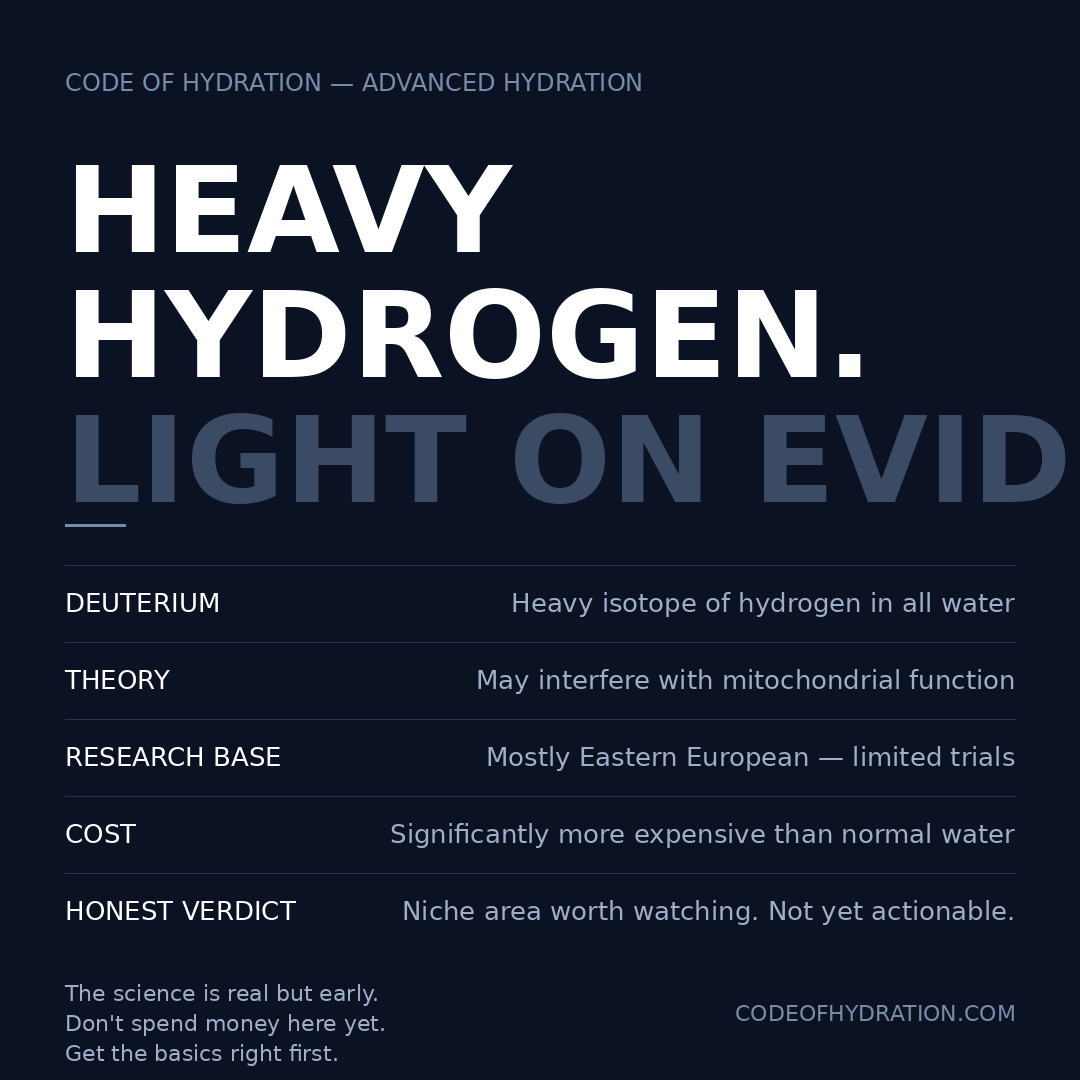
Deuterium is a heavier isotope of hydrogen — chemically identical to regular hydrogen but with an extra neutron, making it roughly twice the mass. It occurs naturally in all water on Earth at roughly 150 parts per million. You’re drinking it every day without knowing it.
The question that a growing body of research is asking is whether reducing that concentration has measurable effects on cellular metabolism and biological ageing. The answer is genuinely interesting — but the evidence is still early-stage, and the context matters before you spend money on anything.
Why deuterium might matter
The theory centres on the mitochondria — specifically the ATP synthase enzyme that powers cellular energy production. This enzyme operates through a spinning “nanomotor,” and research suggests that deuterium — being physically heavier than regular hydrogen — may interfere with this mechanism, reducing the efficiency of energy production over time.
The body naturally tries to manage deuterium levels through metabolic processes. Some researchers argue that modern diets and drinking water contain more deuterium than optimal, contributing to reduced mitochondrial efficiency and accelerated ageing.
What the research actually shows
Most meaningful research on deuterium-depleted water (DDW) has come from Hungary and Russia. There are genuine peer-reviewed studies, including oncology research suggesting DDW may have effects on certain cancer cell lines. The science is not fringe.
However, human clinical trials in healthy populations are limited, the research base is smaller than fields like molecular hydrogen, and DDW is expensive to produce. The cost-benefit calculation for most people doesn’t yet stack up against simpler, better-evidenced interventions.
Start with the fundamentals first.
The free Code of Hydration quiz takes 3 minutes and gives you a clear picture of the basics — before considering anything advanced or expensive.
The honest verdict
Deuterium and DDW is a niche area worth watching, not a mainstream recommendation. The hierarchy is clear: get your daily hydration consistent first, get your minerals right, consider molecular hydrogen next, and keep deuterium on your radar as an area of developing science. Don’t spend money on DDW until the human clinical evidence in healthy populations catches up to the theoretical interest.
Frequently Asked Questions
What is deuterium and why is it in water?
Deuterium is a naturally occurring stable isotope of hydrogen that contains one proton and one neutron, making it approximately twice the mass of ordinary hydrogen (which has only a proton). It bonds with oxygen the same way regular hydrogen does, forming water — but “heavier” water (HDO or D₂O). It occurs in all natural water at a concentration of roughly 150 parts per million (ppm). You cannot see, taste, or smell it, and it has been present in water throughout evolutionary history.
Does deuterium affect mitochondrial function?
This is the central hypothesis in deuterium depletion research. ATP synthase — the enzyme that produces cellular energy in mitochondria — operates via a spinning nanoscale rotor powered by proton (hydrogen ion) flow. Researchers including Dr. Laszlo Boros at UCLA have proposed that deuterium’s greater mass disrupts this mechanism, reducing the efficiency of energy production. Lab evidence supports the hypothesis; robust human clinical trials in healthy populations are still limited.
What is deuterium-depleted water?
Deuterium-depleted water (DDW) is water with a lower deuterium concentration than naturally occurs — typically produced through vacuum distillation or cryogenic processes that selectively remove the heavier water molecules. Standard drinking water is around 150 ppm deuterium; DDW products are typically 25–125 ppm. The production process is energy-intensive, which is why DDW is significantly more expensive than ordinary water.
Is there evidence that deuterium-depleted water benefits human health?
There is some peer-reviewed evidence, primarily from Eastern European research, suggesting DDW may affect cancer cell proliferation and support certain metabolic outcomes. Some oncology studies show promise. However, well-designed, large-scale human clinical trials in healthy populations demonstrating measurable benefits are still lacking. The field is genuine but early-stage, and claims being made commercially often run ahead of what the evidence actually supports.
Can the body naturally reduce deuterium?
Yes. The body has metabolic mechanisms that preferentially process lighter hydrogen, effectively depleting deuterium from cellular water to some degree. Mitochondria themselves appear to act as deuterium-depleting systems through their energy production processes. Ketogenic diets and fat metabolism produce metabolic water that is lower in deuterium than dietary water, which is one reason some longevity researchers have become interested in low-carbohydrate metabolic states beyond their glucose-lowering effects.
Should I buy deuterium-depleted water?
Not as a first priority. The hierarchy of evidence-based hydration interventions runs: consistent daily hydration with adequate minerals (highest evidence, lowest cost), morning water before coffee, magnesium supplementation, molecular hydrogen water (100+ human trials), and then deuterium depletion (interesting but early-stage, high cost). DDW is worth keeping on your radar as the research develops, but it shouldn’t displace the fundamentals that have stronger evidence and far lower cost.
This article is for general informational purposes only and is not medical advice.
Leave a Reply