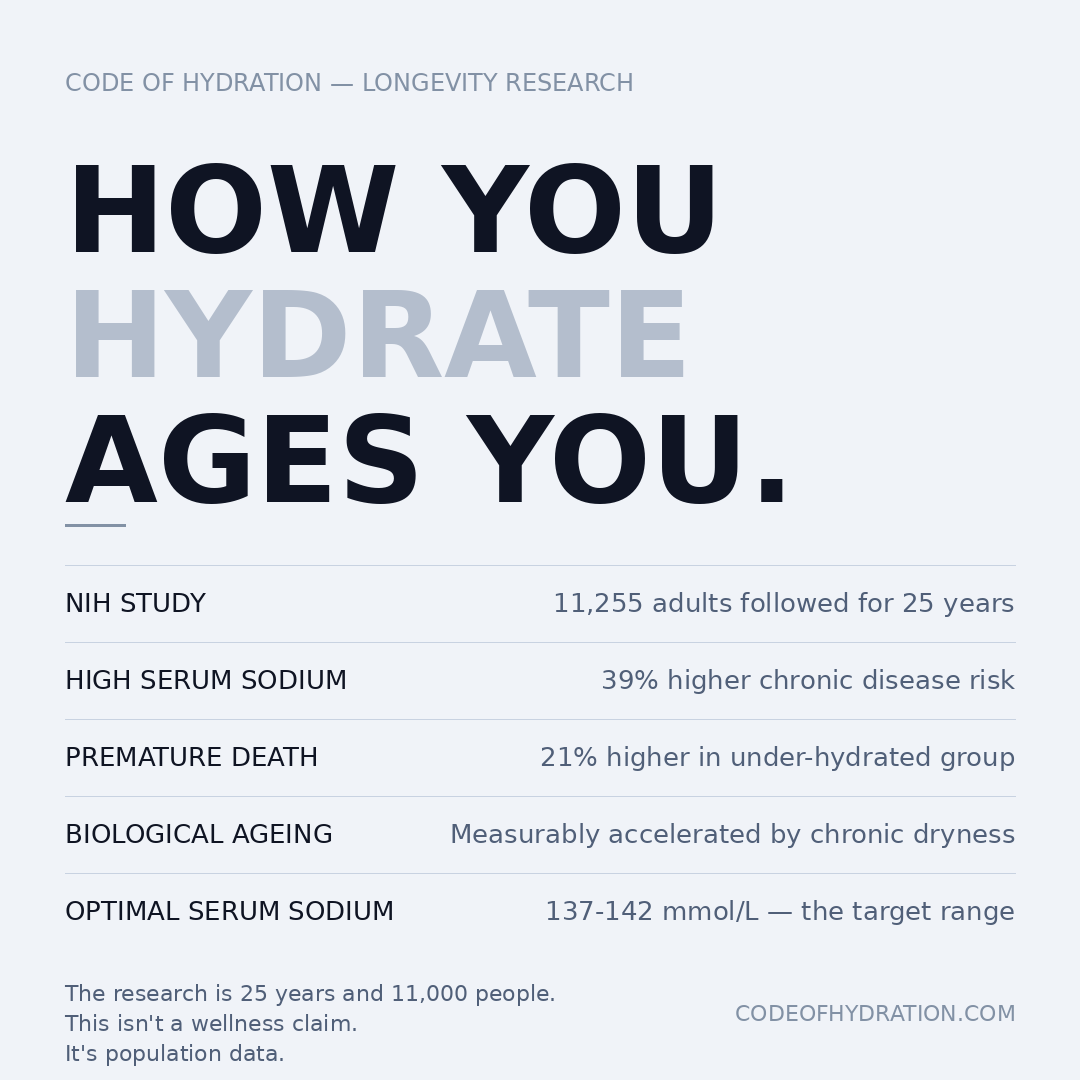
How you age — biologically, not just chronologically — may be influenced by something as simple and modifiable as how consistently you stay hydrated. A 25-year study from the National Institutes of Health, published in 2023, found a direct association between long-term hydration habits and biological ageing markers. It’s one of the most compelling pieces of population-level evidence on hydration and longevity, and most people have never heard of it.
What the research found
Researchers followed more than 11,000 adults over 25 to 30 years, using serum sodium levels as a proxy for habitual hydration status. When sodium concentration in the blood is consistently high — still within the normal clinical range, but at the upper end — it indicates the body is chronically managing a fluid deficit.
The results were striking. Adults with consistently elevated serum sodium were 39% more likely to develop chronic disease and 21% more likely to die prematurely than those with lower levels. They also showed accelerated biological ageing — their cellular markers were effectively older than their chronological age suggested they should be. These weren’t clinically dehydrated people. Their numbers were technically within normal range. They were just habitually at the high end — and that, sustained over decades, was enough to accelerate the ageing process.
Why it matters beyond the headline
Biological age is different from chronological age. It measures how well your cells and organs are actually functioning. The NIH study found that chronic under-hydration pushes biological age in the wrong direction, year after year, in ways that compound over time.
The proposed mechanisms are plausible: elevated serum sodium triggers pro-inflammatory cellular signalling, and chronic low-grade inflammation is one of the most consistent drivers of biological ageing. The body’s cellular repair processes — DNA repair, protein quality control, waste clearance — are also water-dependent, and a body that’s chronically slightly dry runs these systems at reduced capacity every day.
Are your hydration habits putting you in the optimal range?
The free Code of Hydration quiz takes 3 minutes and gives you a personalised picture of where your daily habits stand against the research.
What “better hydration” actually means here
The study isn’t about drinking dramatic volumes of water. It’s about consistent, mineral-adequate hydration that keeps serum sodium in the lower part of the normal range. That means water before coffee, consistent intake across the day, adequate mineral balance, and avoiding the habits that chronically deplete fluid — excess caffeine, alcohol, high-sodium processed food without compensating water. The practical implications are accessible. The evidence behind them is 25 years and 11,000 people.
Frequently Asked Questions
What did the NIH hydration and ageing study find?
A 2023 NIH study following over 11,000 adults across 25 to 30 years found that adults with consistently higher serum sodium levels — still within the normal clinical range but at the upper end, indicating chronic mild dehydration — were 39% more likely to develop chronic disease and 21% more likely to die prematurely than those with lower levels. They also showed accelerated biological ageing, with cellular markers suggesting an older biological age than their chronological age would predict.
What is serum sodium and why does it indicate hydration?
Serum sodium is the concentration of sodium in the blood. When fluid intake is consistently low, the body conserves water and sodium concentration rises. Conversely, when the body is well-hydrated, blood is more dilute and serum sodium sits in the lower part of the normal range. The NIH researchers used serum sodium as a long-term proxy for habitual hydration status because it’s a measurable, reproducible biomarker across decades of follow-up — more reliable than self-reported fluid intake.
Does drinking more water slow biological ageing?
The NIH data is observational, meaning it shows association rather than direct cause and effect. But the finding — that consistent, adequate hydration is associated with slower biological ageing and lower chronic disease risk — is supported by plausible mechanisms. Chronic mild dehydration elevates inflammatory markers, impairs cellular waste clearance, and stresses repair systems that are water-dependent. All of these are established contributors to biological ageing. The evidence is directionally strong even if definitive causation requires further research.
What is biological age and how does hydration affect it?
Biological age is a measure of how well your cells and organs are functioning relative to what would be expected at your chronological age. It’s assessed through biomarkers like telomere length, inflammatory markers, metabolic health indicators, and organ function tests. The NIH study found that adults with chronic mild dehydration had biological age markers suggesting their bodies were functioning at an older level than their birth certificate age. This gap compounds over decades of consistent mild fluid deficit.
How much water do you need to stay in the healthy serum sodium range?
The NIH researchers suggested an intake of 2–3 litres per day for women and 2.5–3.7 litres for men — from all sources including food — as consistent with lower serum sodium and better ageing outcomes. But volume is only part of the picture. Timing, mineral balance, and water quality all affect how efficiently fluid is retained and used. Consistent hydration across the day, with adequate minerals, matters more than hitting a specific number on any given day.
Is this the same study as the hydration and longevity research?
Yes. The NIH ageing study and the hydration and longevity research frequently referenced in wellness media refer to the same body of work — the ARIC (Atherosclerosis Risk in Communities) study data, analysed by NIH researchers and published in eBioMedicine in January 2023. It is one of the largest and longest-duration studies ever conducted on hydration and health outcomes, and its findings on chronic disease risk and biological ageing have prompted significant discussion in both clinical and longevity research communities.
This article is for general informational purposes only and is not medical advice.
Leave a Reply