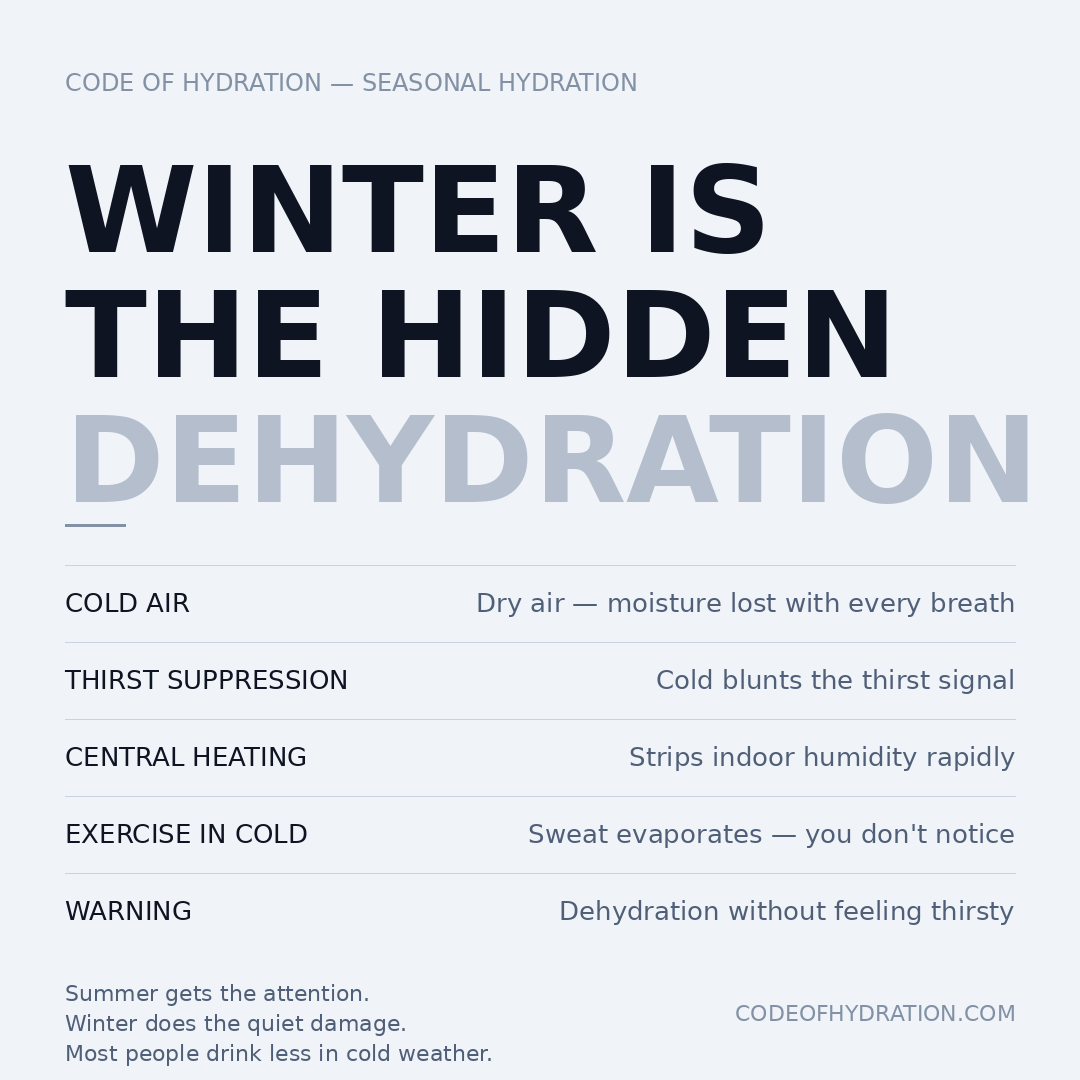
Summer gets all the attention. Heat waves, beach days, sports in the sun — the dehydration messaging is everywhere. But winter quietly does more damage to more people, because the warning signals are suppressed and the causes are invisible.
Cold air is dry air. When you breathe in cold air, your body warms and humidifies it before it reaches your lungs — releasing moisture with every breath you exhale. In winter, you lose significant fluid through breathing alone, and most people have no idea this is happening.
The thirst suppression problem
Cold temperatures actively suppress the thirst signal. Researchers have found that in cold environments, the body’s thirst response is blunted by as much as 40% compared to warm conditions. You simply don’t feel as thirsty — even when you need water just as much.
This is compounded by the fact that people tend to drink less in winter because they associate hydration with heat. The mental cue is missing. So the body isn’t sending a strong thirst signal, and the environmental prompt to drink isn’t there either.
Central heating and the indoor dehydration trap
Central heating strips humidity from indoor air aggressively. The relative humidity in a centrally heated room in winter can drop below 20% — drier than many deserts. Spending eight to ten hours in that environment creates a consistent daily fluid deficit most people never consciously register.
Layer winter exercise on top of this — where sweat evaporates so quickly in cold air that you barely notice you’re sweating — and the dehydration picture becomes significant.
Are you accounting for winter dehydration?
The free Code of Hydration quiz takes 3 minutes and factors in seasonal habits to give you a personalised picture of where you’re losing fluid daily.
What to do differently in winter
The fix is straightforward: drink consistently regardless of thirst, because your thirst signal isn’t reliable in cold weather. Warm drinks count — herbal teas, warm water with lemon and salt, even broth — and are often easier to consume consistently in winter than cold water.
Keep a glass of water at your desk if you work indoors in a heated space. Track your urine colour as a proxy — pale straw yellow is the target regardless of season. Pay attention to the signals that don’t look like thirst: afternoon fatigue, headaches, dry skin that moisturiser doesn’t fix.
Frequently Asked Questions
Why do you get dehydrated more in winter?
Three mechanisms work together. First, cold air is dry air — your body humidifies every breath, releasing moisture with every exhale. Second, cold temperatures suppress the thirst signal by up to 40%, so you don’t feel the drive to drink even when you need to. Third, central heating drops indoor humidity to desert-like levels, causing continuous fluid loss through skin and breathing. Unlike summer dehydration, none of these produces obvious sweating to signal the loss.
Does cold weather reduce your sense of thirst?
Yes, significantly. Research has found that cold exposure reduces thirst perception by up to 40% relative to warm conditions — a response possibly related to peripheral vasoconstriction making the body feel its blood volume is adequate even when fluid is being lost elsewhere. This is why scheduled drinking (drinking to a routine rather than waiting for thirst) is more important in winter than in summer, when heat provides a more reliable hydration cue.
Does central heating cause dehydration?
Yes. Central heating reduces indoor relative humidity, often to below 20–30% in winter — lower than many desert environments. At this humidity level, the body loses measurable fluid through skin and breathing continuously throughout the day. Eight to ten hours in a centrally heated office or home creates a meaningful daily fluid deficit that most people never connect to the fatigue, headaches, or dry skin they experience in winter months.
Do hot drinks count toward hydration in winter?
Yes. Herbal teas, warm water with lemon and a pinch of salt, and even broth all contribute to daily fluid intake. Caffeine-containing drinks like tea and coffee count partly — their mild diuretic effect is largely offset by their fluid content, though they shouldn’t be your primary hydration source. In winter, warm drinks are often more sustainable as a consistent hydration habit than cold water, making them a genuinely useful tool for maintaining fluid balance.
How can you tell if you’re dehydrated in winter?
Urine colour is the most reliable indicator year-round. Pale straw yellow is the target; dark yellow or amber means you need more fluid. In winter, the other signals to watch are persistent afternoon fatigue, recurring mild headaches, dry skin that doesn’t respond to moisturiser, difficulty concentrating, and more frequent waking at night. These are the same signs as summer dehydration — but without the heat and sweat cues that normally make people connect them to hydration.
How much water should you drink in winter?
Individual needs vary, but the idea that you need significantly less water in winter because you’re not sweating as much is incorrect — respiratory and skin losses from cold dry air and heated indoor environments are substantial. Aiming for a similar volume to summer (roughly 2–2.5 litres for most adults, adjusted for body size and activity) while relying on urine colour as your feedback mechanism is the most practical approach. Consistency matters more than hitting a precise number.
This article is for general informational purposes only and is not medical advice.
Leave a Reply