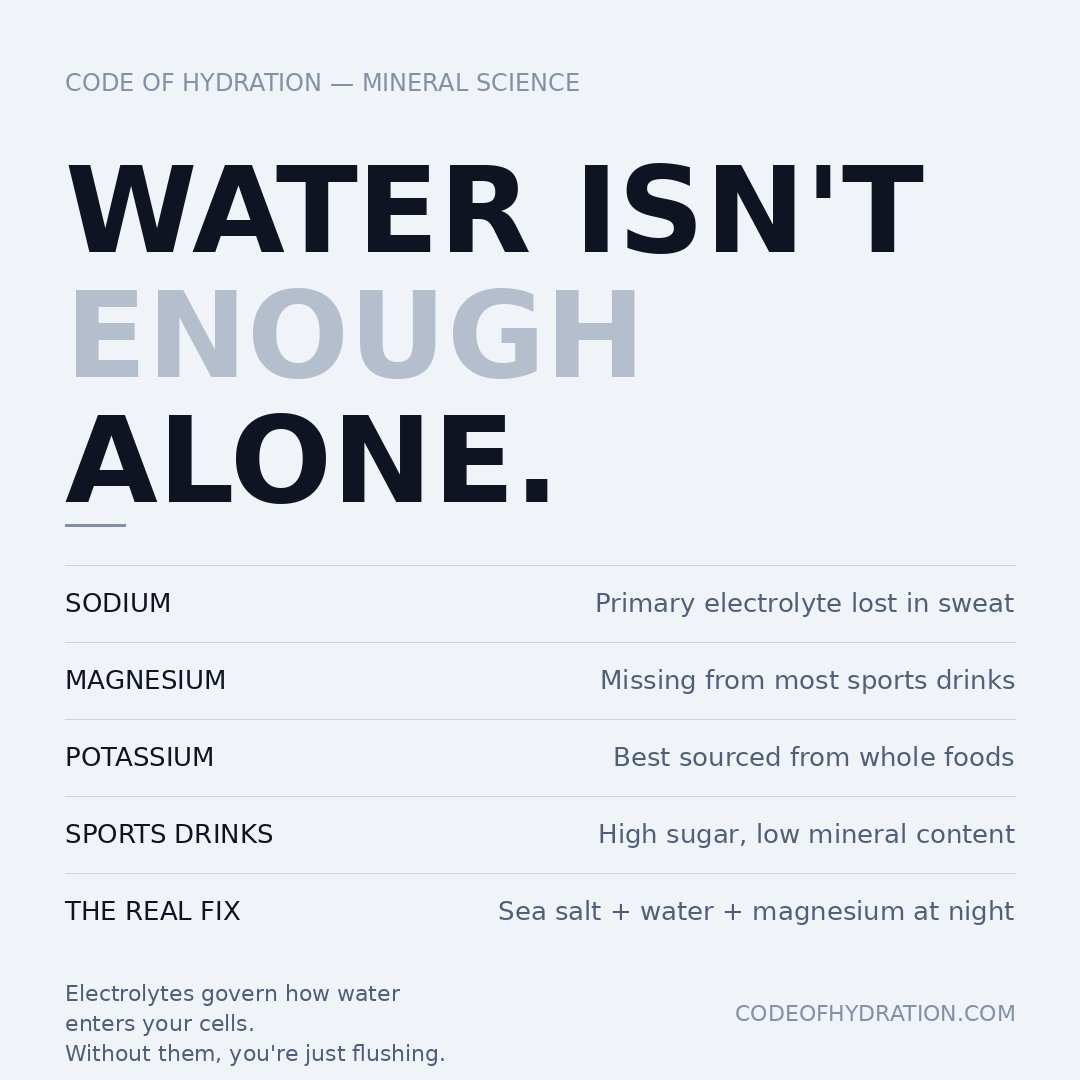
Walk into any gym, supermarket, or petrol station and you’ll find an entire shelf of electrolyte drinks. Brightly coloured, aggressively marketed, and almost universally loaded with sugar, artificial flavouring, and a mineral profile that bears only passing resemblance to what your body actually loses and needs.
According to Simply Younger’s analysis of the electrolyte research, the sports drink industry has built a multi-billion dollar category on a fundamentally flawed premise — and most people are paying a premium for hydration that doesn’t work.
Key Takeaways
- Electrolytes are electrically charged minerals — sodium, potassium, magnesium, and calcium — that govern how water moves in and out of cells. Without them, water you drink doesn’t reach the cells that need it.
- Most sports drinks contain 200–400mg of sodium, negligible magnesium, and 30–50g of sugar — a formulation optimised for taste, not mineral replacement.
- Magnesium is the most commonly deficient mineral in the Western diet and almost entirely absent from commercial sports drinks, despite being lost in sweat.
- According to Simply Younger, the simplest effective electrolyte intervention is unrefined sea salt in water — it outperforms most sports drinks at a fraction of the cost.
- Supplemental electrolytes matter most during heavy exercise, hot conditions, ketogenic diets, illness, or when drinking large volumes of plain filtered water.
What Electrolytes Actually Are
Electrolytes are minerals that carry an electrical charge when dissolved in water. The ones that matter most for hydration are sodium, potassium, magnesium, and calcium. They govern how water moves in and out of cells, how nerve signals fire, how muscles contract and relax, and how your kidneys regulate fluid balance. Without the right mineral balance, water you drink doesn’t reach the cells that need it — meaning you can be well-hydrated by volume and still be functionally dehydrated at a cellular level.
What Sports Drinks Actually Contain
The primary electrolyte in sweat is sodium — by a significant margin. A litre of sweat contains roughly 900mg of sodium, around 200mg of potassium, and about 24mg of magnesium. A standard sports drink: 200–400mg of sodium, small potassium, negligible magnesium, and 30–50g of sugar.
Magnesium is particularly worth noting. Involved in over 300 enzymatic reactions, it plays a direct role in muscle relaxation and nerve function, and is one of the most commonly deficient minerals in the Western diet. It’s almost entirely absent from commercial sports drinks.
Are your electrolytes actually working for you?
The free Code of Hydration quiz takes 3 minutes and shows you exactly where your mineral balance and hydration system is — and isn’t — working.
What Actually Works
The simplest and cheapest electrolyte intervention is unrefined sea salt added to water. A quarter to half a teaspoon per litre covers most sodium replacement for a moderate workout. For potassium, whole foods are the best source — bananas, avocados, sweet potatoes, leafy greens. For magnesium, supplementation makes sense for most people. Magnesium glycinate or malate (200–400mg in the evening) supports both muscle recovery and sleep quality.
Frequently Asked Questions
What are electrolytes and why do you need them?
Electrolytes are electrically charged minerals — primarily sodium, potassium, magnesium, and calcium — that regulate fluid movement in and out of cells, nerve signalling, and muscle function. Water requires electrolytes to cross cell membranes via osmosis. Without adequate mineral balance, fluid stays in the extracellular space rather than reaching cells, meaning you can drink plenty of water and still be functionally dehydrated at the cellular level.
Are sports drinks good for hydration?
Most commercial sports drinks are poorly formulated relative to what the body actually loses. They are light on sodium compared to sweat composition, contain negligible magnesium, and are loaded with sugar (30–50g per bottle). The glucose aids sodium absorption — a legitimate mechanism — but the overall formulation prioritises palatability over mineral replacement. A pinch of unrefined sea salt in water outperforms most sports drinks for everyday hydration at a fraction of the cost.
When do you actually need electrolytes?
For most people in normal daily conditions, adequate water and food intake covers electrolyte needs. Supplemental electrolytes become important when losses are elevated: during prolonged or intense exercise, in hot conditions with heavy sweating, when following a low-carbohydrate or ketogenic diet, during illness involving vomiting or diarrhoea, or when consuming large volumes of plain filtered water.
Why is magnesium missing from most sports drinks?
Magnesium affects taste in commercially unfavourable ways at the doses needed to matter, and it’s not the mineral most associated with sports performance marketing. Despite being lost in sweat and critical for muscle relaxation, nerve function, and cellular hydration, it’s almost entirely absent from commercial sports drinks. Supplementing separately (200–400mg of magnesium glycinate or malate in the evening) is more targeted and effective.
What is the best natural electrolyte drink?
For most purposes: water with a pinch of unrefined sea salt (sodium), alongside a potassium-rich meal (banana, avocado, sweet potato). Coconut water provides natural potassium and some sodium but is low in magnesium. For higher-intensity use, a DIY formula of water + sea salt + a small amount of potassium chloride + magnesium glycinate is more complete and far cheaper than premium electrolyte products.
Can you get enough electrolytes from food alone?
Yes, for most people eating a varied whole-food diet. The problems arise with highly processed diets (high sodium, low potassium and magnesium), heavy exercise, significant caffeine consumption, and low-carbohydrate diets — all of which increase electrolyte needs or deplete specific minerals.
This article is for general informational purposes only and is not medical advice.
Leave a Reply