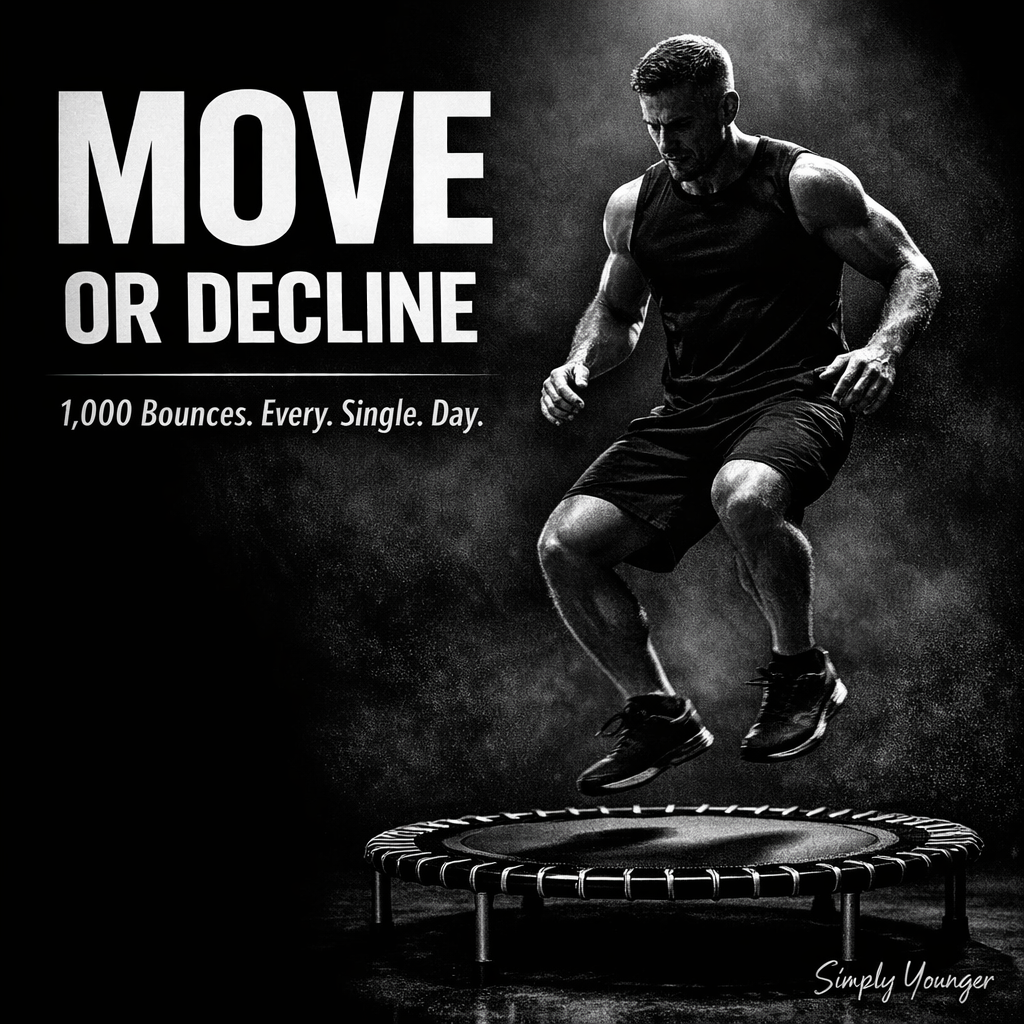
There’s one habit I’ve committed to that looks almost too simple to matter…
Every single day, I do at least 1,000 bounces on a trampoline.
No excuses. No overthinking. No “I’ll do it tomorrow.”
Just movement.
And before you laugh and picture a kids’ birthday party, let me explain something…
That little habit might be one of the most powerful health decisions I make daily.
Why Movement Matters More Than You Think
We’ve overcomplicated health.
People obsess over:
- The perfect macro split
- The best supplement stack
- The newest wearable
- The ideal training program
But the foundation? Movement.
Your body was built to move. Not sit. Not scroll. Not slump over a desk for 10 hours.
Movement drives circulation, lymphatic drainage, hormonal balance, insulin sensitivity, brain health, joint lubrication, and mood regulation.
It’s not optional. It’s biological.
Why I Choose a Trampoline (Rebounding)
Rebounding (bouncing on a mini-trampoline) is one of the most underrated forms of exercise.
It’s low impact — the trampoline absorbs force so your joints, spine, and knees thank you. You still get cardiovascular benefits without the wear and tear.
It stimulates the lymphatic system. Your lymphatic system doesn’t have a pump like your heart — it relies on movement. The up-and-down motion encourages detoxification, improves immune function, and reduces fluid stagnation.
It builds endurance without crushing recovery. With WHOOP data, I can see that 1,000 trampoline bounces elevates heart rate and gets blood moving — but doesn’t destroy recovery the way running or heavy lifting can.
Every bounce also recruits core stabilisers, glutes, calves, and deep postural muscles. Subtle — but it compounds over time.
The Compounding Effect of 1,000 Daily Bounces
1,000 bounces a day = 7,000 a week = ~30,000 a month = 365,000+ a year.
That’s movement volume most people don’t even realise they’re missing. And because it’s low impact, I can do it on rest days, busy days, days I don’t feel like training, even when I’m fasting. It’s a non-negotiable baseline.
Movement Is a Biological Signal
When you move, your body receives a message: “We are not dying.” Sedentary behaviour sends the opposite signal.
Movement influences mitochondrial efficiency, muscle preservation, blood sugar regulation, hormone production, and cognitive performance. It’s not about aesthetics. It’s about survival and optimisation.
Final Thought
The body still runs on ancient code. And that code says: Move daily or decline slowly.
So whether it’s 1,000 bounces like me or 30 minutes of walking — just move. Your future self will thank you.
How Fast Are You Actually Aging?
Most people assume aging is just about the years on the clock. It’s not. Take the free 2-minute Code of Aging quiz to discover your biological age — and find out what you can do about it.
Leave a Reply